Boats That Ride a Hum
When a bottle hum becomes a motor
You already know the trick. Blow across a glass bottle and the air inside starts to thrum. That cozy little note is Helmholtz resonance—air sloshing in a cavity until the whole thing rings. Most of us stop at the music. A team at EPFL’s MICROBS Lab asked a different question: what if the hum could push?
They answered by carving that physics into hollow shells that turn sound into directed jets of air. No motors. No batteries on board. No magnets. Just cleverly shaped emptiness, excited by a speaker, shoving tiny vehicles through water and air.
Lab head Selman Sakar puts it cleanly: “Instead of pushing devices around with sound waves, we have created acoustic resonators that are tuned to harness sound at specific frequencies to generate directional thrust and controlled motion.” In other words, the robot is not a passenger of the sound field. It is an engine that drinks the right pitch and spits out force.
Hollow engines, printed to order
The working parts are simple cavities—round or bell-shaped hollows—made from everyday 3D-printing plastics, soft rubbery polymers, or even glassblown shells. Microscopic versions were built with two-photon polymerization, a nanoprinting method fine enough to sculpt features you could lose on a fingertip.
When sound hits the tuned frequency, air inside the cavity oscillates hard. On the way out it leaves as a tight jet; on the way in it arrives more loosely. That imbalance is thrust—quiet, wireless, and switchable just by changing the note the speaker plays.
At centimeter scale the researchers fitted miniature boats with as many as three cavities, each listening for a different audible frequency and aimed to shove in its own direction. Change the tone and a different cavity wakes up. The boats could be steered around obstacles or handed simple navigation routines, all without a single onboard actuator or circuit.
Microfliers that listen upward
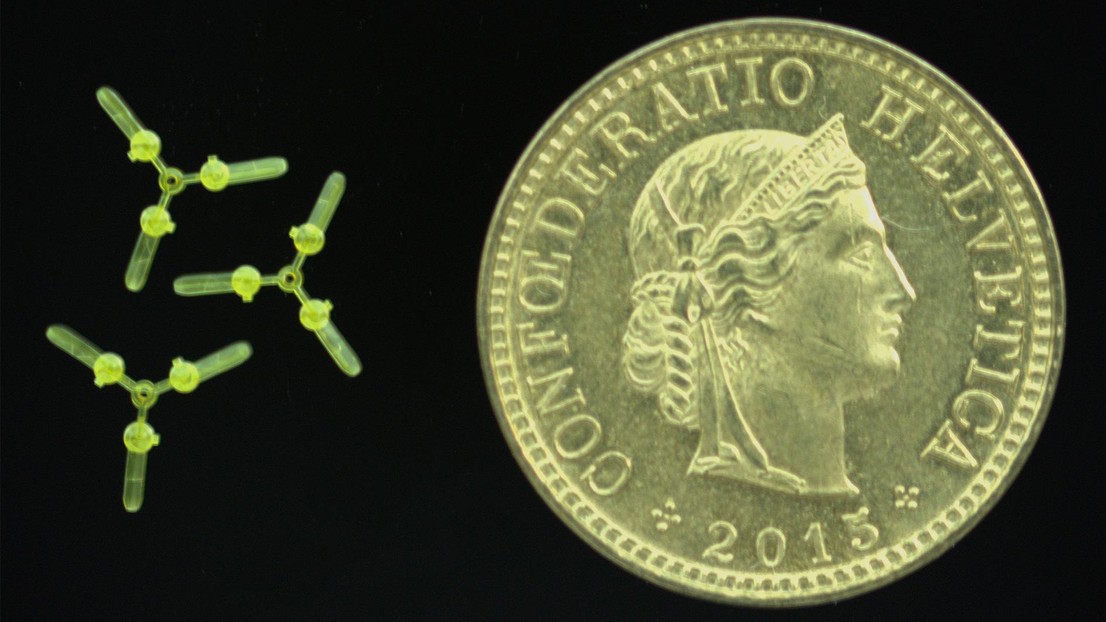
Then they went smaller. Ultralight “microfliers” carried three microscopic cavities molded right into their polymer bodies. These flyers answered ultrasonic tones—pitches our ears never hear.
One design weighed about 150 micrograms and used its cavities like tiny rockets, firing straight up. Another married the cavities to miniature blades that spun as fast as 13,000 revolutions per minute, producing steadier, helicopter-style lift. Takeoff and sustained flight arrived from sound alone.
First author Junsun Hwang notes the approach still has room to shrink: “Our concept is compatible with even further miniaturization, enabling advanced designs that push the boundaries of robotics and aeronautics.” Because the thrusters are empty space rather than motors or gears, every gram saved on actuators becomes payload, sensor, or simply less mass to lift.
Why the quiet power matters
Conventional micro-robots wrestle with a stubborn trade-off. Motors, batteries, and control boards eat space and weight just when you need both most. Magnetic or optical tethers can help, yet they often demand special environments or line-of-sight. Acoustic resonators sidestep much of that clutter. A remote speaker becomes the power plant; frequency becomes the remote control.
The work is still early—proof that the physics can steer boats and loft fleets of microfliers under lab conditions. Real-world air currents, longer ranges, and crowded acoustic environments remain open questions the team treats as the next design brief, not a dead end. Materials already span rigid plastics to soft elastomers, so the same idea can live in stiff frames or bendable skins.
Sakar sketches a gentler future step: packing several differently tuned cavities into one flexible body. Each cavity would answer its own frequency, letting parts of the device flex, vibrate, or bend on command. Imagine an aerodynamic surface that changes camber because the room hummed a chord, or a soft robot that crawls by singing to itself through the air.
A chorus still assembling
What lingers is the elegance. A principle most of us meet as a party trick—air singing in a bottle—has been coaxed into controlled motion at scales from toy boats down to dust-light flyers. The cavities are wireless actuators made of almost nothing, printable, frequency-addressable, and free of onboard electronics.
The air is full of unused notes. These little hollow engines are learning which ones push.
“Our work shows the feasibility of transforming a simple, cleverly designed mechanical piece into robotic matter.” — Selman Sakar