Understanding Cosmic Carbon
Look up on a clear night and you are staring at chemistry on a grand scale. Between the stars, and around aging ones that shed their outer layers, sit vast stores of carbon locked into elegant ring structures. For a long time, astronomers could see those molecules—but not quite explain how nature assembled them so quickly.
A team led by the University of Hawaiʻi at Mānoa Department of Chemistry has now traced a faster route. In work published in Nature Communications, they show how polycyclic aromatic hydrocarbons—PAHs, the multi-ring carbon-and-hydrogen molecules that carpet much of the cosmos—can grow in a single, efficient leap rather than a slow crawl of one-carbon additions.
The Mystery the Sky Kept Posing
PAHs turn up almost everywhere carbon chemistry gets interesting: in the envelopes of dying stars, in the cold gas between stars, and in the dark, carbon-rich material returned from asteroids such as Ryugu. Telescopes and sample-return missions keep confirming they are abundant. Older models, though, struggled to keep pace. Piece-by-piece growth simply looked too sluggish to match what observers measure.
That gap mattered. These molecules help shape how carbon moves through stellar life cycles, planetary nurseries, and the raw stuff of solar systems. If the assembly line was incomplete on paper, our story of cosmic carbon was incomplete too.
Recreating Stellar Heat on the Bench
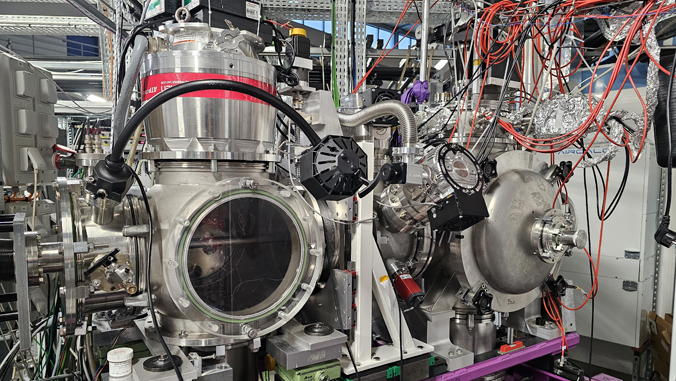
Graduate student Shane J. Goettl and colleagues set out to watch the reactions under controlled extremes. They generated 1- and 2-naphthyl radicals—reactive fragments of naphthalene, the familiar two-ring cousin of benzene—by gently pyrolyzing bromonaphthalene precursors inside a silicon carbide microreactor. Temperatures reached roughly 1600–1700 K, hot enough to stand in for the energetic zones around aging stars.
Those radicals then met biphenyl or naphthalene in a molecular-beam apparatus that freezes the chemistry in flight. Products were sorted isomer by isomer with tunable vacuum-ultraviolet light and a technique called imaging photoelectron photoion coincidence spectroscopy (i²PEPICO) at the SOLEIL DESIRS beamline in France. In plain terms: the team could “fingerprint” exactly which large ring systems formed, not just that something big appeared.
Electronic-structure calculations (B3LYP and coupled-cluster methods) plus statistical rate theory filled in the map of how atoms rearranged and how fast each step ran.
One Step, Several New Bonds
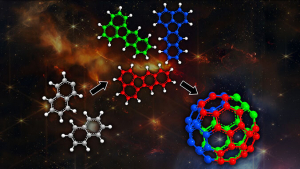
The key insight is a sequence the researchers call aryl radical addition–dehydrocyclization. A reactive aryl radical latches onto another aromatic molecule. Instead of stopping there, the complex quickly sheds hydrogen atoms while knitting new fused rings. Several chemical bonds form in essentially one continuous act.
Think of it less like stacking bricks one by one and more like snapping a whole new bay window onto a house in a single coordinated move. The laboratory runs produced several sizable PAHs that theory had predicted yet older stepwise pathways had trouble supplying on realistic timescales.
“This discovery changes how we think these large carbon molecules are built,” said Professor Ralf I. Kaiser. “For years, we knew they existed in enormous numbers throughout space, but we couldn’t explain how nature produced them so efficiently. We’ve now identified a much faster pathway that helps connect the smallest carbon molecules to the complex structures found across the universe.”
Collaborators included Agnes Chang’s group in Taiwan and Laurent Nahon at SOLEIL, underscoring how ground-based microreactors, synchrotron light, and theory now travel together.
What the New Pathway Opens
The work does not claim every PAH in every environment forms this way. High-temperature gas-phase conditions like those near certain stars are the natural home for the mechanism demonstrated here. Colder clouds will still need their own chapters. The team is careful: this is a powerful new route, not a universal monopoly.
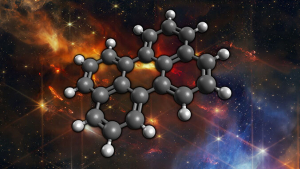
Even so, the finding reframes the efficiency problem. When several bonds can lock in together, growth no longer has to wait for a long chain of rare encounters. That helps close the gap between what telescopes and asteroid samples show and what laboratory kinetics can supply.
Carbon’s cosmic biography suddenly has a clearer middle chapter—the stretch where small rings become the multi-ring architectures that seed later chemistry around stars and planets. Future models of stellar outflows, interstellar clouds, and even the organic inventories of young solar systems can now fold in this faster gear.
The molecules themselves remain ordinary in the best sense: rings of carbon and hydrogen doing what physics allows when the temperature is right and the right partners meet. What feels extraordinary is realizing how deftly those ordinary rules can scale, from a microreactor on Earth to the glowing outskirts of a star.
Next experiments will keep widening the cast of radicals and partners, testing how far the addition–dehydrocyclization motif travels. Each new isomer identified is another concrete link between the smallest carbon fragments and the rich aromatic tapestry the universe already wears.
“We’ve now identified a much faster pathway that helps connect the smallest carbon molecules to the complex structures found across the universe.” — Professor Ralf I. Kaiser