Strain Wakes Magnetism
A Material That Prefers Thin
Most of us meet magnets as fridge ornaments or laptop hard-drive guts—loud, familiar, and stubbornly either “on” or “off.” Quantum materials, though, keep quieter secrets. Ruthenium dioxide (RuO₂), a crystalline oxide long treated as nonmagnetic in its everyday bulk form, has just offered researchers a surprise: when sliced into a film only a few atomic layers thick and gently squeezed by its crystal lattice, its electrons arrange their spins in patterns that match a newly proposed magnetic family called altermagnetism.
The work, led by physicist Ming Yi at Rice University with collaborators Bharat Jalan at the University of Minnesota and Milan Radovic at the Paul Scherrer Institute, appears in Science Advances. First author Yichen Zhang, a recent Rice graduate, and the team show that thickness and strain can flip a material’s magnetic personality without adding foreign atoms or brute-force fields.
Why Altermagnetism Matters
Classic ferromagnets align electron spins like tiny compass needles all pointing the same way; antiferromagnets cancel in pairs. Altermagnetism sits in a fascinating middle ground. Spins still cancel overall—so there is little stray magnetic field to mess with neighboring circuits—yet the electronic structure can still break certain symmetries in useful ways. Theorists argue that combination could let engineers pack denser, faster, cooler memory that reads and writes information using spin as well as charge. That vision is still early, but materials that can host the state are scarce. RuO₂ was an early candidate on paper; bulk crystals stubbornly refused to cooperate.
“Ruthenium dioxide was one of the first materials to be proposed as an altermagnetic candidate, but studies on its bulk form didn’t return evidence of magnetism,” Yi explained. “Our research shows that its ultrathin form, on the other hand, may be the key in making it magnetic.”
Growing a Whisper-Thin Crystal
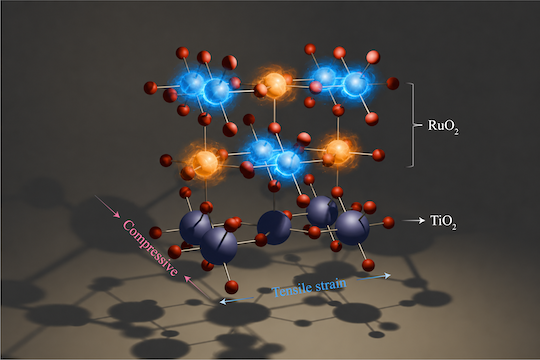
The team grew epitaxial RuO₂ films roughly 2 to 2.7 nanometers thick—about a dozen atoms—on carefully prepared titanium dioxide surfaces using hybrid molecular beam epitaxy, a method that builds crystals layer by layer with atomic precision. Because the film’s atoms are forced to match the substrate’s spacing, the lattice sits under epitaxial strain: a uniform, built-in stretch or compression. Structural checks with X-ray reflectivity, diffraction, electron diffraction, and microscopy confirmed the films were continuous, oriented, and fully strained rather than relaxed into bulk-like comfort.
To watch the electrons themselves, the researchers turned to spin-resolved angle-resolved photoemission spectroscopy—spin-resolved ARPES. In plain terms, they shine tuned X-rays (at synchrotron beamlines) onto the film, knock electrons free, and map both where those electrons came from in energy-momentum space and which way their spins pointed. Geometry and polarization of the light act like carefully chosen flashlights, revealing whether spin patterns are even or odd under mirror reflections—the fingerprints that theory associates with altermagnetic order and with time-reversal symmetry breaking of a particular kind.
What the Spins Said
After the measurements, and with help from density-functional theory (computer models of bulk and slab geometries), one-step photoemission calculations, and group-theory symmetry analysis, a clear picture emerged. Under the strained ultrathin conditions, RuO₂ displayed both mirror-odd and mirror-even spin textures consistent with unconventional magnetism. Without that lattice strain—the situation that bulk crystals enjoy—the telltale patterns faded.
“After analyzing our measurements, including informing our interpretation with theoretical calculations, we found that, in our experimental conditions, the ruthenium dioxide shows spin textures consistent with unconventional magnetism,” Zhang said. “This suggests that bulk and ultrathin ruthenium dioxide, under the right conditions, may have distinctly different magnetic properties.”
Zhang added a practical hope: “The strain-dependent nature suggests that we may be able to use lattice strain as a tuning knob to induce or control altermagnetism. This could be extremely useful when thinking about next-generation spintronics and RAM architectures.”
Careful Work, Open Horizon
The result does not claim a finished memory chip. It is an observation of spin texture under specific epitaxial conditions, interpreted with theory as a pathway toward altermagnetic behavior. Bulk RuO₂ remains the nonmagnetic consensus after years of debate; the new data simply show that shrinking the crystal and stressing its lattice can open a different electronic world. High-quality growth and meticulous spin-resolved ARPES were essential—noise or mixed domains would have blurred the symmetry signatures.
Yi underscored the craft: “This work shows just how complex these questions can be. The high quality material prep and the careful measurement protocol were critical to our observation of the correct electron spin properties… Through this, we were able to determine not only the magnetic state symmetries but a potential way to manipulate it in next-generation quantum materials.”
Next steps feel inviting rather than daunting. Can other oxide films be strained into similar states? Can researchers dial the strain continuously—perhaps with flexible substrates or piezoelectric actuators—to switch the spin pattern on and off? How do these textures evolve with temperature and thickness down to a single unit cell? Each question is a laboratory-sized adventure, not a roadblock.
For now, a once-“boring” oxide has reminded us that materials listen to their surroundings. Make them thin enough, press gently on their atoms, and quiet electrons can start to dance in patterns engineers have only recently learned to name. Spintronics still has miles to go, yet every newly unlocked control knob—here, lattice strain—makes the path a little brighter and a lot more fun to walk.
"The strain-dependent nature suggests that we may be able to use lattice strain as a tuning knob to induce or control altermagnetism." — Yichen Zhang