A Gravity Message
A Whisper Through Solid Walls
Your phone drops out in a tunnel. Wi-Fi stalls behind thick walls. Everyday wireless life is built on electromagnetic waves—radio, light, microwaves—and those signals are easy to block with ordinary stuff: concrete, rock, metal, even a few meters of dirt.
Gravity plays by different rules.
A team at the University of Queensland has now shown, in a cheerfully low-tech experiment, that you can encode information in tiny shifts of the gravitational field and recover it on the far side of a solid barrier. No radio. No cable. Just mass, motion, and a patient detector.
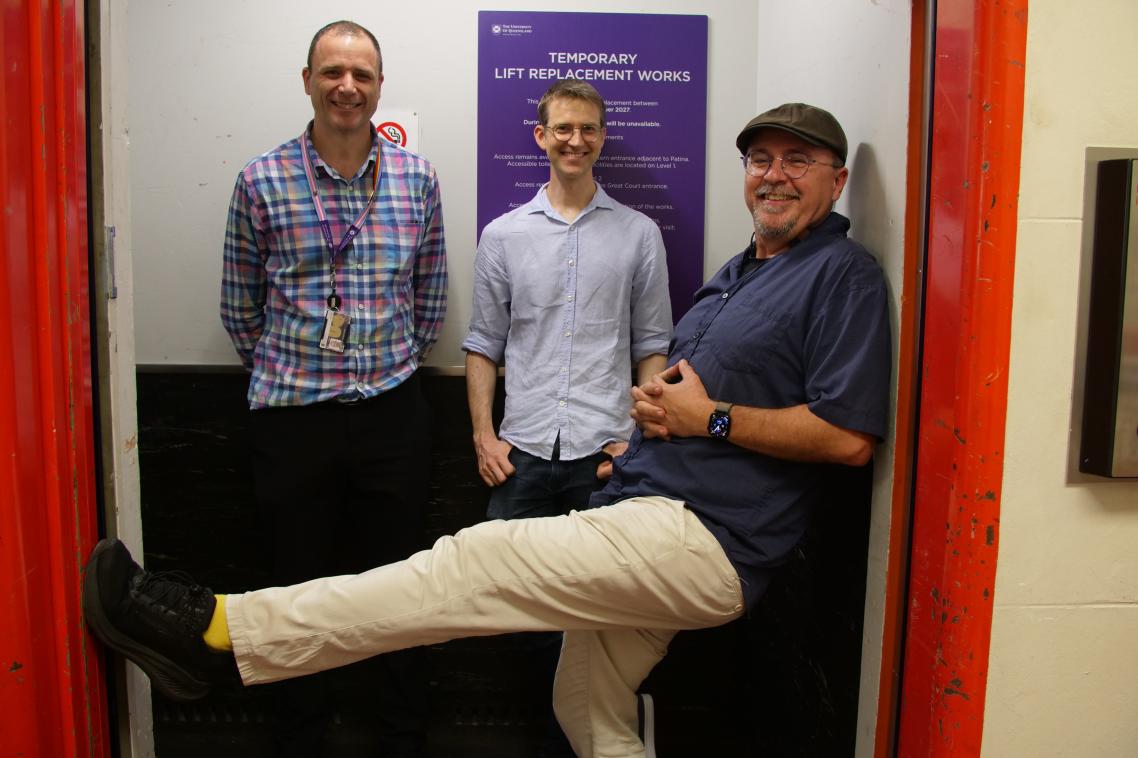
In UQ’s Parnell Building, physicists sent an elevator back and forth between two floors. What mattered was not the cabin itself but its counterweight—about 1.8 tonnes of metal left over from a 1950s installation. By parking that mass high or low, they defined binary bits: one position for 0, the other for 1. On the adjacent ground floor, behind a brick wall, a sensitive gravimeter waited.
A gravimeter is an instrument that measures minute changes in gravitational pull—here, a LaCoste and Romberg Model D mass-spring device sampling relative vertical gravity at about 1.9 hertz. When the counterweight rose or fell, the local field shifted by roughly 50 nanometers per second squared. Those faint tugs matched a simple Newtonian model of the moving mass. Bit by bit, the team spelled out a 49-bit ASCII message bracketed by control bits. The word was “Gravity.”
It took about a minute per bit—twenty-five seconds of motion, ten of settling, twenty-five of integration—so the whole word needed roughly an hour. Nobody is pitching this as the next messaging app. The charm is elsewhere.
Why a Wall Doesn’t Matter
“Unlike the electromagnetic signals used in modern wireless communication, a gravitational signal cannot simply be screened out by placing ordinary material in its path,” said Dr Charles Woffinden of UQ’s School of Mathematics and Physics. Anyone who has lost reception underground or fought Wi-Fi through masonry, he noted, will grasp the appeal. The present setup is far from practical, yet it shows communication that ordinary physical barriers cannot block.
The idea grew out of something more earthbound. Dr Andrew Groszek and colleagues had been exploring a contactless weighbridge—estimating the mass of trucks and other large vehicles from their tiny gravitational pull. Once that principle worked, the same physics looked like a way to encode and send information.
Professor Andrew White was frank about the bottleneck. “Our lift was snail-paced – it’s from the 1950s – so our experiment transmitted just 1 bit per minute, meaning it took an hour to send a single word.” Future speed, he said, would hinge on how large a mass you can move, how quickly you can move it, and how sensitive the detector is. Telegraphy took more than a century to become the mobile phone; gravity links are not practical today, but they need not stay that way forever.
From Proof to Possibility
Professor Matthew Davis put the result in plain terms: it is not often you get to demonstrate an entirely new way of communicating. The team showed experimentally that information can be written into the gravitational field and read out at the other end.
Their detector was classical. Modeling suggests that quantum sensors—devices that exploit quantum effects to measure gravity with extreme delicacy—could, under rather ambitious assumptions, reach ranges of about 500 metres and rates around 15 bits per minute. That is still leisurely by phone standards, yet it sketches environments where radio, light, and conventional signals fail: deep tunnels, shielded chambers, dense structures, places where electromagnetic silence is the rule rather than the exception.
Limitations are real and cheerfully admitted. The rate is glacial. The mass is huge. The detector must be exquisitely quiet. None of that erases the central demonstration: a brick wall that would smother Wi-Fi left the gravitational message intact. The signal is not “stronger” in the usual sense; it simply couples to mass itself, so bulk ordinary matter does not screen it the way it screens electromagnetic waves.
The Long Game of a Soft Signal
Think of gravity as a whisper that travels through everything. You cannot shout with it yet—not with a 1950s elevator and a bathroom-floor gravimeter. But you can prove the channel exists. You can measure the tugs, match them to a model, and decode a word that means exactly what the experiment is about.
From a weighbridge concept to a one-word telegram through masonry is a small, delightful leap. The next steps are engineering ones: faster masses, quieter quantum sensors, smarter encoding. Whether those steps ever yield a working link in a mine, a bunker, or a research lab is an open frontier. For now, the elevator has already spoken.
“We have shown experimentally that information can be encoded in the gravitational field and recovered at the other end.” — Professor Matthew Davis