Quantum Push
A Quantum Push You Can Almost See
Picture a diamond a few millimeters across, hanging in midair, gently bobbing when nothing but the spins of its own electrons give it a shove.
That is roughly what a team at the Okinawa Institute of Science and Technology has now watched happen in the lab. Using only the force from quantum spins inside a diamond, they drove measurable motion in a levitated oscillator weighing about a hundred milligrams—orders of magnitude heavier than the tiny systems usually used in spin-mechanical experiments. The work, published in Science Advances, offers a fresh platform for probing where everyday classical physics meets the quantum world, and for building ultra-sensitive detectors along the way.
Quantum mechanics already powers lasers, MRI machines, and the early quantum computers. Most of that story, though, unfolds at the scale of atoms and molecules—far smaller than anything gravity can meaningfully tug on. Testing whether quantum rules still hold for objects large enough to feel gravity has been stubbornly hard. Heat, vibration, and other everyday noise drown out the subtle signals. The OIST group chose an unusual route: start big, stay levitated, and let spin do the work.
Magnets, Graphite, and a Hungry Diamond
Their setup looks almost playful. A thin plate of pyrolytic graphite—a material that magnets repel—floats above an array of permanent magnets, a trick related to the same diamagnetic levitation that can lift maglev trains. From that floating plate a slender carbon-fiber rod drops through magnetic shielding and holds a single-crystal diamond slab a few millimeters on a side. The whole hanging assembly forms a mechanical resonator of roughly 128 milligrams.
The diamond is not pure. It is peppered with nitrogen-vacancy centers—tiny defects where a nitrogen atom sits next to an empty spot in the carbon lattice. Each center traps an unpaired electron that behaves like a miniature, controllable magnet. Billions of these centers act together. A pulsed green laser (532 nanometers) optically resets their spin states, flipping the ensemble between optically and thermally polarized configurations. Those flips change the diamond’s weak magnetic moment. Sitting in the steep field gradient of a cylindrical permanent magnet below, the changing moment produces a periodic spin force—a gentle, repeated push that drives the diamond up and down at the oscillator’s natural frequency.
Vertical motion is read out with a fiber-optic interferometer bouncing light off a mirror on the graphite plate. The team recorded clear center-of-mass motion at room temperature and ordinary air pressure—conditions far less pristine than the cryogenic, high-vacuum chambers many quantum experiments demand. When the laser pulses were timed to the mechanical resonance, the diamond’s bobbing grew far larger than the quiet baseline seen with the laser off.
Professor Jason Twamley of OIST’s Quantum Machines Unit puts the scale in perspective: the object is eight to nine orders of magnitude more massive than the current state-of-the-art spin-mechanical experiments. First author Anshuman Nayak, a PhD student in the unit, notes that the usual strategy has been to start with extremely small levitated particles and slowly grow their mass until gravity matters. Optical traps struggle at centimeter scales. “That’s why we’re in the opposite camp—going from large to small,” he explains, pointing to diamagnetic levitation as the way to keep heavy objects floating while gravity remains strong.
Why This Nudge Matters
Co-author Daehee Kim, also a PhD student, highlights a practical advantage of NV diamonds: they are well understood, easy to control, and keep quantum coherence—holding a fragile spin superposition—for relatively long times even at room temperature. That combination makes them attractive building blocks for future attempts to put the motion of a macroscopic object into superposition, not just the spins inside it.
The experiment does not yet place the diamond in two places at once. It shows a classical mechanical response—an ordinary up-and-down wiggle—driven purely by a quantum spin force. The researchers treat that as a carefully measured stepping stone. Environmental isolation still needs to improve; vacuum and quieter conditions will be part of the next refinements. Twamley frames the outlook with characteristic care: they have shown a large classical answer to a small quantum effect. The open question is no longer whether the technology can exist, but how to refine the conditions until superposition can be explored in a regime where Einstein’s gravity is also relevant. Along that path, the same hardware points toward a new class of extremely precise sensors—tools that might one day listen for dark matter, gravitational waves, or other faint signals.
From Floating Diamond to Open Frontier
In the lab photo, the diamond glows soft red under the green laser as excited electrons relax—an almost jewel-like reminder that quantum defects can be both delicate and sturdy. The motion they produce is tiny by everyday standards, yet it is large enough to track with picometer-scale interferometry on an object you could hold between your fingers.
That bridge—quantum spins quietly commanding a millimeter-scale mass under gravity—is what makes the result feel like a door cracking open. Schrödinger’s famous cat remains a thought experiment for now. The OIST team is not claiming to have observed it. They are claiming something quieter and, in its way, more useful: a working, room-temperature platform where spin force alone moves something heavy enough that gravity cannot be ignored. Another order of magnitude in isolation and control, Twamley suggests, and the path toward testing macroscopic quantum motion in a gravitational setting looks newly real.
For a field that has long lived in the nanoworld, watching electron spins shift a floating diamond is a hopeful kind of progress—patient, precise, and pointed straight at the questions that still link quantum mechanics to the weight of the world.
“We’ve shown a large classical response from a small quantum effect. It’s no longer a question of whether such technology is possible, but of how we can refine experimental conditions to achieve quantum superposition within the regime of Einstein’s general relativity.” — Jason Twamley
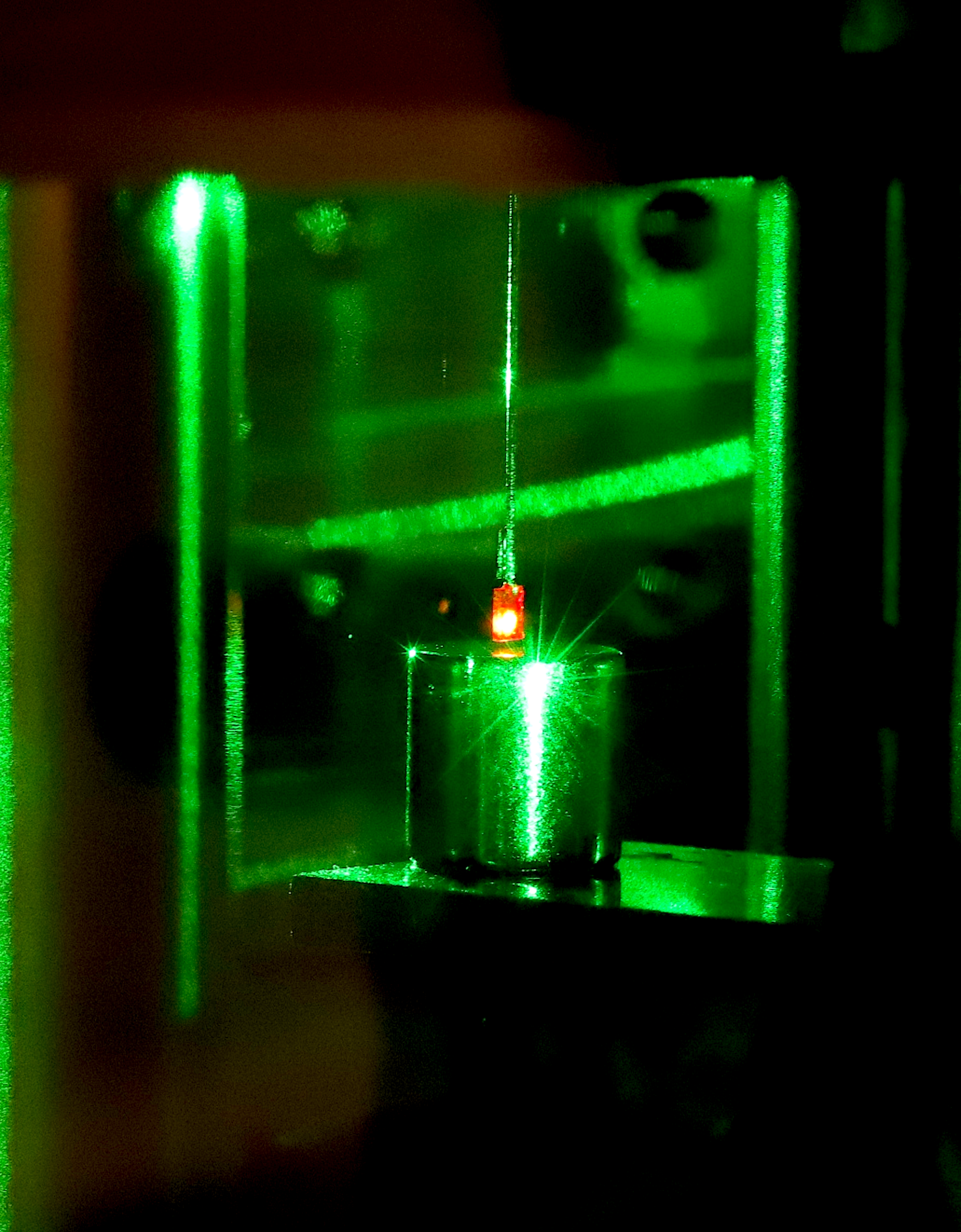 Real-color photo of the lower half of the experimental setup. The diamond with nitrogen-vacancy centers is suspended via a carbon fiber rod above a magnet. When the diamond is illuminated with a green laser, the spin state within the diamond shifts, pushing it down towards the magnet. The diamond glows red due to electrons in the nitrogen-vacancy centers being excited to a higher energy state by the laser.
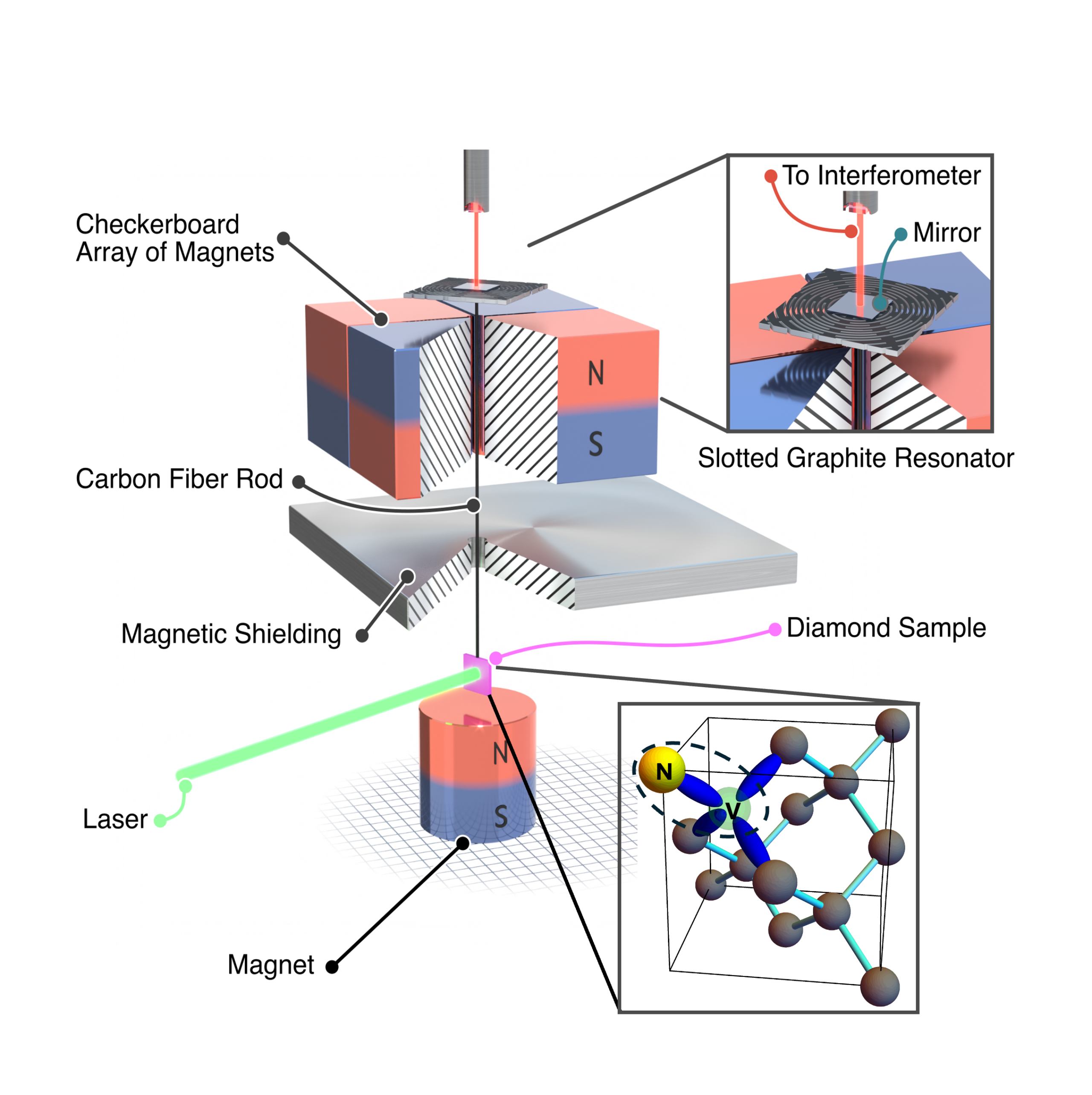 The setup used to detect movement driven by quantum spin. A diamond sample containing nitrogen-vacancy centers in its atomic structure (inset) is suspended above a magnet by a carbon fiber rod, which runs up through magnetic shielding to prevent interference, then through another magnet assembly to a levitating graphite plate, slotted to minimize movement caused by the magnetic array. A mirror on top of the graphite plate reflects a laser beam from an interferometer, which measures distance changes with picometer precision.
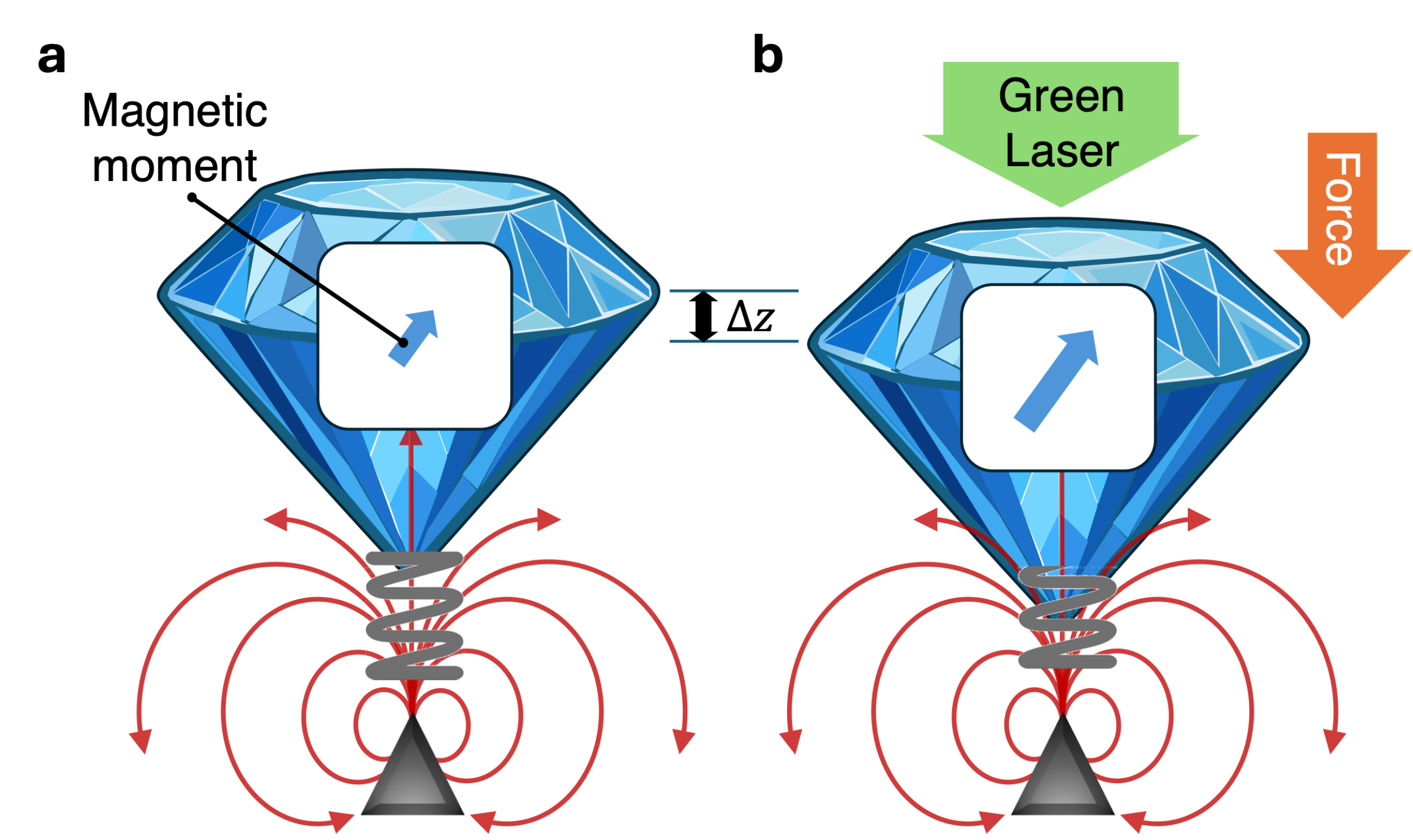 A graphical representation of the observed movements. a) When the laser is off, the diamond slab has a small magnetic moment (blue arrow) induced by the latent spin-state inside the nitrogen-vacancy centers of the diamond. b) When the green laser is on, the spin-state is polarized, causing the magnetic moment to fluctuate weakly, pushing the diamond down towards the magnetic field (red arrows). The amount of movement is labeled as displacement (Δz).