Crystals That Tick in Time
A Lattice Built From Moments
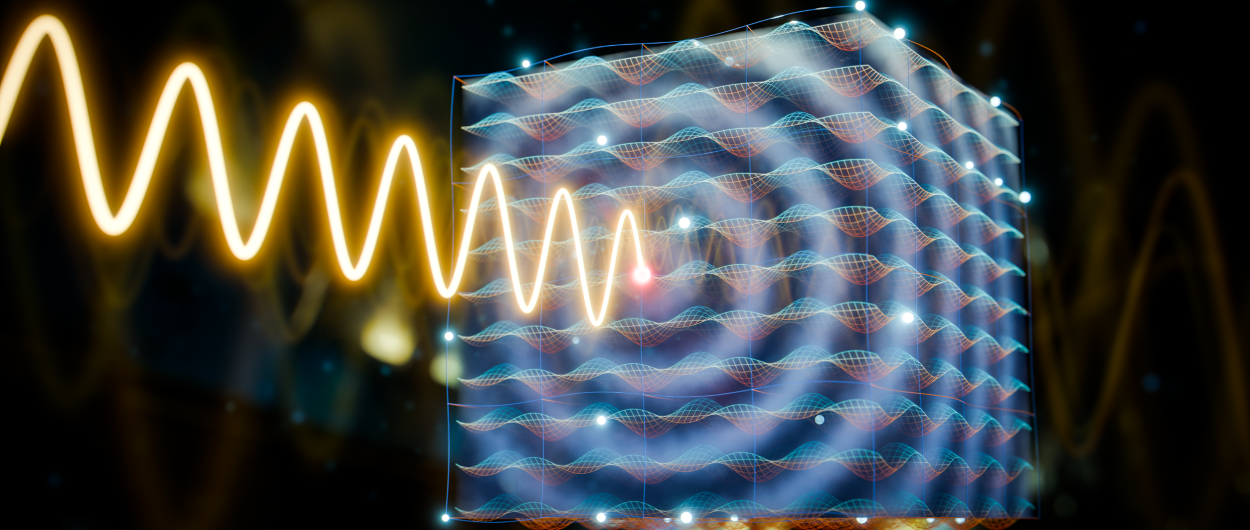
Ordinary crystals are tidy patterns in space—atoms locked into repeating rows. Now picture a crystal whose pattern lives in time: its optical personality rising and falling in a steady beat, faster than a single blink of light. That is a photonic time crystal, and an international team has just made one work with light alone.
Scientists from École Polytechnique, the Collège de France, and Helmholtz-Zentrum Dresden-Rossendorf (HZDR) report the first experimental realization of an all-optical photonic time crystal in Nature. By driving a specially engineered material with intense terahertz pulses, they forced its reflectivity and resonance to swing hard and fast—on timescales matching the light’s own oscillations. The result is a new handle on light in a frequency range that has long sat between electronics and optics, waiting for tools this precise.
Why Terahertz Matters
The terahertz band sits roughly a thousand times faster than everyday electronics yet slower than visible light. It is a sweet spot for peering into materials and for future communications, yet it has remained comparatively underequipped. “The THz range represents the frontier between electronic and photonic technologies,” says Yannis Laplace, assistant professor at École Polytechnique. “It is a range full of opportunities both for science and for society, yet is still under-developed technologically.”
Conventional photonic crystals already help. These are materials patterned with tiny repeating structures that steer photons the way semiconductors steer electrons—blocking some wavelengths, guiding others, or trapping light in carefully shaped cavities. Until now, those patterns were essentially static: you set the geometry or applied a slow change in temperature or magnetism, and the crystal stayed put. Extending the idea into time means the material’s optical constants themselves become a rapid, periodic drumbeat.
“By extending photonic crystals from space to time, we open a new dimension for light control—and a novel path toward amplification and lasing,” explains Tingwen Guo, PhD student at École Polytechnique and lead author. That could matter enormously for terahertz technologies and beyond.
Building a Time-Beating Metamaterial
Turning the idea into hardware took a one-of-a-kind stack of materials. Working with Thales’ Laboratoire Albert Fert and École Polytechnique’s Physics of Interfaces laboratory, the team fabricated a plasmonic metamaterial—an artificial structure designed so that light couples tightly to collective waves of electrons. Micrometer-scale gold crenellations sit atop a thin insulating layer of silicon nitride, which in turn rests on a semiconductor of indium antimonide (InSb). The gold features form tiny cavities that trap terahertz photons between the metal and the semiconductor surface.
When light excites that surface, electrons surge together as surface plasmons—coherent electron waves that grab and hold the electromagnetic field. The whole stack behaves like a set of miniature optical resonators whose properties can be nudged by a strong external field.
The nudge came from HZDR’s TELBE source, a superradiant terahertz facility capable of delivering high-field, phase-stable, multi-cycle pulses. Peak fields around 40 kV/cm, centered near 0.69 THz, slammed into the metamaterial. A weaker broadband terahertz probe, read out by electro-optic sampling, then mapped how the cavities responded in both time and frequency.
What emerged were strong, coherent modulations of the cavity resonance occurring within a single optical cycle. The driving field changed the kinetic energy and effective mass of the carriers inside the semiconductor, which in turn swung the resonance frequency and the material’s reflectivity. In plain terms: the crystal’s “color” and brightness for terahertz light were being rewritten on the fly, beat after beat.
“TELBE’s unique ability to generate high-field, phase-stable terahertz pulses was critical,” notes Jan-Christoph Deinert, coordinator of the TELBE facility. “Without this infrastructure, achieving the coherent, ultrafast modulation needed for the photonic-time-crystal regime would have been impossible.”
Less Loss, More Possibility
A theoretical model developed by Marco Schiró’s group at the Collège de France matched the measurements and clarified the underlying photon dynamics. Encouragingly, the temporal modulation also cut dissipation—the fraction of photons that slip through instead of reflecting—by half. Fewer lost photons means a cleaner, more efficient interaction.
“The theory not only reproduces the experiment but also provides the basis for guiding future discoveries in this system,” Schiró says.
The researchers are clear-eyed about the next steps. They aim to suppress the remaining dissipation still further and then push the trapped light into a regime of net amplification. At high enough gain, the same platform could seed new kinds of terahertz lasers whose output can be tuned on demand—changing intensity or effective “color” almost instantly. Ultrafast optical computing elements and more adaptable telecommunication links sit on the same horizon. None of that is here yet; the present work is a carefully demonstrated proof that the time-crystal regime is experimentally reachable with all-optical drive.
Still, the path feels newly open. A material that can rewrite how it handles light on the scale of the light’s own heartbeat is no longer a thought experiment. It is a laboratory object, humming in the terahertz, waiting for the next turn of the dial.
“By extending photonic crystals from space to time, we open a new dimension for light control—and a novel path toward amplification and lasing.” — Tingwen Guo