Gold That Filters Quantum Light
A Crystal Nature Never Made
Most quantum gadgets live in a freezer. Heat jostles atoms, and the delicate patterns that make quantum information useful fall apart almost instantly. So labs spend fortunes on cryogenic gear that keeps everything near absolute zero.
A team at Louisiana State University decided to stop waiting for nature to hand them a warmer option. They built one.
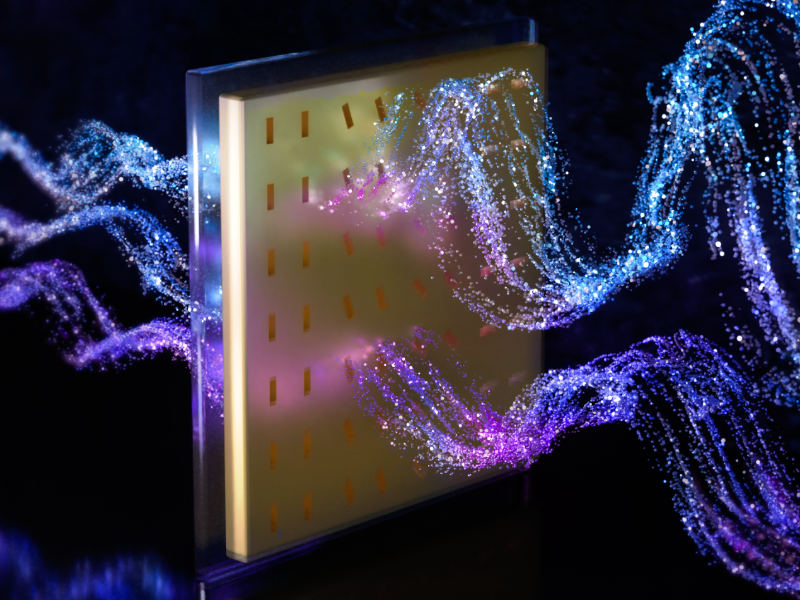
Led by physicist Omar S. Magaña-Loaiza, the group sputtered a 110-nanometer film of gold onto a thin glass chip—about the thickness of a few hundred gold atoms stacked up—then carved it with a focused beam of gallium ions. What emerged was a lattice of tiny gold “nanoantennas,” each roughly 200 by 400 nanometers, spaced a micrometer apart, plus grating couplers that shepherd light onto the surface. Thinner than a human hair, the whole device is what they call a quantum statistical plasmonic metacrystal: an artificial crystal whose building blocks are engineered meta-atoms rather than ordinary atoms.
When light skims across that gold, it rides as surface plasmons—collective ripples of electrons and electromagnetic field that hug the metal. By tuning the size, shape, and spacing of those meta-atoms, the researchers gained a surprising kind of control. The crystal does not merely pass light by color or brightness. It notices the quantum statistics of the photons themselves—the subtle ways their arrivals bunch, thin out, or stay random—and steers different statistical flavors along different paths.
Sorting Light by Its Hidden Habits
Sunlight, laser light, and the glow from a fluorescent bulb are all streams of photons, yet those photons fluctuate differently. Those differences show up in a number physicists write as g^(2)(0), a second-order coherence that captures whether photons tend to arrive together, apart, or independently. Until now, telling those states apart usually meant banks of cold detectors and mountains of repeated measurements.
Here the material itself does the sorting. Multiphoton fields with tunable coherence—generated by focusing a continuous-wave 780-nanometer laser onto rotating ground glass—were coupled into the metacrystal through the gratings. Light that made it through was collected with a high-numerical-aperture microscope objective and counted with photon-number-resolving avalanche photodetectors. The crystal acted as a statistical filter: certain quantum states passed with their defining character largely intact, a behavior the team calls robust transport, while others were redirected or reshaped.
“By engineering the distribution of meta-atoms in the plasmonic metacrystal, we can systematically dictate which quantum statistics are allowed to pass through the structure,” said Riley B. Dawkins, who completed his Ph.D. on the work and is moving to NIST. Magaña-Loaiza put the practical hope plainly: the crystal can distinguish quantum states that carry information and move them from point to point without cryogenic cooling. That is the door toward devices that might one day leave the lab.
The structure even forms what the researchers nickname quantum statistical bands—patterns that echo the electronic band structures of semiconductors, except these bands govern how quantum states of light travel and keep (or lose) their statistical identity. Change the layout of the meta-atoms and you rewrite which states glide through unaltered and which ones are rewritten. In that sense the device is less a one-off curiosity and more a design language.
From Theory Sketch to Working Chip
Chenglong You, a former LSU postdoc now a professor at the University of Electronic Science and Technology of China, recalled the quiet thrill of watching prediction meet fabrication. “One of the most exciting parts of this project was realizing that we could build a material that does something nature doesn’t provide on its own. Seeing it work exactly as we predicted was incredibly rewarding.”
Graduate student Jannatul Ferdous stressed the dual achievement: not only a new class of room-temperature quantum material, but the theory needed to understand and steer it. The LSU Quantum Photonics Group handled the full arc—theory, design, nanofabrication, and measurement—under support from the U.S. Department of Energy’s Office of Basic Energy Sciences.
None of this claims a finished quantum computer on a desktop. The result is a proof-of-concept material and a blueprint. Heat still exists; everyday environments are still noisy. What the work shows is that sensitivity to many-body quantum coherence need not be locked behind refrigeration if the material’s architecture is chosen with enough care.
Where the Light Might Go Next
Practical quantum networks, compact sensors, and information processors all stand to gain if fragile states can travel at room temperature. The same light-guiding discipline may also matter far from pure quantum hardware. Solar cells lose part of the sunlight that enters them; photons bounce, get trapped, and end up as waste heat. A surface that shepherds light along more stable paths could, in principle, leave more energy available for conversion. The team’s next experiments aim to fold the metacrystal into solar-cell architectures and measure whether that extra guidance shows up as usable electricity.
For now the wonder sits on a glass chip the size of a research sample: hundreds of gold slits, a beam of carefully prepared light, and a crystal that reads a property of photons most materials ignore. Nature did not stock this shelf. Researchers wrote the recipe, milled the pattern, and watched the statistics sort themselves at the temperature of an ordinary room. The freezer door, at least for this particular trick, can stay open a little longer.