Biohybrid Robots
Muscle and Scaffold, Designed as a Pair
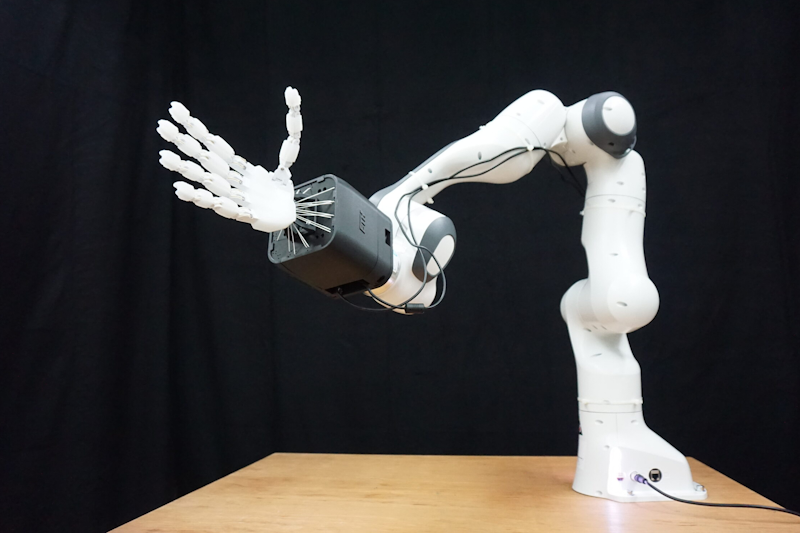
Picture a tiny robot that flexes because real muscle is doing the work. Not a motor. Not a battery-powered hinge. Living tissue, grown and guided so it can pull, bend, and spring.
That is the promise of biohybrid robots—machines that blend engineered parts with living muscle as the actuator, the thing that makes motion happen. They can self-organize, adapt, and even heal in ways metal alone cannot. Yet many designs have treated the muscle almost in isolation, polishing its biology while paying less attention to how it partners with the soft scaffold that holds it.
A team at ETH Zurich’s Soft Robotics Laboratory decided the partnership itself was the missing piece. Led by Robert K. Katzschmann, with equal contributions from Aiste Balciunaite and Mike Y. Michelis, they built a pipeline that designs muscle and scaffold together—then fabricates what the computer recommends. The result: centimeter-scale bioactuators that move farther and faster than earlier versions of similar muscle volume, and robots that jump, swim, walk, and grip.
Why the Interface Matters
In a biohybrid robot, force has to travel from contracting muscle fibers into a soft support structure and out into the world. If that handoff is clumsy, motion is lost. Previous work often improved the cells or the culture conditions; this group asked a different question. What if form and function of the whole muscle–scaffold unit were optimized as one system?
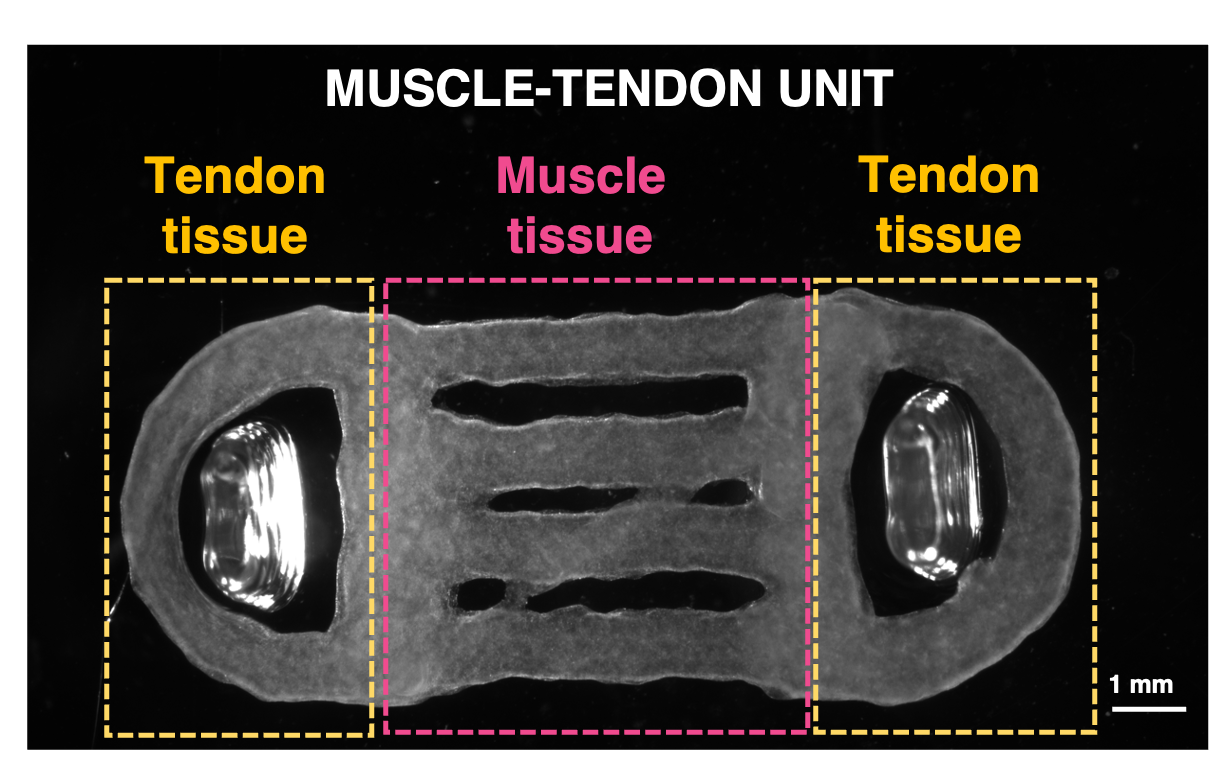
They turned to soft-body simulation—software that treats the construct like a stretchy, continuous material rather than a stack of rigid parts. Muscle and hydrogel (a water-rich gel used as a scaffold) were modeled together. An evolutionary algorithm then searched for shapes that maximized range of motion, with targeted parameter sweeps to refine the winners. The search converged on bilayered designs: layered geometries where contractile tissue and passive scaffold work in concert.
Think of it as teaching two dancers the same routine instead of drilling each one alone. The choreography is the point.
From Screen to Soft Tissue
Fabrication followed the model. The team used xolographic volumetric printing—a light-based method that builds three-dimensional objects in a volume of material rather than layer by layer—to create microgrooved hydrogel scaffolds from GelMA and PEGDA, two biocompatible gel chemistries. Onto those grooves they placed C2C12 myoblasts (muscle precursor cells) in a GelMA–Matrigel matrix, cured the construct with UV light, and guided the cells to differentiate into contractile skeletal muscle.
The continuous interface between tissue and scaffold is more than a neat manufacturing detail. It lets force transmit efficiently, so the bioactuator can produce large, rapid deformations when electrically stimulated—typically a few volts per centimeter at frequencies of one to a few hertz in their tests.
Compared with earlier designs of similar muscle volume, the co-optimized actuators reached up to an eleven-fold increase in range of motion. That is not a slogan; it is the measured payoff of treating muscle and scaffold as a single mechanical team.
Robots That Jump, Swim, Walk, and Grip
With that motion in hand, the group powered a small menagerie of behaviors. Supplementary demonstrations show a jumping robot, swimmers paced at different beat rates, walkers that can circle or turn near a pillar, and a gripper driven by a bilayered bioactuator. Single units, double units, and multi-leg arrangements all respond to pacing, hinting that the same building block can scale into multi-unit systems.
None of this claims a finished consumer gadget. These are laboratory platforms—centimeter-scale, electrically driven, carefully characterized for deformation, tissue structure, and mechanics. The researchers present the work as a unified pipeline of modeling, optimization, and fabrication that can speed the next round of designs, not as a final product catalog.
Honest Limits, Open Doors
The muscle still begins as cultured cells on engineered gels. Performance depends on stimulation protocols, material stiffness, and how well fibers align and fuse. Long-term durability, fully autonomous control, and translation beyond the lab remain open frontiers—the kind of questions diligent teams list because they plan to answer them, not because the idea has stalled.
What the study does show is clearer: when you co-optimize the living and the soft-engineered halves of a bioactuator, you can unlock deformations large enough for versatile motion from a modest volume of muscle. The bilayered, microgrooved architecture is a concrete proof of that principle, and the simulation-plus-evolution loop is a reusable way to hunt for better ones.
A Softer Kind of Machine
There is something quietly wonderful about watching a robot hop or paddle because tissue contracted on cue. It blurs the line between organism and device without erasing either. Soft robots already borrow ideas from octopus arms and elephant trunks; biohybrids go a step further and invite living muscle into the chassis.
By insisting that scaffold and muscle grow up together—in the computer first, then in the dish—this ETH Zurich team offers a hopeful blueprint. Design the partnership. Print the groove. Grow the pull. Then see how far a small, living actuator can bend the world around it.
The next steps will refine materials, pacing, and multi-unit coordination. For now, the message is simple and bright: treat the whole actuator as one system, and the range of motion can leap—literally—into new territory.