Electric Nanoribbons
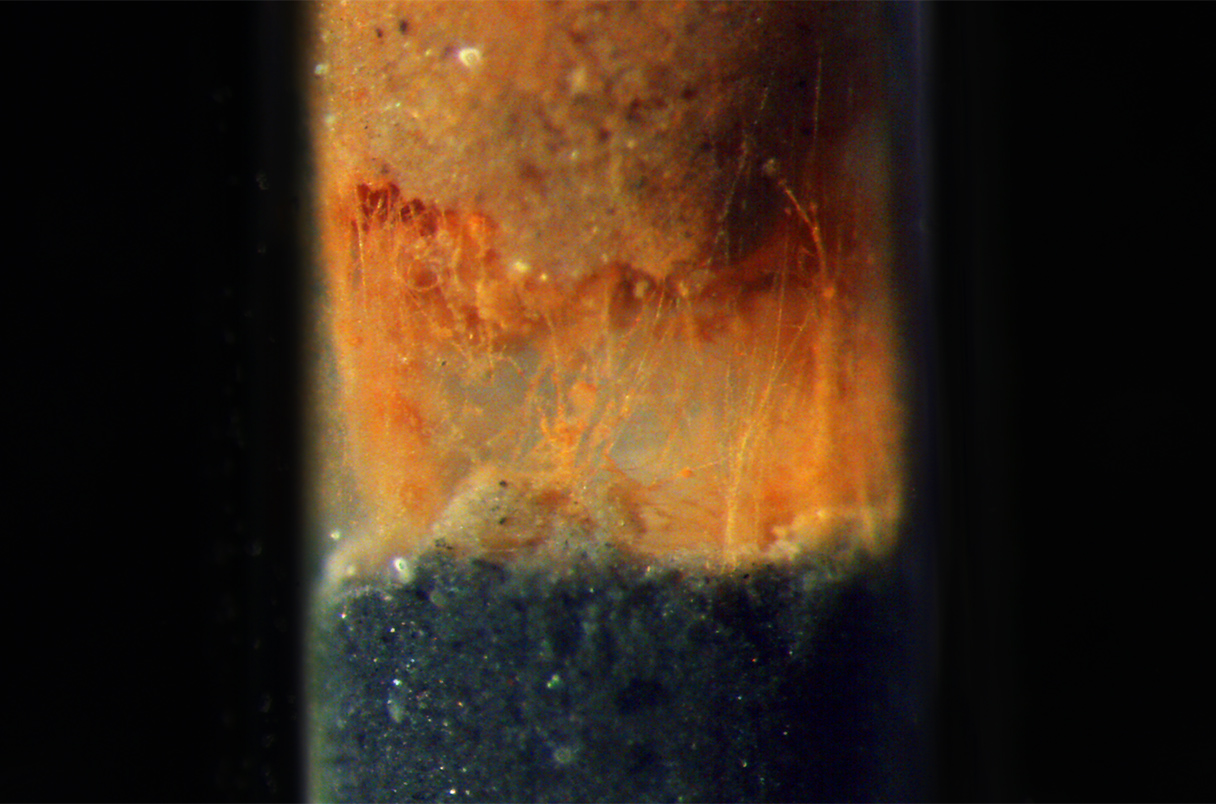
On the seafloor, some bacteria live as long, multicellular filaments that behave a bit like living power cords. They ferry electrical currents across centimetres of sediment, linking chemical reactions that would otherwise stay separate. For years that feat looked almost impossible for a biological material. Most conductive proteins shuffle electrons in short hops between iron centres. Cable bacteria do something far more continuous—and far more metal-organic.
A large international team led by Filip J. R. Meysman has now resolved the architecture that makes it possible. Inside each fibre sits an extended nickel-organic framework: a bundle of intertwined nanoribbons built from stacked nickel centres linked by organic dithiolene ligands. The result is extensive conjugation and electron delocalization over macroscopic distances.
Why biomaterials usually fall short
Biobased electronics wants the best of both worlds—electronic function plus flexibility, self-assembly and biodegradability—while cutting reliance on scarce metals and toxic processing. The bottleneck has been conductivity. Ordinary biomaterials simply cannot compete with the metal inks or conductive polymers used in printed electronics.
Cable bacteria challenged that assumption. Their cell envelopes contain parallel protein fibres (typically 20–70 per filament) that run the full length of the centimetre-scale organism. Earlier measurements already showed conductivities reaching hundreds of siemens per centimetre—values that rival commercial electronic inks. Yet the molecular structure remained unknown, so no one could explain the performance or copy it.
Mapping the conductive core
The researchers isolated individual filaments of Candidatus Electrothrix gigas, gently extracted “fibre skeletons” that strip away membranes and cytoplasm while leaving the conductive network intact, and then applied a battery of imaging and spectroscopy tools.
Nano-X-ray fluorescence showed nickel running in continuous parallel lines that match the fibre geometry and stay unbroken across cell junctions. High-angle annular dark-field scanning transmission electron microscopy revealed that each fibre contains roughly eleven electron-dense nanoribbons, each about 1.4 nm across, waving and intertwining along the fibre axis. Energy-dispersive X-ray maps confirmed that nickel and sulphur concentrate inside those ribbons.
Iron is not enriched there. The classic multi-heme or iron-sulphur hopping architecture is simply absent. Instead the fibres carry a nickel-and-sulphur complex that accounts for the great majority of the cell’s nickel budget—far more nickel than typical bacteria keep on hand.
A conjugated nickel bis(dithiolene) polymer
Raman spectra of the fibres display an intense, characteristic fingerprint that matches polymeric nickel bis(dithiolene) compounds, especially poly-nickel(ethene tetrathiolate). X-ray absorption spectra at the nickel K-edge reinforce the same picture: square-planar nickel coordinated by sulphur, closely resembling the synthetic polymers. Electron paramagnetic resonance detects organic radicals centred mainly on the terminal ligands rather than on the metal, consistent with longer oligomers in which spins appear only at the ends.
Taken together, the data point to oligomeric nickel(ethene tetrathiolate) units—Niₙ(ett)ₙ₊₁—stacked and aligned into one-dimensional nanoribbons. Roughly four such oligomers sit side-by-side in each ribbon; about eleven ribbons braid together inside each fibre. Polarized light and angle-resolved Raman microscopy show the planar complexes lie with their long axes parallel to the fibre, exactly along the direction of current flow.
The whole arrangement is a biological one-dimensional metal-organic framework. Metal centres linked by organic bridges form continuous nanoribbons; multiple ribbons intertwine like the braided strands inside a household power cord. That geometry keeps the conduit flexible enough for a motile bacterium that bends and turns, yet stiff and solvent-isolated enough for efficient charge transport.
Performance that still surprises
Earlier work already placed whole-fibre conductivity in the range of 5–500 S cm⁻¹. When the conducting cross-section is restricted to the nanoribbon bundle alone, the estimated conductivity of a single nanoribbon climbs into the hundreds to thousands of siemens per centimetre—among the highest values reported for any metal-organic structure. Low reorganization energy and persistent conductance even below 20 K further support a picture of delocalized, vibronically assisted transport rather than classical hopping.
Some details remain open. Exact oligomer length is still only loosely constrained (likely several to a couple of dozen nickel centres), and the precise stacking register of the layers needs tighter experimental definition. Those are natural next steps, not shortcomings of the core discovery.
A design principle already perfected by microbes
Metal-organic frameworks have never before been shown as products of living cells. Cable bacteria demonstrate that evolution solved the long-range conduction problem by building exactly such a framework inside protein sheaths. The same architecture now offers a concrete template for synthetic chemists and materials scientists: rigid, π-conjugated nickel-dithiolene oligomers stacked into nanoribbons, braided for mechanical resilience, and wrapped for environmental isolation.
Because the material is ultimately biological, it also raises the longer-term possibility of true biosynthesis of conductive metal-organic frameworks—grown rather than fabricated. For a field still searching for greener routes to flexible electronics, that is an especially hopeful horizon.
The next time you picture electricity moving through a wire, you might also picture a quiet filament of bacteria on the seafloor, already doing the same job with nickel, sulphur and a molecular elegance that human technology is only beginning to appreciate.