Rocks That Remember Lakes
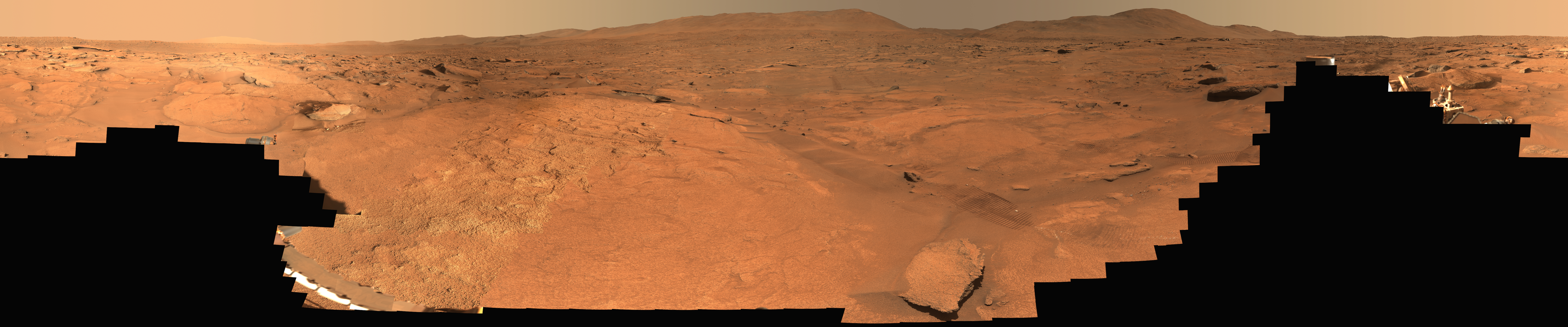
Picture a greenish cliff on Mars that once sat near the edge of a lake. The cliff is gone now, but its chemical memory remains. NASA’s Perseverance rover has spent months reading that memory across Jezero crater’s enigmatic Margin unit, and the story that emerges is both quieter and richer than a simple shoreline tale.
A large international team, including lead author Candice C. Bedford of Purdue University and colleagues from Imperial College London and many partner institutions, used SuperCam—the rover’s mast-mounted laser and imaging suite—to examine more than 185 bedrock targets. What they found redraws the unit’s origin and its long conversation with water.
High Ground, Little Water
At the highest elevations Perseverance visited (above roughly –2350 m), the rock looks almost pristine. SuperCam images and chemistry show interlocking, subhedral grains of olivine—the magnesium- and iron-rich silicate that crystallizes when magma cools slowly. The texture matches a cumulate: dense crystals that settled inside a magma body, much like the olivine-rich Séitah rocks already studied on Jezero’s floor.
These High Margin outcrops carry almost no carbonate or silica overprint. In other words, they escaped significant water exposure. Grain shapes stay angular and abutting; thin interstitial material is the only filler. The chemistry clusters tightly around olivine compositions, confirming the original igneous character.
Lower Elevations Tell a Wetter Story
Drop below the hypothesized second terrace of the ancient Jezero lake and the picture changes. East and West Margin rocks still contain the same olivine lineage, yet they wear the scars of repeated fluid events. Near Neretva Vallis and the Western fan, some beds even show possible local reworking—finer grains, subtle layering, and higher secondary mineral content—while a distinctive matrix-supported deposit at Pearce Canyon looks more like a debris flow linked to the Bright Angel formation than pure Margin bedrock.
Across these lower outcrops SuperCam data reveal three clear alteration chapters.
First, neutral-to-alkaline, CO₂-rich fluids moved through fractures. They converted olivine into Fe/Mg-carbonate, filling cracks that later resisted erosion and stood out as pale ridges. The carbonate keeps the same iron-to-magnesium ratio as the parent olivine, a chemical fingerprint of that early carbonation stage.
Second, cooler or lower-pH fluids—possibly lake water after a rim breach, or evolving groundwater—remobilized some of that carbonate. Magnesium was stripped, secondary pores opened, and silica precipitated in the remaining spaces. This silica-rich matrix is common only below the second terrace level and is absent from the high, unaltered cliffs.
Third, still later fluids raced through younger fractures and left thin veins of calcium sulfate laced with fluorite (CaF₂). Because the surrounding bedrock is poor in calcium, sulfur, and fluorine, these fluids must have tapped a different source—perhaps crater-rim rocks or deeper hydrothermal circulation linked to regional volcanism.
Reading the Sequence Without Overclaiming
The researchers are careful. Not every layered texture is sedimentary; magma chambers can produce similar grading and lamination. Distinct chromite populations from place to place argue that any shoreline reworking stayed local. Séitah, lower in the crater, shows far less alteration, perhaps because overlying rock once shielded it or because it simply had fewer open fractures when the fluids arrived.
Still, the spatial pattern is hard to ignore: the most complex mineral assemblage sits precisely where lake levels and groundwater pathways would have overlapped. The result is a multi-chapter aqueous history recorded inside a single olivine-rich body.
Why Astrobiologists Are Paying Attention
Carbonate, silica, and late sulfate-fluorite veins together create a diverse set of chemical environments. On Earth, similar sequences can trap and preserve organic molecules or microbial textures. Perseverance has already collected samples—Pelican Point, Lefroy Bay, Comet Geyser—from the altered lower Margin. Those cores now carry the three-fluid story back toward Earth.
The Margin unit was once eyed mainly as a possible lake-shore carbonate deposit. SuperCam has shown it is more interesting than that: an igneous foundation later rewritten by successive generations of water. Each rewrite left a readable mineral sentence. Together they turn a stretch of Martian cliff into one of the richest water diaries the rover has yet opened—and a place where the next chapter of the search for ancient life may still be waiting.