Sound's Quantum Jumps
Strike a bell and the ring fades the way you expect: louder, then softer, then gone. At the smallest scales, vibration does not taper that way. It drops in sudden steps—energy states flipping like a light switch. For more than a century those steps were theory. Ions showed them in 1986. Photons followed in 2007. Sound held out.
Until now.
A team led by Stanford applied physicist Amir Safavi-Naeini has recorded the first direct, real-time observation of quantum jumps of sound inside a mechanical resonator. The work appears in Science, and it closes a long arc while quietly opening another.
A microscopic tuning fork that will not quit
The quantum unit of light is a photon—one discrete packet. The quantum unit of sound is a phonon: not a lonely particle, but the coordinated motion of a throng of atoms vibrating together. Everyday ears never notice the staircase. A resonator at the quantum level, though, changes energy in clean jumps, the same way ions and photons do.
Earlier experiments had left fingerprints of those jumps. This one caught them mid-leap.
The device itself is a chip-scale mechanical resonator, built with the same family of techniques used to make ordinary microelectronics. It behaves like a microscopic tuning fork—except its “ringdown” lasts about two milliseconds. Stretch that performance to a desk-drawer tuning fork and the note would hang in the air for hours. That patient ringing is what made the measurement possible: enough time for hundreds of careful checks while a single phonon occupied the first excited state, then vanished into the ground state.
Listening without spoiling the song
Quantum systems are famously shy. Look too hard and you scramble the very state you hoped to read. Co-first authors Takuma Makihara and Erik Szakiel paired the long-lived resonator with a superconducting qubit—an electrical circuit that can hold quantum information and act as a gentle detector.
In practice, the resonator was a thin-film lithium niobate phononic crystal cavity, transferred and suspended a mere 75 nanometers above a half-micron gap in the qubit circuit. Working in the dispersive regime, the team used repeated quantum nondemolition parity checks—Ramsey interrogations of the qubit that reveal whether the phonon number is odd or even without destroying the vibration outright. By post-selecting runs that showed consecutive excited-state outcomes, they heralded clean single-phonon states. Individual trajectories, reconstructed with Bayesian forward-backward estimation, then revealed the jumps from the first excited state down to ground.
“We had to continually develop new processes to make this extremely long-lived, vibrating object and then integrate it with the qubit, which is our little electrical detector—without ruining either subsystem,” Makihara said. The qubit simply asked, again and again across those two milliseconds: energy level 1, or 0? When the answer flipped, the jump was written down.
Why a jump matters
Safavi-Naeini puts the immediate payoff plainly: “What this study shows will allow us to move forward with developing new quantum technologies with sound. We have seen that vibrating objects can exhibit quantum behavior, which is the prerequisite for many of the operations needed by quantum computing and sensing.”
One concrete hope is error awareness. In many quantum architectures a jump is precisely the kind of event that can spoil a calculation. Identifying when those jumps occur has been difficult, so the ability to detect them marks an important step toward error correction. Because the resonator-plus-qubit package is tiny and highly sensitive, the same platform is already being explored—together with Michael Roukes’s group at Caltech—for detecting and identifying proteins inside cells. Everyday gadgets that already lean on sound, from phones to sensors, stand to gain from finer control as well.
“This shows we can have incredibly fine-tuned control of sound, which might mean that devices that use sound as a fundamental technology can get much better,” Szakiel noted.
The work is a foundational step, not a finished machine. Yet the essential proof is in hand: sound, like light and matter before it, can be caught in the act of jumping. The staircase is no longer inferred. It has been heard, one discrete step at a time.
"We have seen that vibrating objects can exhibit quantum behavior, which is the prerequisite for many of the operations needed by quantum computing and sensing." — Amir Safavi-Naeini
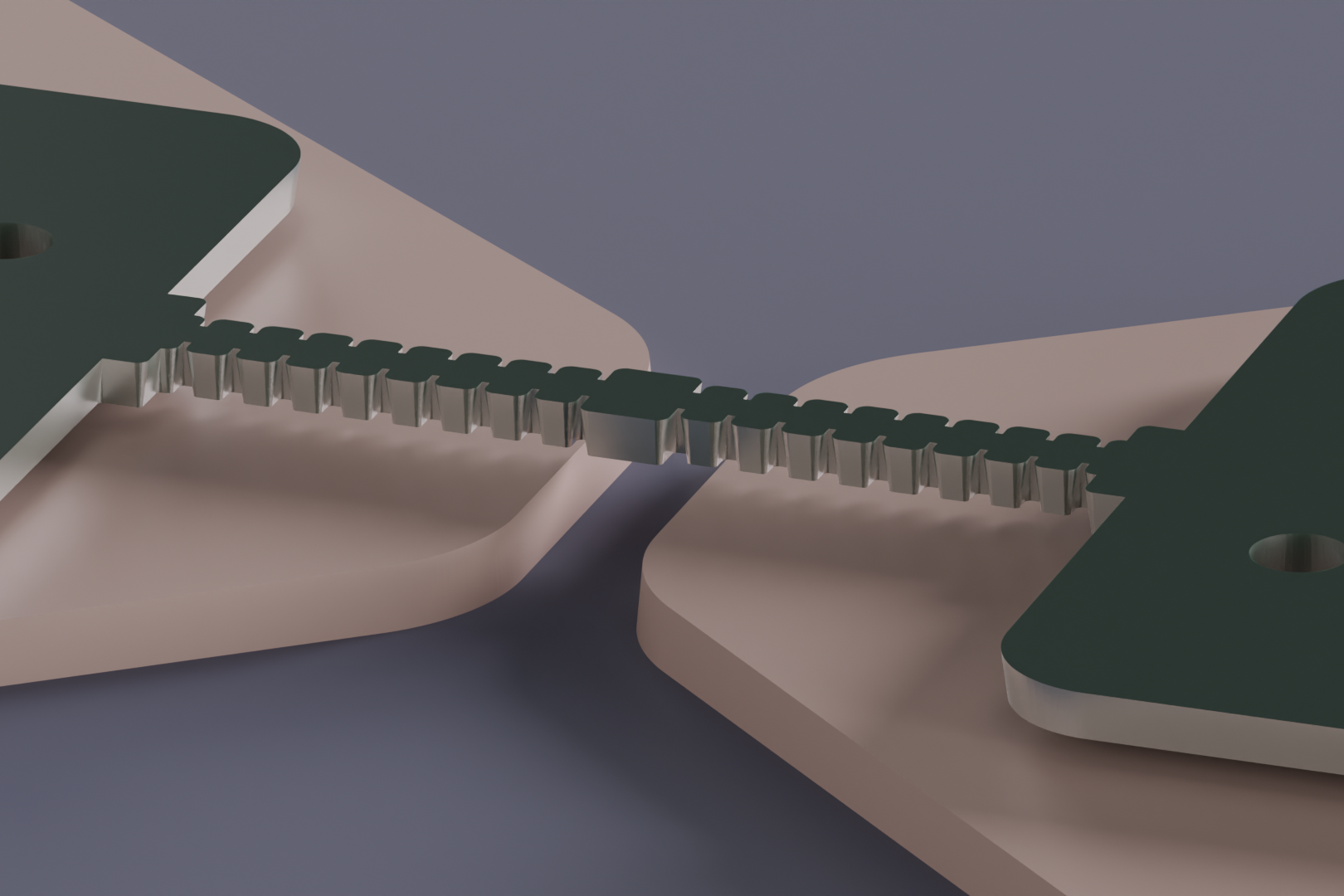 Illustration of the mechanical resonator
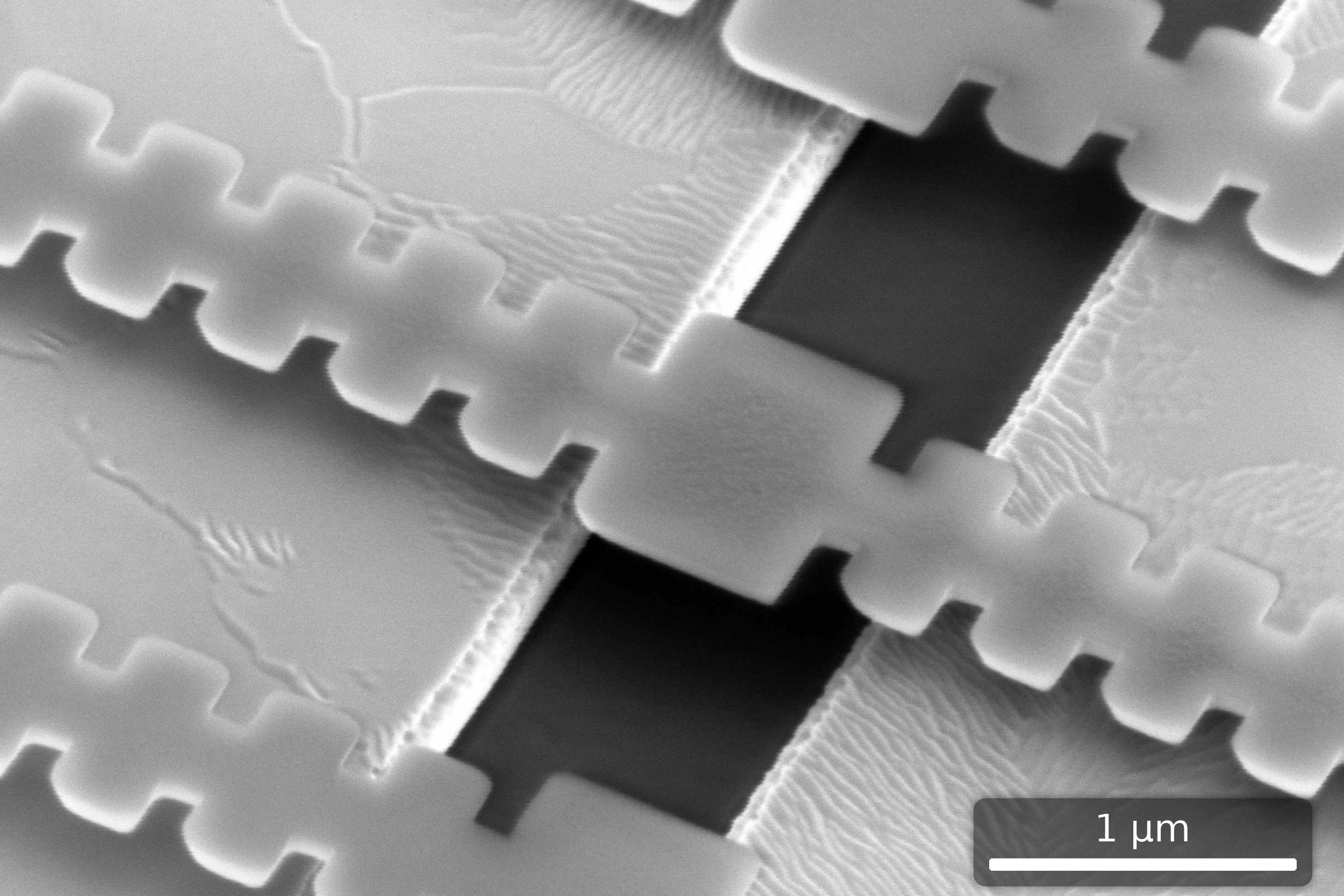 Scanning electron microscope image of the mechanical resonator
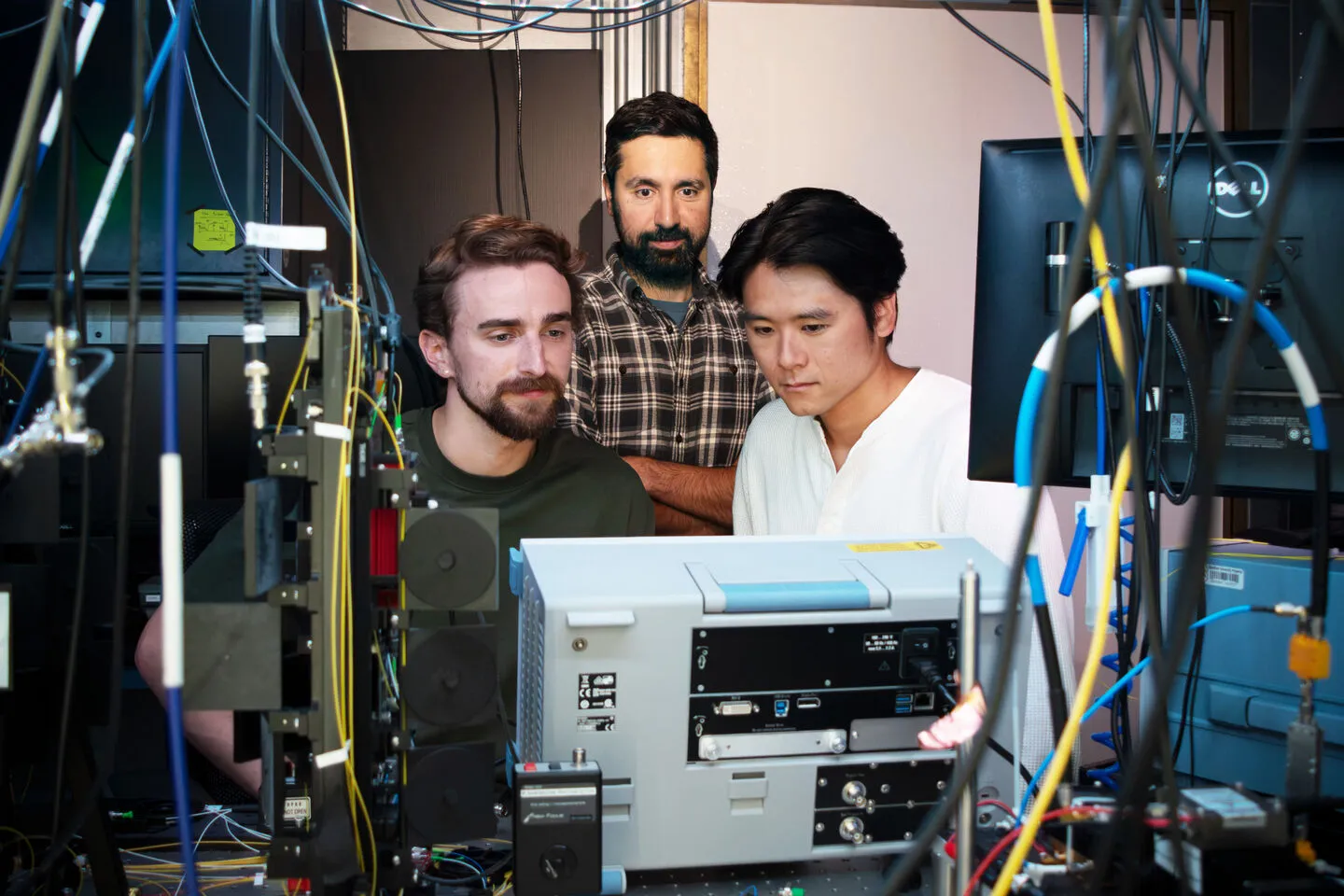 Study co-authors Erik Szakiel (left), Professor Amir Safavi-Naeini, and Takuma Makihara look at radio frequency instrumentation.