A Comet's Distant Birthmark
Every so often, a wanderer from another star system drifts into our neighborhood. These interstellar visitors carry frozen memories of places we will never visit—disks of gas and dust swirling around stars that may have been born long before the Sun.
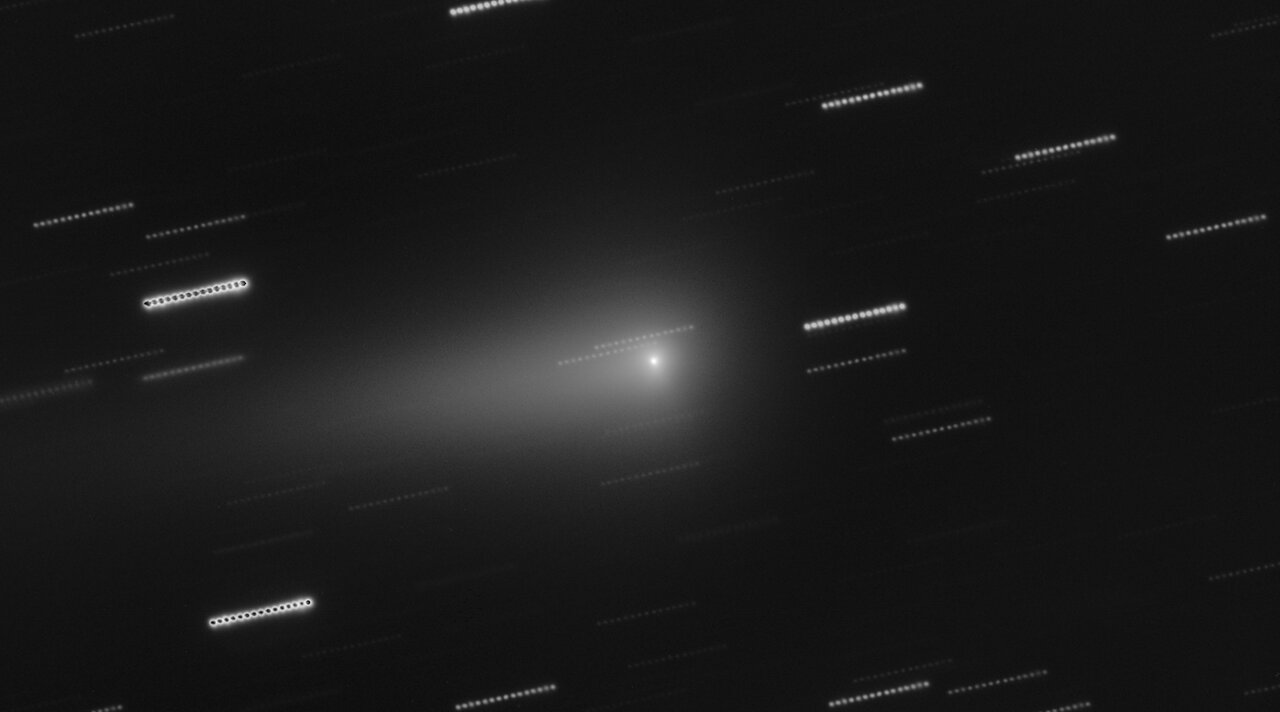
In late 2025, one of them put on a show. Comet 3I/ATLAS arrived already active, grew brighter than its predecessors, and gave scientists a rare chance to read its chemical diary in detail. A team led by Cyrielle Opitom at the University of Edinburgh has now measured two key isotopic ratios in the comet’s gas—ratios that act like birth certificates written in atoms.
Tiny differences, big stories
Isotopes are slightly different versions of the same element. Carbon-12 is the everyday kind; carbon-13 is a bit heavier. Nitrogen-14 is common; nitrogen-15 is the scarcer sibling. The relative amounts of these versions—the ¹²C/¹³C and ¹⁴N/¹⁵N ratios—shift depending on temperature, starlight, and the chemistry of the cloud where a body formed. They are subtle fingerprints of origin.
Using the UV-Visual Echelle Spectrograph (UVES) on the Very Large Telescope in Chile, the team watched the blue glow of CN—the cyanide radical, a molecule that lights up readily in comet comas—between 6 and 26 December 2025, after 3I’s closest approach to the Sun. Individual isotopic lines were too faint to catch one by one. So the researchers carefully stacked clean lines into combined profiles and fitted models of the ordinary and rare versions of CN. The result: ¹²C/¹³C = 151 (with asymmetric uncertainties spanning roughly 107 to 261) and ¹⁴N/¹⁵N = 363 (spanning roughly 210 to nearly 1000 at the 3-sigma level).
Not like our local comets
Those numbers stand out. Solar System comets typically show ¹⁴N/¹⁵N around 150 when measured in CN, HCN, or related species—noticeably enriched in the heavier nitrogen compared with the Sun itself. 3I’s ratio is higher, sitting closer to values seen in the broader interstellar medium, in cold prestellar cores, and in some outer regions of young planet-forming disks.
The carbon ratio is elevated too. Local Solar System comets usually hover near 90. The local interstellar medium sits around 69. 3I’s higher value lines up with independent JWST measurements of carbon isotopes in the comet’s CO and CO₂, which also came in high. That consistency across different molecules is important: it suggests the whole reservoir of carbon the comet carried was relatively poor in carbon-13 from the start.
Reading the birth environment
Nitrogen ratios can be reshaped by isotope-selective photodissociation—starlight that preferentially breaks apart certain versions of N₂ depending on how shielded a region is. In the inner parts of protoplanetary disks (the dusty, gassy cradles around young stars), strong ultraviolet light and abundant N₂ can drive enrichment in nitrogen-15. Farther out, or in better-shielded zones, that process weakens and ¹⁴N/¹⁵N climbs. 3I’s high nitrogen ratio is therefore consistent with formation at a relatively large distance from its star, or in an environment where shielding limited that fractionation.
Carbon tells a complementary tale. Models of Galactic chemical evolution show that older, lower-metallicity stars—stars poorer in elements heavier than hydrogen and helium—tend to produce material with higher ¹²C/¹³C ratios. As the Galaxy ages and becomes more chemically complex, more carbon-13 is forged. Observations of a radial gradient across the Milky Way match this picture: outer, lower-metallicity regions display higher carbon ratios. Earlier dynamical and population studies had already suggested 3I likely came from around an older, metal-poor star. The new isotope measurements fit that story neatly.
Could chemistry inside the disk itself have driven the high carbon ratio instead? In principle, exchange reactions can leave molecules formed from C⁺ (such as CN) depleted in carbon-13 while molecules formed from CO become enriched. Yet JWST found similarly high ¹²C/¹³C in CO and CO₂. That argues against two strongly different carbon reservoirs and favors an originally ¹³C-poor starting mix—again pointing toward a low-metallicity parent star rather than purely local disk processing.
Layers that remember
One practical worry with any long-traveling interstellar object is surface processing by galactic cosmic rays over billions of years. The team notes that their spectra were taken well after perihelion, once 3I had been vigorously active for months. Rough estimates of water production suggest the comet shed at least several meters of surface material. The gas they sampled may therefore come from deeper layers that still preserve the original ice chemistry—though confirming that fully will take more work.
Uncertainties on the ratios remain sizable, as expected for such faint isotopic signals. The researchers treated those uncertainties carefully with multiple fitting approaches and report them openly. The numbers are still high enough, and consistent enough across techniques and with the JWST carbon results, to be meaningful.
A wider horizon
3I/ATLAS is the first interstellar object bright and cooperative enough for these isotope measurements. Earlier visitors—1I/ʻOumuamua and 2I/Borisov—could not offer the same spectroscopic detail. Each new ratio we can extract becomes a tiny window onto how planetesimals assemble around stars of different ages and compositions.
The picture that emerges is quietly thrilling: a chunk of ice and rock that condensed in the outer reaches of a disk around an older, metal-poor star, then wandered for gigayears until it lit up in our sky. Its atoms still carry the memory of that distant nursery. As more interstellar visitors are found and studied, those memories will start to map how common—and how varied—planet-building really is across the Galaxy.
We are only beginning to read the postcards.