Stellar Encore
A Sequel Written in Starlight
Most of us picture planets as leftovers from a star’s birth—dust and gas that never quite joined the party, settling into orbits while the young sun lit up. Earth and its neighbors are that kind of first-generation crew.
But what if a star’s death could start a second chapter?
A team led by Jamie Williams, a doctoral candidate at the University of Warwick, has reopened decades-old ultraviolet spectra of the white dwarf HS 0209+0832 and found chemical evidence for just that: a candidate second-generation planet. The work, published in Nature Astronomy, suggests a gas giant roughly Jupiter’s size may have formed from material the star flung outward as it expired—and that this newcomer is still feeding scraps of itself back onto the stellar remnant.
The Cold Case in the Archive
A white dwarf is the dense, cooling core left when a Sun-like star burns through its fuel and sheds its outer layers. In 1999, NASA’s Hubble Space Telescope recorded the light of HS 0209+0832 and turned up roughly a hundred spectral features no one could name. The trail went quiet.
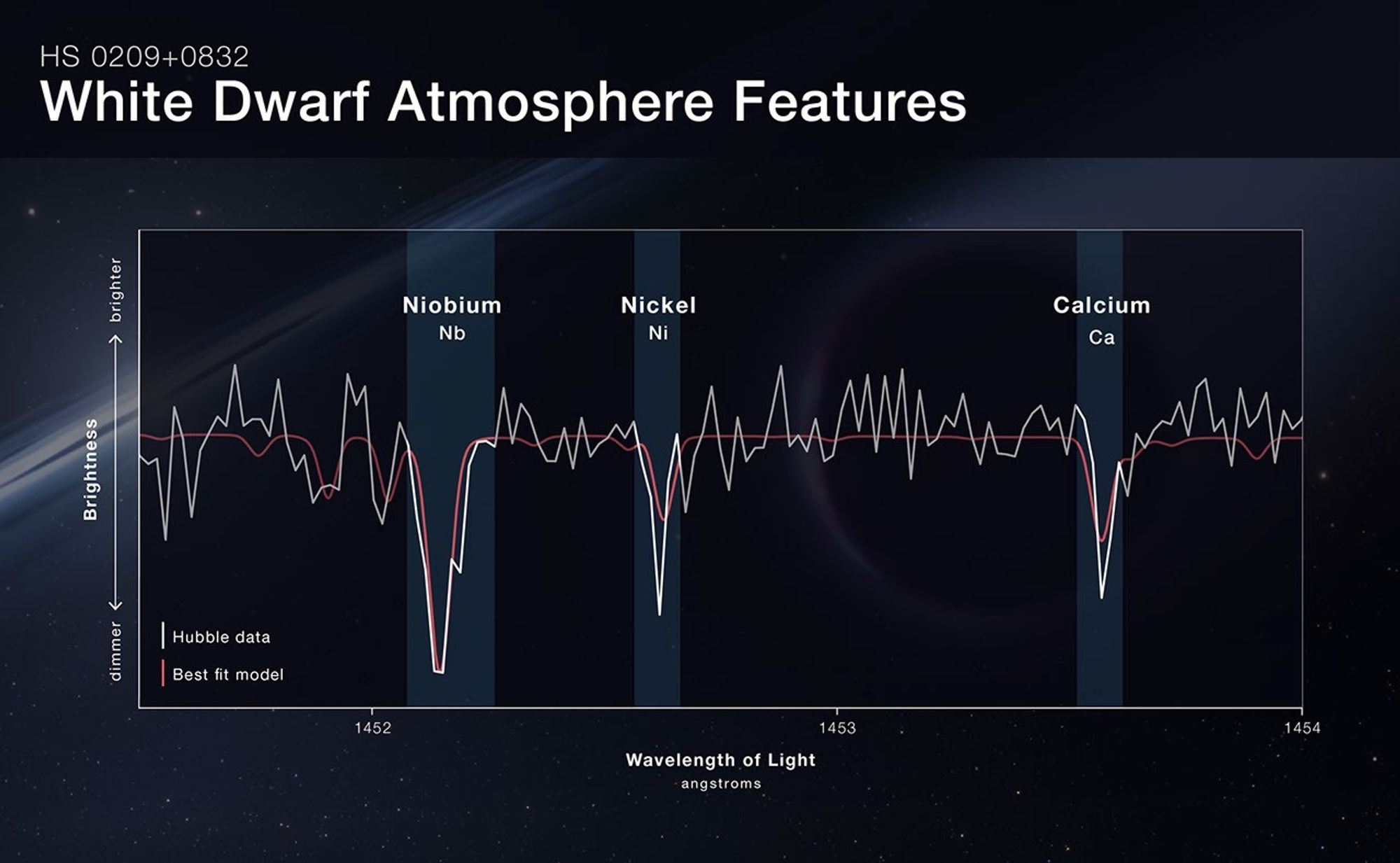
Williams returned to those same records with a fresher chemical library. Many of the mystery dips lined up with niobium—an element familiar on Earth in jewelry and medical imaging, yet vanishingly rare in the atmospheres of white dwarfs. Co-author Boris Gaensicke, also at Warwick, recalls the jolt of recognition: when Williams raised the niobium match, the piece that had never been reported in any other white dwarf suddenly made the whole puzzle click.
Independent far-ultraviolet data from NASA’s retired FUSE mission showed the same strong niobium signatures, confirming the archival find was no fluke.
Why Niobium Matters
Nicholas Stone, a theoretical astrophysicist at the University of Wisconsin–Madison, puts the element in cosmic context. Niobium and other metals heavier than iron are not forged by the everyday fusion that powers a star’s core. They require the brief, extreme conditions inside a dying star—its “death throes”—before the enriched innards are expelled into space.
In other words, the niobium now sitting in the white dwarf’s thin atmosphere is a chemical postcard from the star’s final act. The team’s working picture is elegant: some of that cast-off, metal-rich debris coalesced into a gas giant. The rest of the ejecta drifted away long ago. The planet stayed.
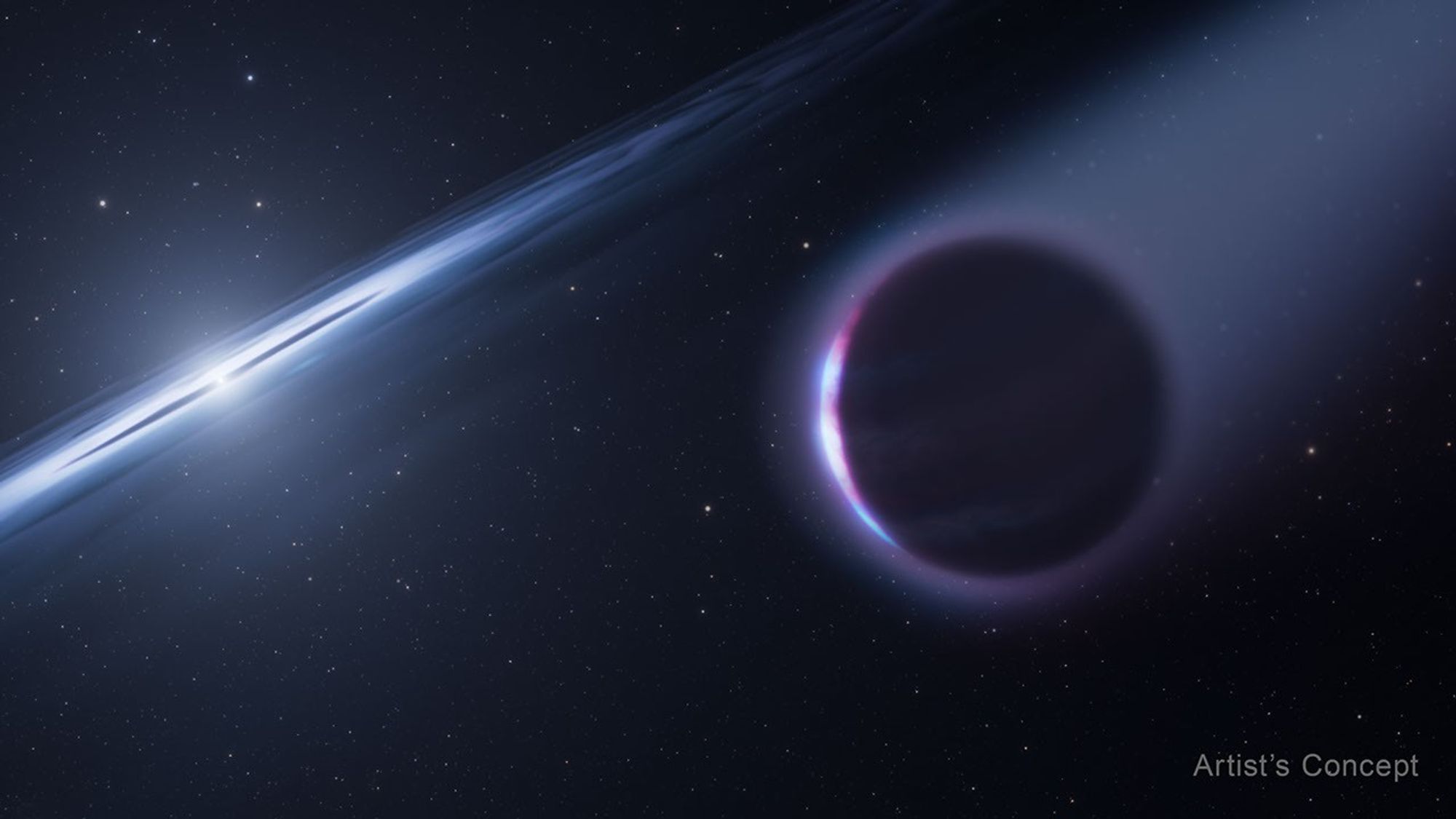
Because the white dwarf is still young and fiercely hot, it bathes the nearby world in energy that strips atmosphere. Material streams off the planet—perhaps in a comet-like tail—settles into a disk, and rains onto the star’s surface. That rain is what Hubble “tastes” as niobium, nickel, calcium, and companions when it samples the white dwarf’s light.
A Close, Flickering Orbit
NASA’s TESS spacecraft watched the system for four months and caught a gentle, repeating pulse in brightness. The sinusoid points to an orbit only about 3.7 million miles out—far tighter than Mercury’s path around the Sun—consistent with a massive companion close enough for the white dwarf’s heat to do real work on its atmosphere.
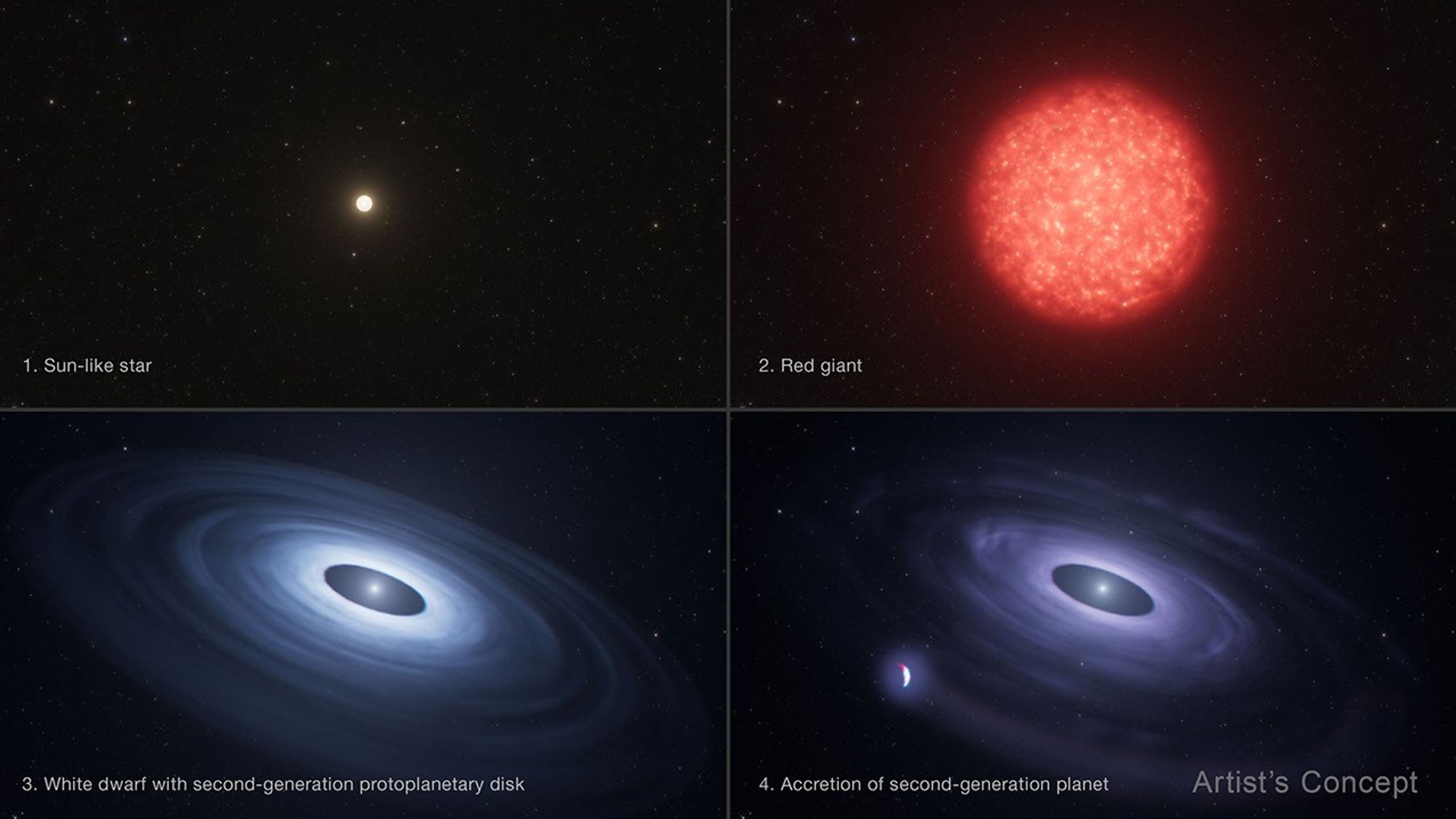
The candidate is still losing mass, yet Williams is cautiously optimistic about its long-term prospects. Once the white dwarf cools and steadies, he notes, the planet could settle into a stable zone for millions of years. Survival, not a brief flash, looks plausible.
First Chapter, Not Last
The finding reframes white dwarfs. Instead of a quiet epilogue for stars and their original planets, the remnant stage may host brand-new characters built from the debris of the old story. Williams puts it with quiet excitement: the systems we know may only be the opening chapter of a much longer tale.
Plenty remains open. How often do second-generation planets form? How do they settle into orbit around a “dead” star? How do they evolve as the white dwarf cools? Williams plans to keep using Hubble in the years ahead to gather the statistics these questions need.
Gaensicke offers a broader reminder that fits the whole episode. Scientific discovery rarely marches in a straight line. It thrives on the moment when people trade the questions already spinning in their heads and, together, notice an answer no one expected.
Somewhere in the archive, a spectrum from 1999 held a metal that had never been catalogued in a white dwarf before. Today that metal is a signpost: even after a star ends, new worlds may still be finding their way into the light.
"Rather than the white dwarf stage being a kind of epilogue to the story of a star and its planets, this research points to the systems we are familiar with only being the first chapter of a potentially much longer tale, with some new characters showing up. That’s a really exciting prospect to pursue." - Jamie Williams