Carbon Cradle Catalysts
Ordered Atoms, Smaller Specks
Picture a fuel cell as a quiet chemical kitchen: hydrogen and oxygen meet, electricity flows out, and the only regular leftovers are water and warmth. The chefs of that kitchen are catalysts—surfaces that speed the reaction without getting used up. Platinum has long been a star performer. It is also scarce and costly, so engineers try to stretch every atom.
One clever stretch is to break platinum into nanoparticles—grains so small that almost every atom sits on the surface, ready to work. Typical loadings drop below a quarter of a milligram per square centimeter. The catch is familiar to anyone who has watched sugar clump in a humid pantry. Under the harsh voltage swings of real operation, those tiny particles can dissolve, wander, and merge into fewer, larger lumps. Activity fades. Lifetime shrinks.
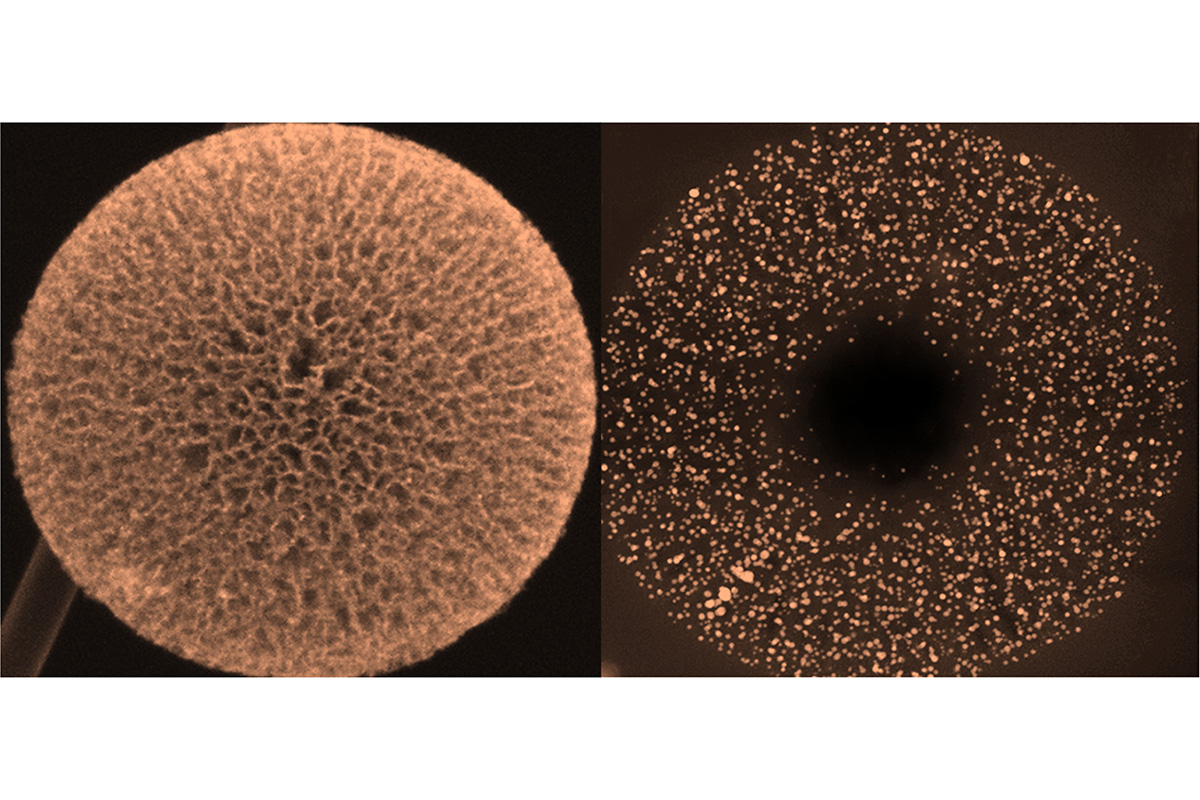
A team led by Gang Wu at Washington University in St. Louis, working with colleagues at Brookhaven National Laboratory, Lawrence Berkeley National Laboratory, Northeastern University, and the University of Pittsburgh, has built a carbon host that eases that squeeze. Their work, reported in Nature Nanotechnology, introduces radial nanochannel-array carbon spheres—RNCS for short. Think of each sphere as a hollow, porous bead whose walls are scored with orderly, open grooves running outward like spokes. Pore size and volume are tuned on purpose, giving the material both high surface area and clear through-paths.
Into those channels the researchers nestled platinum-cobalt nanoparticles. Then came the heat that usually ruins the party.
Heat Without the Clumping
Intermetallic catalysts—alloys whose atoms settle into a precise, repeating pattern rather than a random mix—tend to be more active and tougher than ordinary platinum alloys. Forming that ordered lattice, often called an L1₀ phase for platinum-cobalt, usually wants temperatures well above what nanoparticle makers prefer. Stay cooler than about 700 °C and the particles stay small and evenly spread, but the atomic order stays incomplete. Push hotter and the atoms snap into place… while the particles themselves sinter into sluggish blobs.
Wu’s carbon spokes rewrite the bargain. Confined inside the radial channels, the platinum-cobalt grains could be annealed above 1,000 °C. That is hot enough to drive a highly ordered L1₀-PtCo structure. Yet the particles remained finer than five nanometers—even at an industry-friendly platinum loading of roughly 40 percent by weight—and stayed uniformly dispersed rather than clustering.
"Traditionally, there would be a tradeoff between size and stability, but with the ordered carbon nanochannel host, platinum cobalt nanoparticles can be confined and remain stable at very small particle size even at high temperatures," Wu explained. The same architecture also helps the ionomer—the ion-carrying polymer painted through a fuel-cell electrode—spread more evenly, while giving protons, oxygen, and water clearer routes in and out.
Stress Tests Built for Hard Work
Lab coupons are one thing. The team evaluated the catalysts inside membrane electrode assemblies—the stacked, working hearts of practical fuel cells—under conditions meant to echo heavy-duty vehicles. Accelerated stress testing hammered the cells through 150,000 severe voltage cycles. The material kept about 85 percent of its performance. Researchers estimate that endurance could translate to roughly 25,000 hours of operation.
Those numbers matter because durability and thrift have to travel together. Larger particles can last longer but offer less reactive surface; designs that chase peak activity often wear out sooner. By marrying high-temperature ordering with stubbornly small, well-spaced grains, the RNCS support aims at both sides of the ledger at once.
The open-channel geometry adds a quieter bonus: better mass transport. When reactants and products move freely, less platinum is wasted waiting for molecules to arrive or water to leave. In Wu’s words, the platinum-cobalt nanoparticles built into this support showed "best-in-class performance and long-lasting durability" in their tests—language that reflects the measured gains, not a finished product on a showroom floor.
From Lab Bench Toward Living Grids
Data centers already draw a rising share of electricity—enough that some projections put them near nine percent of U.S. generation by 2030. A fuel cell that converts hydrogen (or other fuels) straight into electricity on-site could lighten that load on the wider grid, while the same core chemistry continues to matter for trucks, buses, and stationary power. Wu has filed a patent through Washington University’s technology office; further development and industry partnerships, he notes, will be needed to clear the remaining catalyst hurdles.
Caveats stay honest. These results come from carefully controlled membrane-electrode tests and accelerated cycling, not decades of field service. Scaling the carbon spheres, integrating them into full systems, and proving cost and lifetime under every climate and duty cycle are the open frontiers ahead. The researchers treat those steps as diligence, not defeat: a map of what to build next.
Still, there is quiet delight in the design itself. A hollow carbon bead, scored with radial grooves no wider than a few molecular lengths, becomes a microscopic kiln and a cradle at the same time—hot enough to order atoms, gentle enough to keep them tiny. Hydrogen’s promise has always been simple chemistry and clean exhaust. Making the catalyst that serves it both thrifty and steadfast is the patient craft now moving forward, one carefully channeled sphere at a time.
"Our strategy is using this new carbon nanostructure to synthesize platinum cobalt intermetallic nanoparticles that can reduce precious metal content and enhance activity and stability." — Gang Wu