Geometric Color
From Clumps to Shimmer
Butterfly wings do not cheat with dye. Their blues and greens come from tiny structures that bend light—a trick shared by opals. For years, chemists have wanted that same never-fading brilliance on everyday surfaces. The catch has always been getting microscopic particles to line up into orderly photonic crystals—lattices that select which wavelengths bounce back as pure colour. Earlier approaches usually meant heat and long waits measured in hours, not seconds.
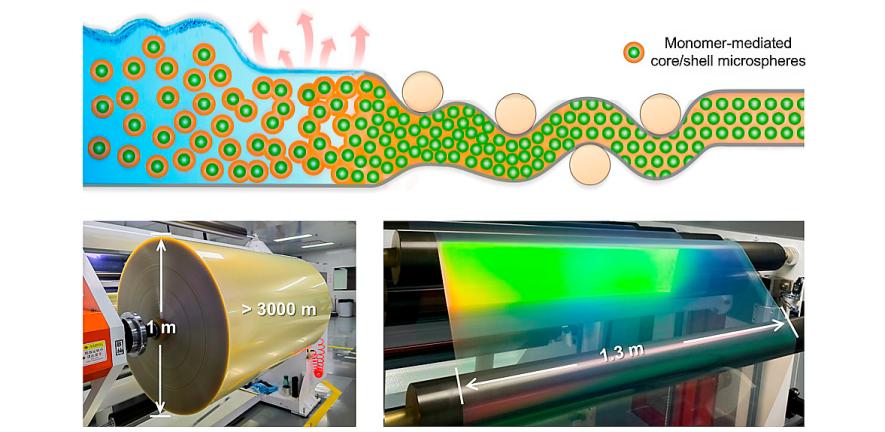
An international team has now flipped that script. By adding a pinch of ordinary monomers—the same small chemical building blocks used to make everyday plastics—they coaxed disordered particle clumps to snap into crystalline order within seconds, under gentle shear at room temperature. A brief flash of ultraviolet light then locked the arrangement into a soft, durable matrix. The result is continuous, industrial-scale film that carries structural colour the way nature does: by geometry, not pigment.
A Soft Nudge Beats Brute Force
Simply pushing harder never solved the problem. Particles either stayed messy or the ordered patches fell apart. The breakthrough, co-led by Professor Changchun Wang of Fudan University with colleagues including Professor Oren A. Scherman of the Melville Laboratory for Polymer Synthesis at the University of Cambridge, was subtler. Low-molecular-weight functional monomers lower the energy barriers between particles. With those interactions tuned, a mild shearing force—think of a smooth, continuous pull rather than a shove—lets the particles rearrange collectively and settle into photonic order almost at once.
"Simply applying more force was not the answer," Wang explained. "The important step was to control the interactions inside the material so that the particles could respond collectively to that force. That balance allows rapid ordering without sacrificing the quality of the final film."
First author Dr Huateng Li of Fudan University put the practical puzzle this way: the particles needed enough freedom to rearrange, yet not so much that the finished lattice would wobble apart. Once the formulation was right, gentle shear was enough. The particles snapped into place almost instantly. A short UV exposure then fixed that order inside a supramolecular matrix—no ovens, no lengthy annealing steps that earlier methods demanded.
Printing-Press Speed, Hair-Thin Film
Because the chemistry works in ambient conditions and finishes in seconds, the team could move from lab dishes to a continuous roll-to-roll line, the polymer equivalent of a printing press. Manufacturing leadership came from Dr Feng Tian, CEO of Phomera Metamaterials Inc., who trained in Scherman’s Cambridge group before co-founding the company to take structural colour into real production.
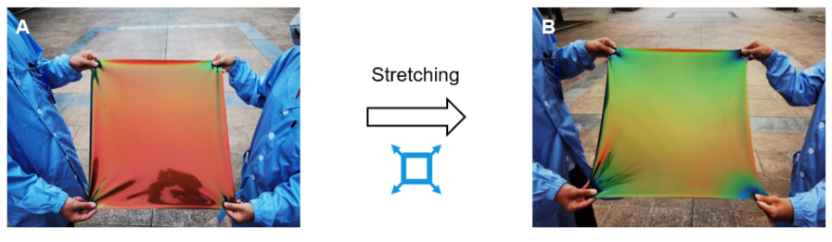
The line turns out robust films about 15 micrometres thick—thinner than a human hair—at roughly 25 metres per minute. Rolls have reached 4,000 metres long and 1.3 metres wide. Outside the narrow band of wavelengths that create the colour, the film stays about 90 percent transparent. It can stretch to twice its length without breaking. Slice it, press the edges together, and the material heals at room temperature in about a minute, recovering strength without glue.
"Making a great sample in the lab and making the same material continuously, at scale, are very different problems," Tian noted. The team had to keep the optical brilliance and the mechanical toughness while the material raced through real machinery. They did.
What the Film Might Do Next
Structural colour that never fades opens quiet, practical doors. On solar panels the film can add cheerful colour while barely touching power output. In sports tape the same lattice shifts hue as it stretches, giving athletes and trainers a quick visual read on strain. Because the monomer-and-particle approach works across a wide menu of everyday chemistries and particle types, the platform is not locked to one recipe.
Scherman captures the wider feeling: the thrill is watching molecular-scale order become kilometres of usable material. This is no longer a bench-top curiosity. It is a workable path to nature’s most striking colour effects on an industrial scale, ready for products people can actually hold.
The hard part was always the disorder-to-order jump under conditions a factory can live with. That jump now happens in seconds, under a gentle shear and a flash of light, and the rolls keep unspooling.
"What's exciting is the link between what's happening at the molecular scale and what we can now do across kilometres of material. This isn't just a lab trick - it's a genuine route to manufacturing nature's most striking colour effects on an industrial scale, for real-world products." - Professor Oren A. Scherman