Dust Thrives Near Chaos
A star that keeps giving
Half a light-year from the supermassive black hole at the heart of the Milky Way is not where you would casually plant a garden. The radiation is fierce, the gravity is unforgiving, and the whole neighborhood has a reputation for stripping molecules to shreds.
Yet one aging star is still sowing seeds.
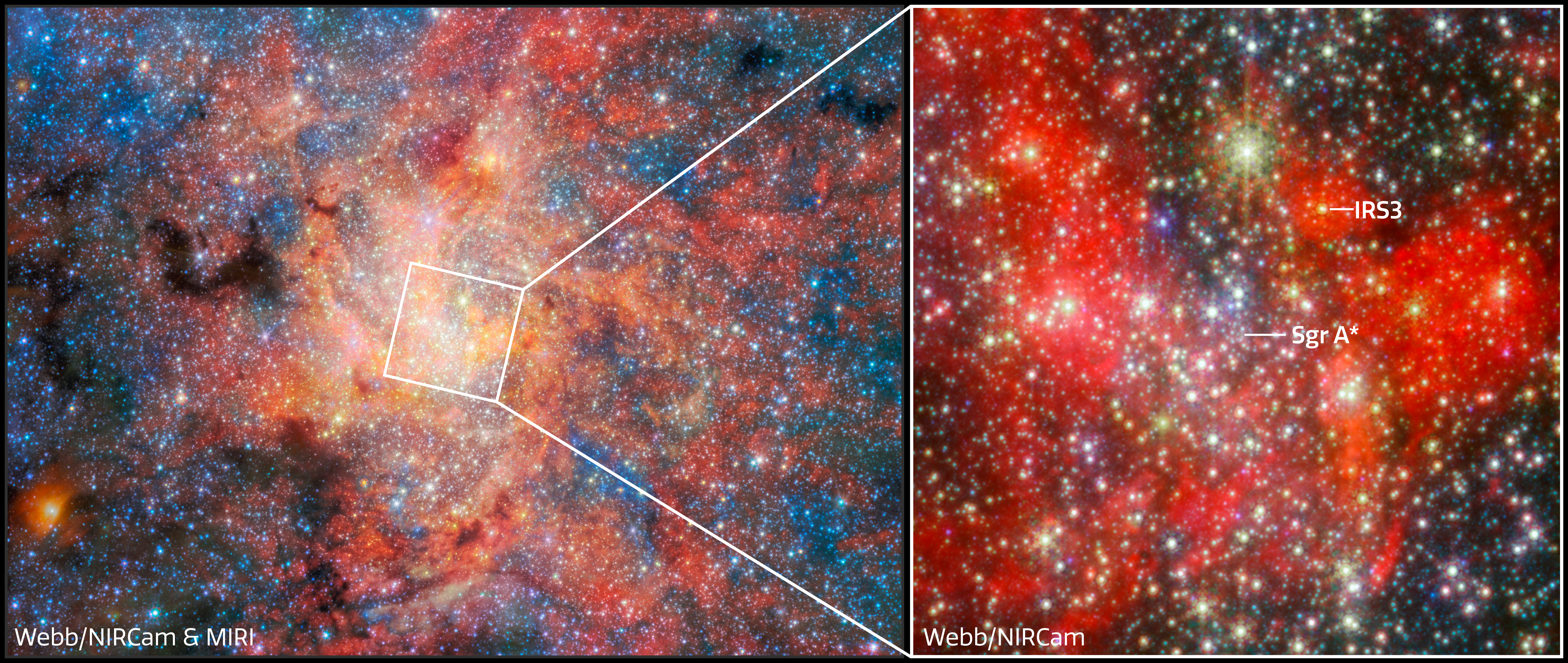
Using the NASA/ESA/CSA James Webb Space Telescope, an international team has shown that the evolved star IRS 3 keeps wrapping itself in fresh dust—and, for the first time clearly detected around this object, water—despite sitting only about 0.55 light-years from Sagittarius A*, our galaxy’s central black hole. The finding turns a long-standing worry on its head: even in one of the harshest corners of the Milky Way, stars near the end of their lives can still enrich the space around them with the raw materials future stars and planets will need.
“Galactic centres are among the most extreme environments, so understanding whether stars can continue enriching their surroundings there is an important question,” said lead author Florian Peißker of the University of Cologne in Germany. “With Webb, we can directly observe how stars behave under these conditions and see that dust production remains remarkably resilient.”
An infrared portrait of a windy elder
IRS 3 has reached the asymptotic giant branch—a late life stage when a star swells into a huge, cool, luminous giant and drives powerful winds that fling gas outward. That shed material is one of the universe’s main factories for cosmic dust. Whether the factory could keep running so close to a supermassive black hole was an open question.
In 2025, as part of the Mid-Infrared Characterisation of Nearby Iconic galaxy Centres (MICONIC) Guaranteed Time Observations programme, Webb’s Mid-Infrared Instrument (MIRI)—its heat-sensing spectrograph that splits light into a continuous rainbow of wavelengths—stared at IRS 3 across roughly 4.9 to 27.9 micrometers. That span is where warm dust and certain molecules write their signatures in light.
Earlier work had hinted the star might be carbon-rich. The new spectrum tells a different chemical story. Two strong infrared features point to silicate dust: grains built from silicon and oxygen, the same family of minerals that help make rocky worlds. The data mark IRS 3 as an oxygen-rich evolved star nearing the end of its life and steadily casting material into space.
“This discovery was possible because of Webb’s highly capable infrared instruments,” said Macarena Garcia Marin of ESA, a co-author and principal investigator of the MICONIC programme. “This is the first time a continuous mid-infrared spectrum has been collected for this star, allowing us to detect the features from the silicate dust and uncover the star’s true chemical identity.”
Shells of grit, a whisper of water
To turn that spectrum into a three-dimensional picture, the team corrected the light for foreground extinction—dimming by intervening dust along the line of sight—using a stellar-based mid-infrared extinction curve. They then fed the cleaned spectrum into Hyperion, a radiative-transfer code that follows how starlight filters through layered clouds of dust. The best-fitting model is a multi-shell envelope of alumina and amorphous silicates: concentric layers of fine mineral grit, more like nested cocoons than a single smoke ring.
The reconstructed envelope stretches roughly 10,000 astronomical units from the star—hundreds of times farther than Neptune sits from the Sun. Temperatures drop from about 1,200 kelvin in the inner zones (hot enough to glow brightly in the mid-infrared) to around 100 kelvin in the outer reaches, where the material is cold and thin.
Within that envelope is a quieter surprise: water absorption. After the spectrum was dereddened, the team identified clear signs of water in the envelope—the first unambiguous detection of its kind for IRS 3.
“The detection of water is especially exciting because it shows that molecular material can survive in an environment dominated by intense radiation,” Garcia Marin said. “This tells us that even close to a supermassive black hole, stars can continue contributing material back into their surroundings.”
Comparing the star with evolutionary tracks—standard road maps of how stars of different masses brighten and cool over time—the researchers estimate IRS 3 is about six times the mass of the Sun and roughly 72 million years old. It appears to be losing mass vigorously, feeding the extended dusty shell Webb now sees in exquisite detail.
What the center still teaches us
None of this claims the galactic center is gentle. It is still a place of intense radiation and wild dynamics. The careful point the observations make is narrower and more hopeful: production of oxygen-rich dust, and the survival of water, are not automatically switched off by proximity to Sagittarius A*. Evolved stars like IRS 3 can keep recycling atoms into grains and molecules that will eventually drift, mix, and—somewhere, someday—help seed new generations of stars and planets.
The work is a single, deeply studied star, not a census of every giant near the black hole. That is exactly why it matters as a proof of concept. If dust and water can hold on here, models of how galactic nuclei build up their dusty reservoirs may need a little more room for resilience.
Webb’s mid-infrared view has turned IRS 3 from a bright puzzle into a working factory in plain sight. In a neighborhood famous for extremes, an aging star is still quietly handing the galaxy its next batch of ingredients—and inviting us to keep watching what else can endure in the glow of the dark heart of the Milky Way.
“With Webb, we can directly observe how stars behave under these conditions and see that dust production remains remarkably resilient.” — Florian Peißker