Forest Playdates
When solitude still needs a social map
Picture a canopy so quiet that adult neighbors barely brush past each other. That is daily life for Bornean orangutans, the most solitary of the great apes. A mother and her dependent youngster may drift through the trees for years with almost no company—yet the youngsters still need rough-and-tumble practice with peers their own size.
A long study at Tuanan Research Station in Central Kalimantan, Indonesia, now shows how mothers quietly solve that puzzle. They do not wait for chance. They reshape their daily routes so their infants can meet suitable playmates, even when the detour means more walking and less eating.
The work, published in the Proceedings of the National Academy of Sciences, draws on nest-to-nest follows of identified mothers and preweaned offspring from 2003 to 2018. Trained observers logged GPS points roughly every half hour and scanned activity and companions every two minutes, building more than 32,000 hours of records across 31 mother–infant pairs.
Kids hit the play button; moms hold the map
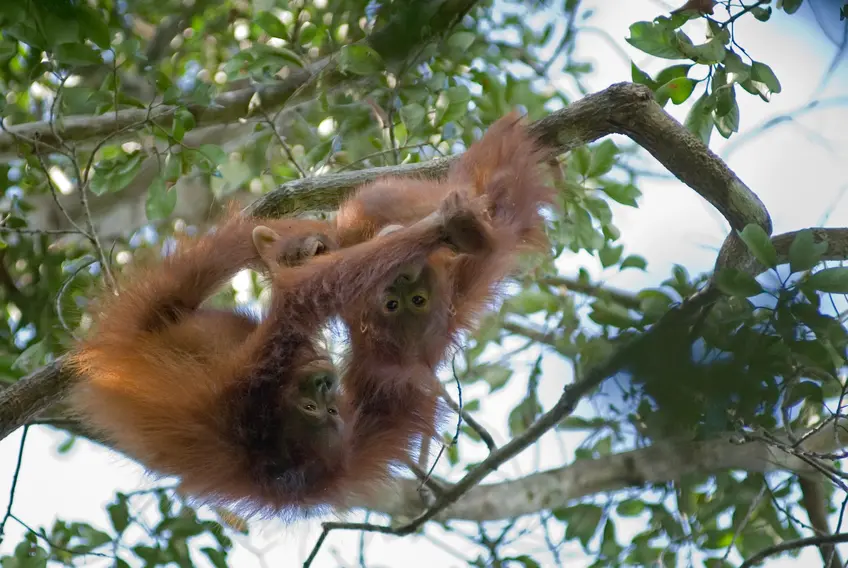
When two mother–infant pairs do meet, the grown-ups keep a respectful distance. The kids do not. They rush in—wrestling, grappling, testing strength—until a mother decides the visit is over. Field leader Maria van Noordwijk, who guided the long campaign while based at the University of Zurich and is now a fellow at the Max Planck Institute of Animal Behavior (MPI-AB), has watched the contrast for years: adults stay careful; infants light up.
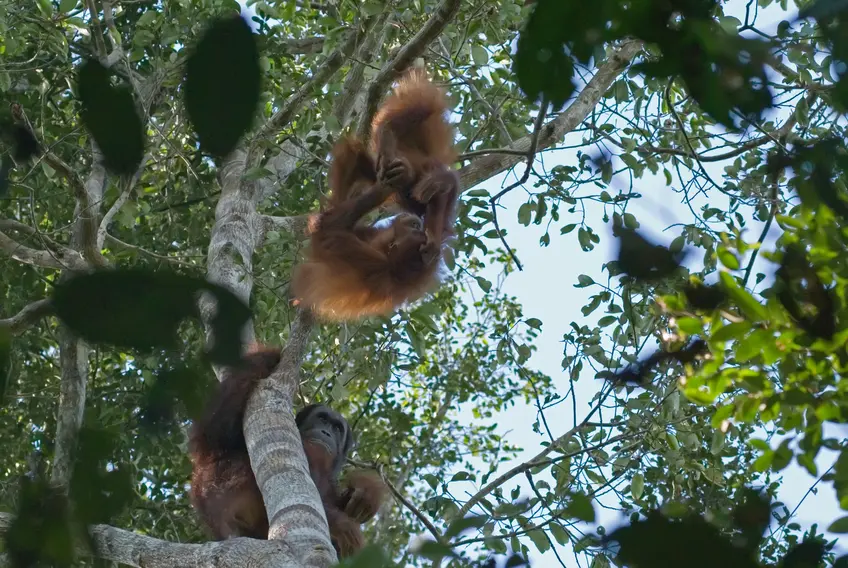
What looked like lucky collisions began to feel patterned. Play days seemed harder on the mothers. The team needed a way to test whether mothers were actively seeking partners for their young, not simply bumping into them while foraging.
Odd T. Jacobson, a postdoctoral researcher at MPI-AB and the paper’s first author, helped supply that test. The group combined continuous-time movement models of home-range overlap and daily path length with Bayesian social-relations and multilevel models. They asked whether age similarity among infants, space use, and energetic costs lined up in ways chance would not predict.
They did. Mothers whose infants were closer in age shared more of the same forest patches, and those infants played together more often—even after the models accounted for relatedness and fruit availability. Mothers, Jacobson notes, appear to match youngsters with partners who are physically and developmentally suitable.
Routes that lean toward friendship
The movement signature is especially telling. On the day before a play meeting, mothers shifted toward the other mother’s core area—the part of the forest she uses most. After the visit, they drifted back toward their own. Path lengths stretched not only on the play day itself but on the days around it.
That pattern reads less like accidental overlap and more like deliberate positioning. Orangutans already navigate a mental map of fruiting trees and travel routes. The new results suggest they fold social information into the same map: who lives nearby, who recently had a baby, and where a useful encounter might happen.
Van Noordwijk frames it as a kind of forest awareness—neighbors known across a lifetime, births noted, positions sensed from the canopy when the chance arises. Solitary days do not mean a blank social slate.
The quiet bill mothers pay
The kindness is not free. On days linked to play, mothers spent more time traveling and less time feeding. In a species that already invests years in a single dependent offspring—youngsters stay close for seven years or more—this is an extra layer of maternal work: food and safety, plus the social spark peers provide.
The appointments themselves stay rare. Peer play showed up on only about six percent of follow days, roughly once every twenty days, and usually added up to around twenty minutes total when it did occur. The researchers are careful not to claim a proven payoff later in life. Whether those short bouts of grappling translate into stronger adults remains an open question—one only continued tracking across decades can answer, as coauthor Sri Suci Utami Atmoko of Universitas Nasional emphasizes.
Still, the pattern itself is hopeful. Even in a lifestyle built around solitude, mothers invest scarce energy so their young can practice the social muscle group living hands out for free. Collaborators from MPI-AB, the University of Zurich, Universitas Nasional, and Rutgers University turned patient field notes into evidence that ranging is not only about calories; it can be about company.
A wider echo under the canopy
Meg Crofoot, a coauthor and director at MPI-AB, draws a gentle human parallel: we evolved to raise children among many hands, yet modern routines can shrink that circle. Orangutans show what happens when contact is scarce—someone still has to carry the cost of making it possible.
For now, the canopy holds a softer lesson. Loneliness is not the whole story of the loneliest ape. Mothers keep a living directory of neighbors and, at real personal expense, walk their infants toward the next brief, joyful tangle of limbs. The forest is quieter than a troop of monkeys, but it is not empty of care—and the next stretch of long-term watching may yet reveal how those hard-won play minutes ripple through a life that unfolds so slowly, branch by branch.