Jonathan's Steady Genetic Glow
A contemporary of Darwin, still going strong
Think of every birthday cake you have ever blown out. Now stack nearly two centuries of them. That is the span Jonathan has quietly occupied on this planet.
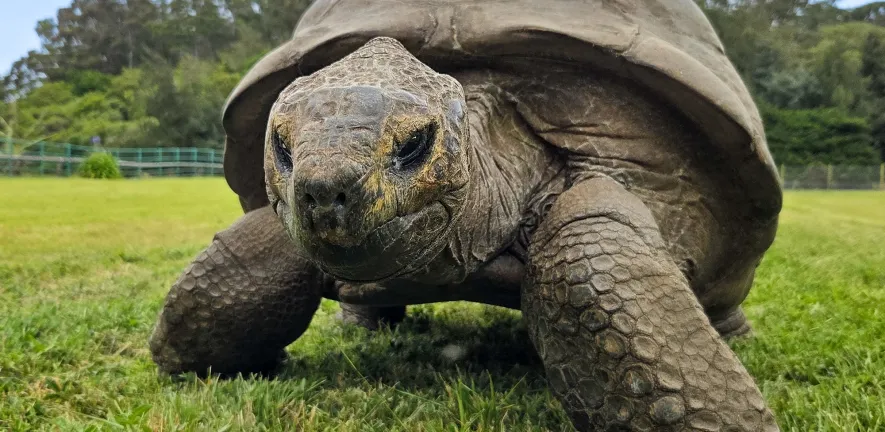
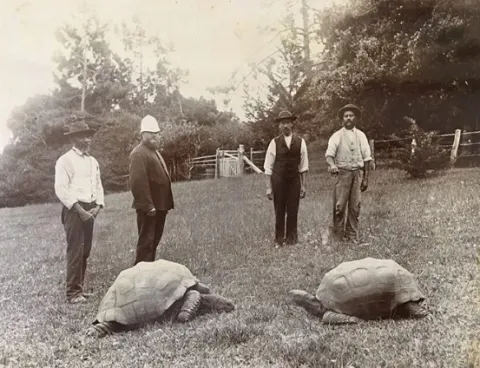
Jonathan is an Aldabra giant tortoise—Aldabrachelys gigantea—thought to have hatched around 1832. That puts him in the same era as Charles Darwin and Queen Victoria. Today he is estimated at 194 years old, the oldest living giant tortoise and the oldest land animal known. He has spent most of that long stretch on the island of St Helena, in the grounds of Plantation House, after arriving from the Seychelles in 1882 as a fully grown gift to the governor.
What keeps a body upright and curious for that long? A new study in Science Advances suggests it is not only a lucky set of genes, but genes that refuse to fray—and the molecular switches that keep them humming in a surprisingly youthful pattern.
Not just genes—the switches stay young
Researchers led by the longevity nonprofit Kallel, working with collaborators including Dr. Justin Gerlach of Peterhouse at the University of Cambridge, set out to read Jonathan’s genome and his epigenome. The epigenome is the collection of chemical tags that act like dimmer switches on DNA: they turn genes up or down without rewriting the genetic code itself. In most animals those switches drift with age, and that drift is one reason older bodies start to struggle.
Because a blood draw was not an option, the team gently collected cheek scrapes and saliva. After attempts to isolate very long DNA strands fell short, they sequenced Jonathan’s genome with short-read methods and compared it with other giant tortoises. They also measured DNA methylation—the chemical “off” marks that help set those dimmers—across Jonathan and four other Aldabra tortoises ranging from a five-year-old to older adults.
The picture that emerged was striking. The team pinpointed 287 unique gene variants in this remarkably long-lived tortoise. Those variants touch processes that usually wear down with time: repairing damaged DNA, dialing down inflammation, regulating insulin, and helping suppress cancer. In other words, the genetic toolkit leans hard toward cellular housekeeping and resilience.
Even more eye-catching was the epigenome. The switches controlling Jonathan’s DNA-repair and metabolism genes looked very much like those in his younger relatives. Usually those patterns shift as years pile up. In Jonathan, the regulators tied to energy production and DNA repair had stayed incredibly stable across nearly two centuries.
“We found that the gene regulators involved in energy production and DNA repair have remained incredibly stable in Jonathan over almost two centuries,” Gerlach said. This is the first time scientists have mapped a giant tortoise’s epigenome in this way, so the comparison offers a rare baseline for what extreme stability can look like.
A collaborator with a shell
Gerlach has spent decades on the ecology and conservation of giant tortoises; studying the architecture of their long lives is newer ground for him, and the tone of the work is almost companionable.
“There are few creatures that could tell us more about ageing than the giant tortoises of the Galapagos and Seychelles islands,” he noted. “Working with a really old giant tortoise is such a privilege: you get a sense of the tortoise being your collaborator, not your study subject.”
Senior author Stephen Clark, founder of Kallel, frames Jonathan’s genome as something nature already perfected. “Nature has already solved the puzzle of ageing in remarkable ways, and Jonathan’s genome provides a blueprint for cellular resilience,” he said. The group’s longer aim is to carry evolutionary clues toward practical, affordable approaches that people might one day use—ageing being a major risk factor for many chronic diseases—while leaning on philanthropic support to widen access. That translation is a goal, not a finished medicine; the present study is a careful reading of one extraordinary animal and his kin.
What the findings do—and do not—claim
Honesty keeps the wonder intact. The work centers on one famous tortoise and a small comparison group of the same species. The samples came from the mouth, not blood, and the sequencing depths were modest by modern standards. The 287 variants and the stable epigenetic patterns are powerful clues about how a body might resist the usual wear of time; they are not a ready-made human therapy, and the researchers treat them as a blueprint rather than a finished map.
Still, the direction of the evidence is hopeful. Giant tortoises of the Galapagos and Seychelles are the last survivors of lineages that once shaped many island ecosystems. Their sturdy repair machinery and this documented molecular steadiness suggest evolution has already stress-tested strategies for lasting. Jonathan simply offers the longest continuous case study still walking the lawn.
Funded by the Voland Fund, the project leaves a clean next question hanging in the air: which of these stable switches and protective variants matter most, and can any of them be gently echoed in other species? For now, the quiet thrill is simpler. A tortoise who shared the sky with Darwin still carries gene regulators that look almost young—and scientists have finally been invited, cheek swab by cheek swab, to see how the lights stayed on.
"Working with a really old giant tortoise is such a privilege: you get a sense of the tortoise being your collaborator, not your study subject." — Justin Gerlach