Light-Grown Foam Prints
Nature has been foaming things for a very long time. Bones. Banana peels. The brilliant white scales of certain beetles. Those materials scatter light or shed water not because someone painted them, but because their internal architecture is full of tiny pores arranged just so.
A team at Kyoto University’s Institute for Integrated Cell-Material Sciences has borrowed that idea and turned it into a printing method. They call it deep-foam photolithography. Shine the right light on a photosensitized polymer film, dip it in a mild solvent, and the film swells into a foam you can pattern at extraordinary resolution—about 20,000 dots per inch. White and greyscale appear without a drop of ink. Push the process a little further and the foam collapses into a surface as water-shy as a lotus leaf.
How a Film Learns to Foam
The recipe starts simple. Researchers mix an ordinary polymer—polystyrene is a favorite, though polycarbonate, PET, cellulose triacetate, and several others work too—with a photoinitiator such as thioxanthone. That molecule absorbs UV-A light, the longer-wavelength ultraviolet that can travel deep into the film rather than stopping at the surface.
Exposure does two things at once. Some polymer chains break apart (scission). Others link into a loose network (crosslinking). The result is a film that still looks solid but is chemically primed for change throughout its thickness—not just a skin-deep skin.
Then comes the developer: a weak solvent such as acetic acid. Water-like osmotic pressure drives what polymer scientists call case II permeation—a sharp front of solvent that advances steadily rather than seeping diffusely. Behind that front, polymer fragments dissolve locally while the crosslinked scaffold holds shape. Pores nucleate, expand, and, if the team chooses, undergo a controlled viscoelastic collapse. Think of bread dough that can either rise into a soft sponge or be gently pressed into a textured crust.
Because the light dose and development time are tunable, so are the pores. Expanded foams scatter light the way beetle scales do, producing bright structural white and smooth greys. At the finest scales the patterns even diffract—splitting white light into color the way a compact disc does, no pigment needed.
Texture You Can Touch and Guide
Collapse is not failure; it is another design knob. When the foam is allowed to settle in a controlled way, it leaves hierarchically rough surfaces. Water beads and rolls off—super-hydrophobicity reminiscent of lotus leaves. Pattern those regions beside unfoamed or differently foamed zones and you can steer tiny droplets, trap picolitres of liquid, or capture colloidal particles with microscopic precision.
The same chemistry works on flexible sheets and on electrospun fibres. Films on polypropylene can be bent and still keep their printed patterns. Fibrous mats foam from the outside in, opening routes to patterned textiles or soft scaffolds. Aspect ratios reach roughly twenty to one: tall, slender foam features standing proud of the surface.
Lead work came from Detao Qin and Easan Sivaniah’s group, with optical studies, fibre experiments, and specialised microscopy shared across Kyoto collaborators and partners in Shanghai. They mapped bubble sizes in three dimensions with focused-ion-beam slicing and watched the solvent front advance in real time under a confocal microscope—the kind of careful watching that turns a pretty effect into a controllable platform.
What It Is—and Is Not—Yet
This is a materials platform demonstrated in the lab, not a factory line. Energy doses, photoinitiator loadings, and development temperatures still need matching to each polymer and each desired texture. The team has shown the method across amorphous and semi-crystalline plastics and with several photoinitiators that absorb in the 300–400 nm window, which is encouraging breadth, not finished product design.
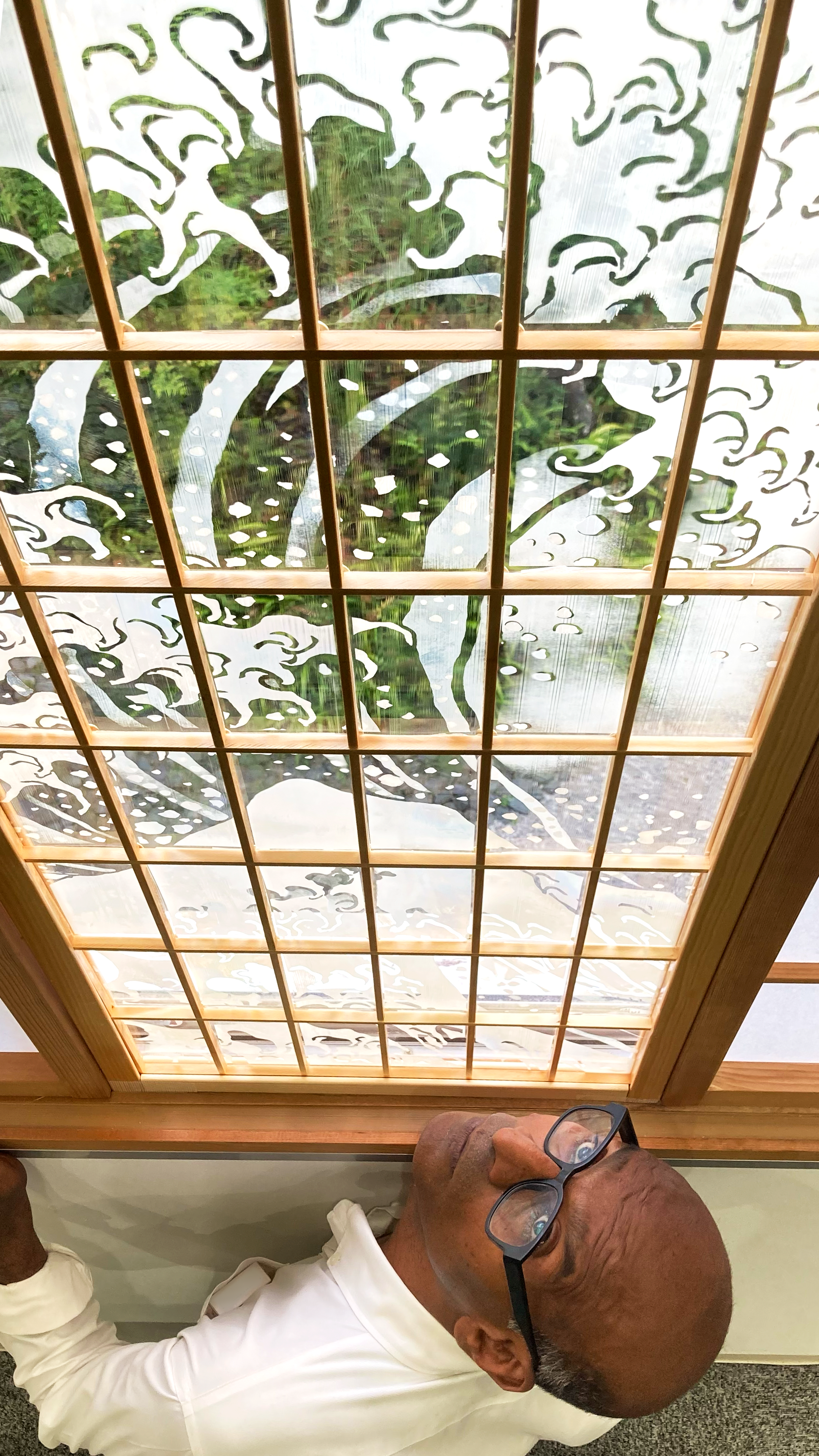
Still, the palette is already rich: inkless high-resolution graphics, greyscale without toner, structural colour from diffraction, microfluidic channels written by foamability itself, and surfaces that repel or capture liquid on command. All of it grows from light, a polymer film, and a gentle solvent—echoing the quiet engineering nature has practised in bones and peels for ages.
Next steps look like any good craft: finer masks, larger areas, smarter combinations of expand-and-collapse, and the patient work of matching foam architecture to real devices. The wonder is already visible under the microscope—a polymer that, given light and a little time, learns to breathe.
"Nature creates a diverse range of foam-like materials… through a rich orchestration of physical and biochemical processes across hierarchical length scales." — from the research team’s framing of deep-foam photolithography
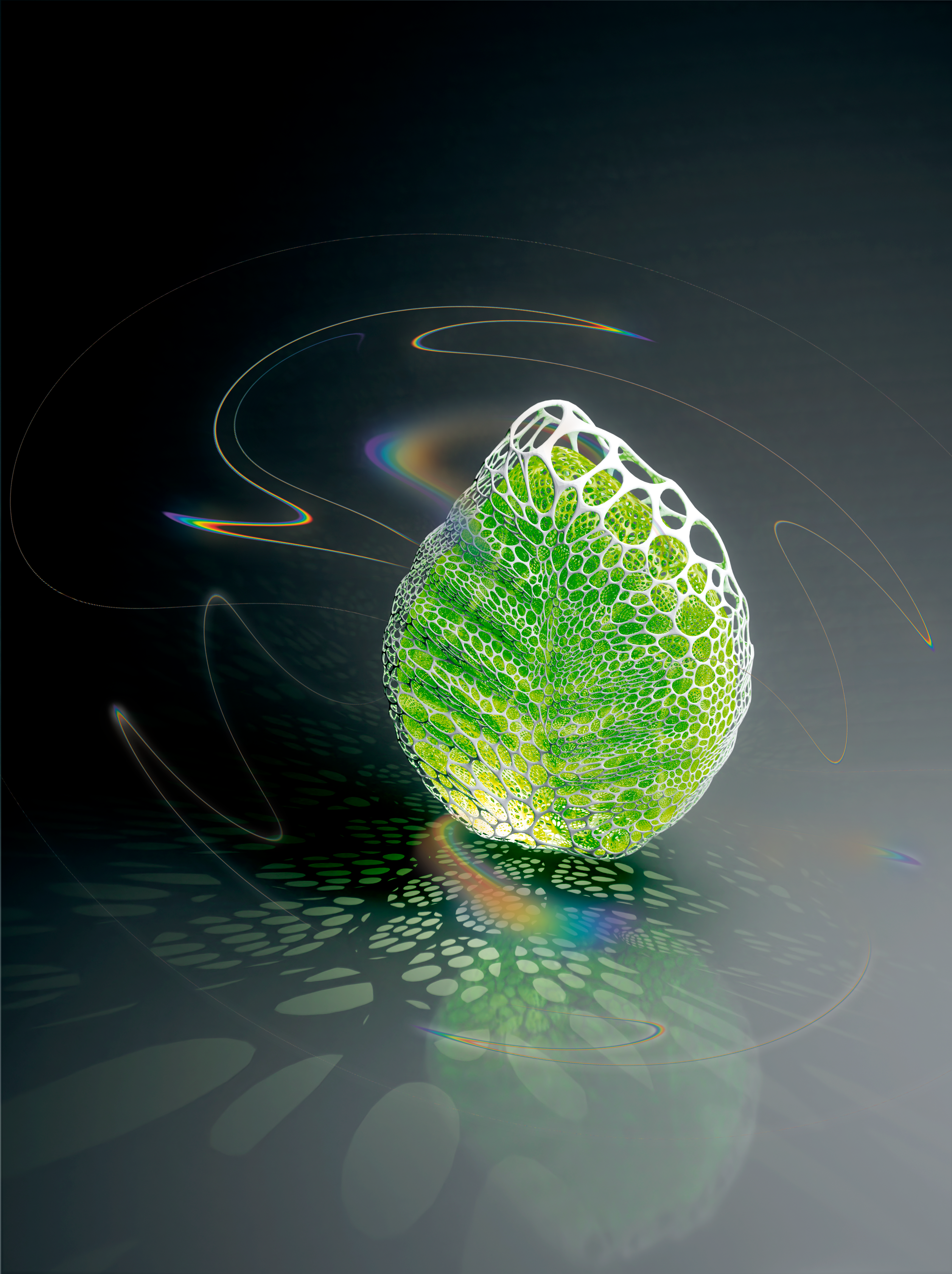 Biomimetic structures transform light into colour, revealing hidden material potential. Blender 3D and Photoshop compositing.
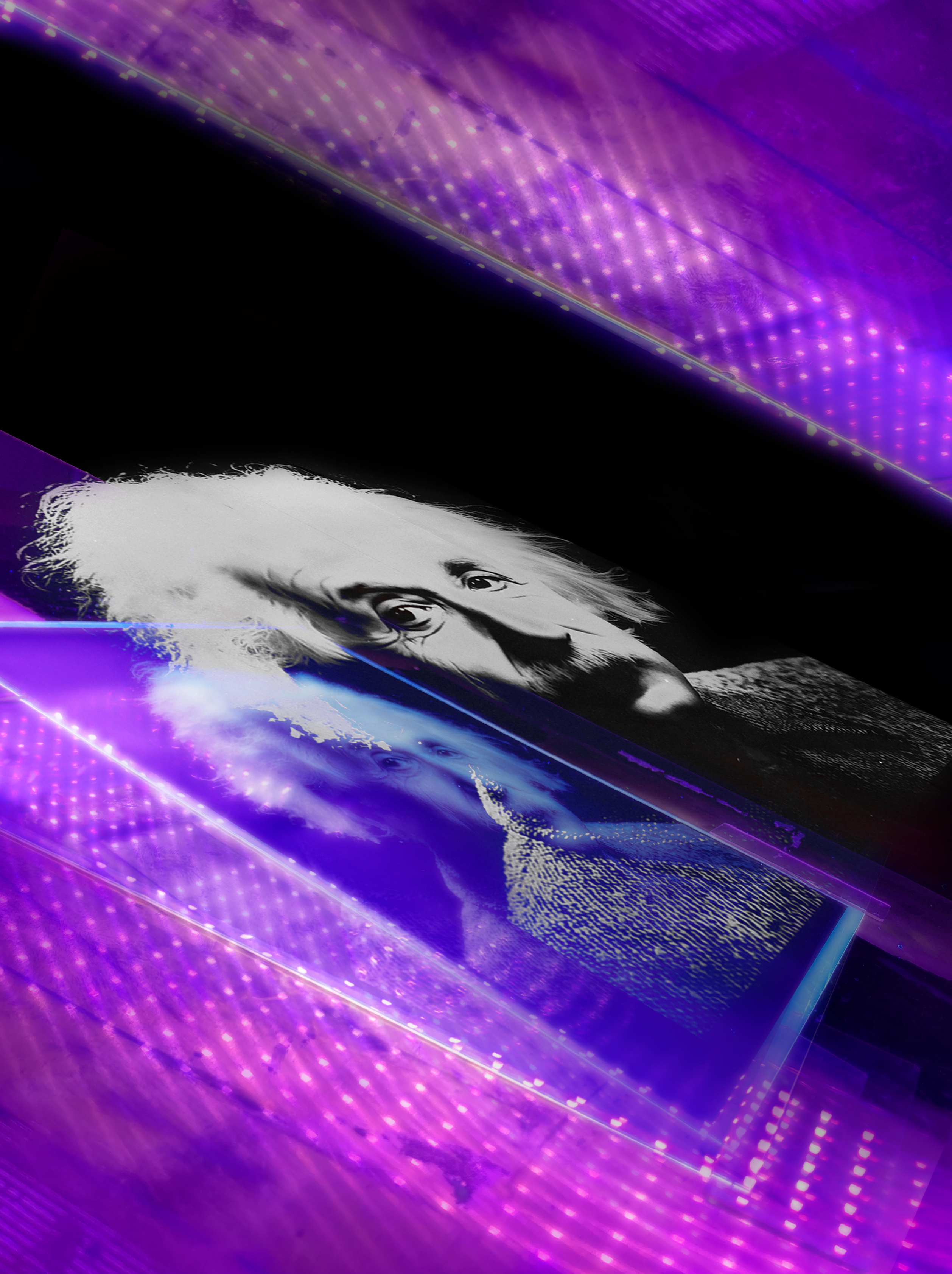 Einstein portrait created with DFP technology, transforming light into matter. Canon EOS 1200D and Photoshop compositing.