Soft Links Smarter Lattices
Letting tiny building blocks choose their neighbors
Imagine trying to build a sculpture from sticky beads that only want to clump into the same tight ball every time. That, in a nutshell, has been the frustration of scientists working with nanoparticles—tiny particles whose custom shapes and sizes already power ideas in energy storage, drug delivery, sensing, and computing. The particles themselves are wonderfully tunable. The networks they form when they link up? Much harder to direct.
A team including researchers at MIT has flipped a long-standing rule of the field. Instead of forcing rigid, carefully aimed connectors between particles, they made the connectors almost absurdly pliable. Those soft links reorganize on their own as particles meet, and that spontaneous reshuffling turns out to be enough to control how many neighbors each particle can claim. The result, reported in Nature Materials, is a practical route to nanoparticle superlattices—ordered crystal-like arrays of particles—with structures that had not been seen before.
“People are interested in nanoparticle superlattices because of the promise of building designer materials where you have more say in what types of structures they can actually build into,” says Rob Macfarlane, the Richard P. Simmons (1953) Professor in Metallurgy in MIT’s Department of Materials Science and Engineering. The new method, he notes, runs against two decades of conventional wisdom that flexible connectors would doom assembly.
Why packing has been so stubborn
In materials science, structure steers function. Know the building blocks and how they sit next to one another, and you can begin to explain—and design—a material’s properties. Nanoparticles are appealing blocks because chemists can dial their size and surface chemistry with real precision. Yet once many particles gather, they tend to pack densely. Dense packing is not always what you want for photonics (technologies that guide and manipulate light), chemical catalysis, medicine, or agriculture, where more open or differently coordinated networks can unlock better performance.
Earlier strategies tried to break that habit by sculpting particle shapes or by making only certain patches of a particle’s surface “sticky.” Both tactics need connector molecules—ligands, polymer chains grafted to the particle surface—to stay stiff and point in fixed directions. Those approaches are often hard to scale, and they tend to be one-off recipes that work for a single material, size, and set of conditions.
Macfarlane’s group asked what would happen if they did the opposite: make the bonds so flexible that their starting orientation barely mattered.
Charged, bendy arms that find their own balance
The nanoparticles in the new system wear coronas of flexible ligands tipped with electric charge—some positive, some negative. Opposite charges attract, so the soft arms bend and reach until stable links form. Rather than programming exact bond angles in the lab, the team lets the ligands reconfigure during assembly. That reorganization itself caps how many partners each particle can keep: a spontaneous form of valency, the effective number of bonds a particle makes.
In experiments led by MIT PhD candidate Nicholas Sbalbi, the researchers showed they could tune those connections simply by changing nanoparticle sizes and ligand chain lengths. Size- and graft-matched systems helped them vary how deformable the ligand shells were. Wide-angle X-ray scattering, including synchrotron measurements at the Advanced Photon Source, confirmed that polyethylene glycol (PEG)—a common flexible polymer used in the ligand arms—aligns at the interfaces where particles meet. Molecular dynamics simulations and theoretical modeling, developed with collaborators including Stephen Kronenberger and former University of Delaware professor Arthi Jayaraman, tied that ligand reconfiguration to lower lattice coordination and the emergence of new superlattice geometries.
“Without having to predesign where the particles connect or what their shapes are, we can control the number of bonds each particle has,” Macfarlane explains. Flexibility of the polymer, not a rigid blueprint, sets the bond count—and that freedom produced lattices the team had never observed.
Co-authors on the work include MIT undergraduate Hana Shinzawa and Matthew Ye, along with the Delaware collaborators. Support came in part from the National Science Foundation, the Department of Energy, and the U.S. Army and Navy, with facilities at MIT.nano contributing to the experimental effort.
From lab lattices toward useful materials
The advance does not instantly ship a finished photonic chip or catalyst off the bench. It is an assembly strategy—a new dial on the control panel—rather than a finished device. Still, it chips away at a gap the field has talked about for years: truly independent control over what a particle is and what architecture it settles into. In practice, those two choices have remained tangled. Soft, electrostatically guided ligands loosen that knot.
By encouraging less dense formations instead of maximal packing, the approach points toward the open, lower-coordination arrangements where many promising applications live. Photonics may benefit from lattices that steer light in fresh ways; catalysis from particle networks that expose more active surface; medicine and agriculture from architectures that carry or release cargo with finer spatial order.
Macfarlane frames the finding with quiet excitement about the tool itself. “It’s exciting to have a new tool that is so counterintuitive,” he says. After years of insisting connectors stay rigid, cranking flexibility to the extreme worked just as well—and, in important ways, better.
The next steps are the familiar, hopeful ones of materials research: map which size-and-length combinations yield which lattices, fold in a wider palette of particle cores, and test how the new architectures behave when light, molecules, or biological environments push back. For now, the lesson is delightfully simple. Sometimes the smartest way to organize the very small is to stop forcing the joints and let soft, charged arms find a stable grip on their own.
"We showed if you just crank it all the way to the opposite extreme, it works just as well." — Rob Macfarlane
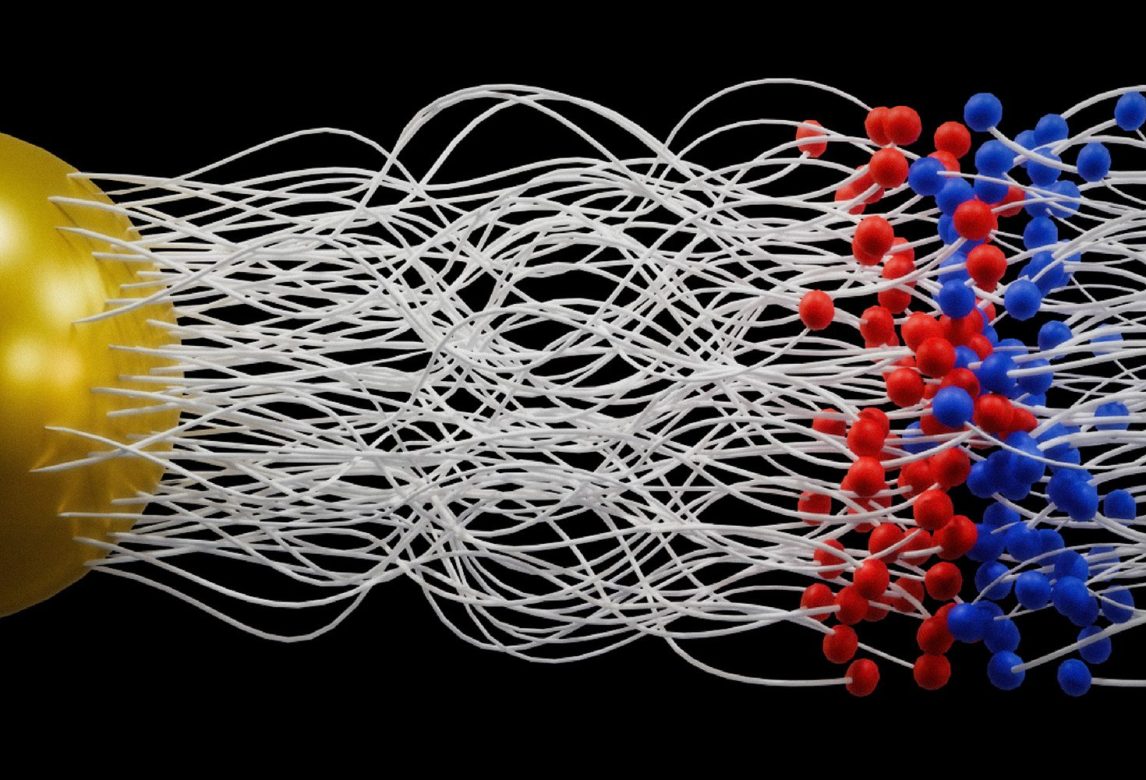 The process of turning nanoparticles into useful new materials has been hampered by the difficulty of controlling the number and direction of the links between each particle and its neighbors. Researchers showed they could control the connections by changing the nanoparticle sizes and ligand chain lengths.
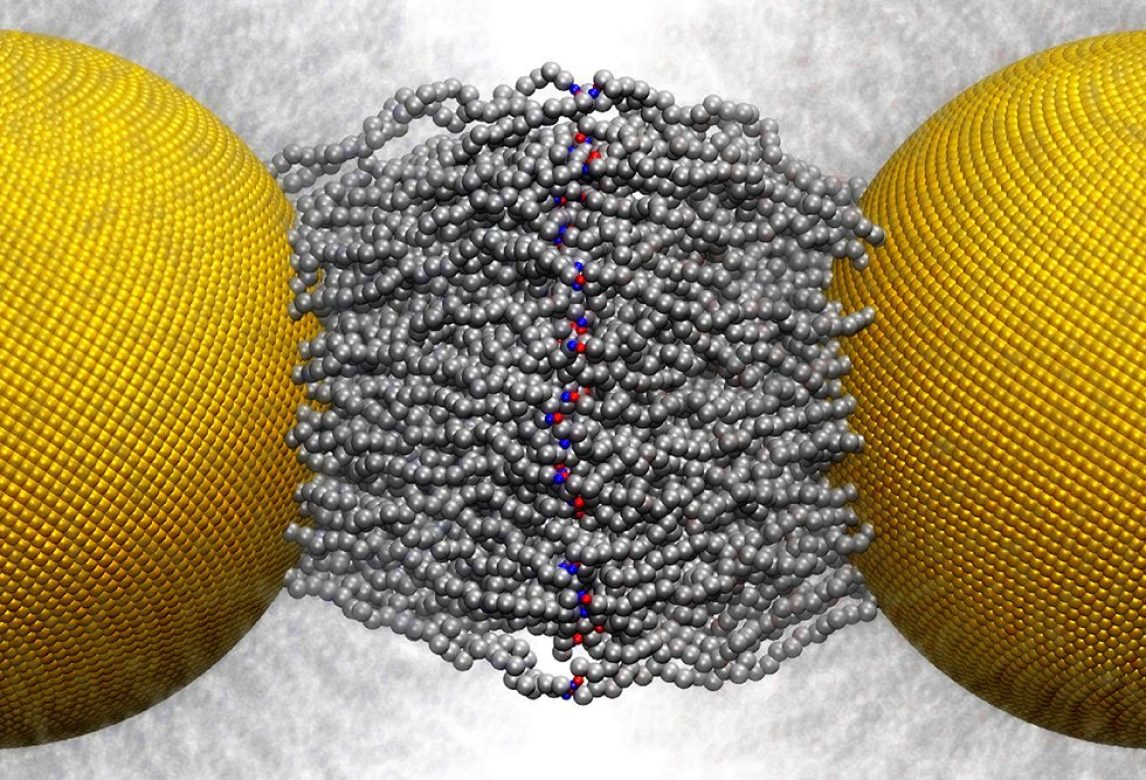 MIT researchers developed a new way to control how nanoparticles come together to create high-performing materials for photonics, chemical catalysis, medicine, agriculture, and more.