The Sun's Secret Whirlpools
Miniature Swirls at the Edge of Boiling Light
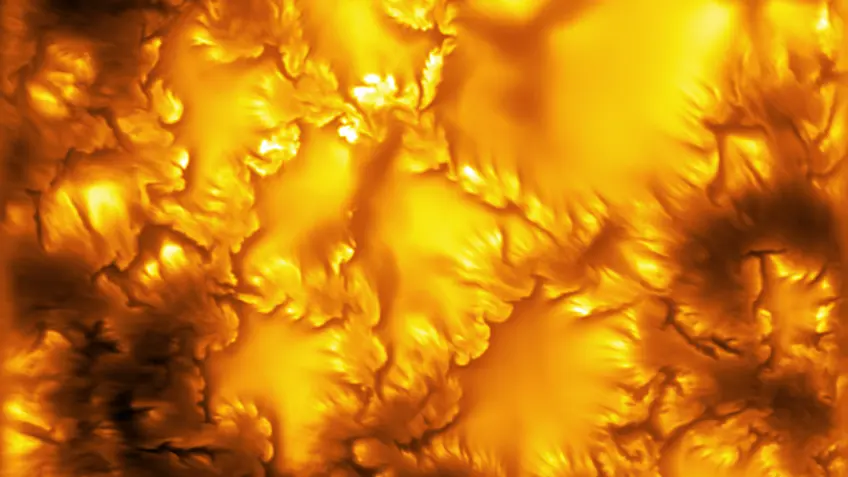
Picture a pot of oatmeal just coming to a simmer. Bubbles of hot porridge rise, spread, and sink in a restless mosaic. The Sun's visible surface does something similar, only with plasma—superheated, electrically charged gas—and the bubbles are vast. Those rising cells are called granules, and they tile the solar surface like a living honeycomb.
For the first time, astronomers have watched the thin edges of those granules fray into tiny whirlpools. Some of the swirls span little more than twenty kilometers. Spotting them is roughly like picking out a coin from nearly two hundred kilometers away. The images come from the NSF Daniel K. Inouye Solar Telescope in Hawaii, working with researchers at the National Solar Observatory, the Max Planck Institute for Solar System Research, and the High Altitude Observatory.
Seeing What Was Always There
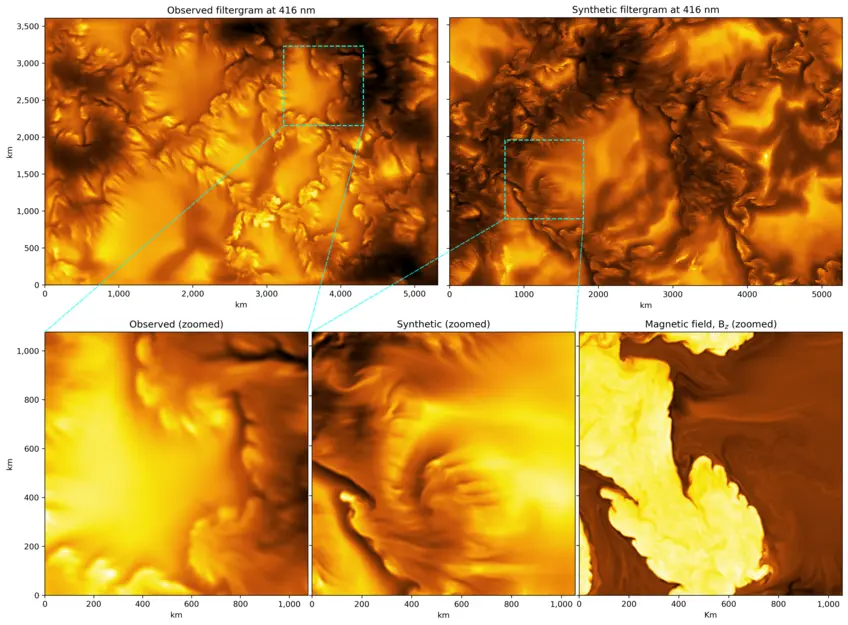
The team pointed a broadband FastCam imager at 416 nanometers toward an active region near a sunspot. The telescope reached roughly nineteen-kilometer resolution—sharp enough to catch fringe-like structures along granule boundaries. Those fringes repeatedly curled into swirling motions that look a lot like ocean waves beginning to break.
"To detect the vortices, we needed to resolve structures on the solar surface about 20 kilometers in size. That is at the limit of what even the world's largest solar telescope and state-of-the-art simulations can achieve," said Michiel van Noort of the Max Planck Institute, who helped with the observations and the painstaking image restoration.
The same patterns appeared in high-resolution computer models. Scientists ran radiation magnetohydrodynamics simulations—calculations that track how plasma, light, and magnetic fields dance together—using the MURaM code at a fine 3.2-kilometer grid. Measured wavelengths, growth rates, and apparent speeds lined up between the real Sun and the virtual one, and both matched the predictions of classic fluid theory.
When Layers Slip Past Each Other
The culprit is a familiar process with a long name: Kelvin–Helmholtz instability. Imagine two streams of air or water sliding past each other at different speeds. Shear at the boundary turns small ripples into rolling waves and then into vortices. You can see the same pattern in breaking ocean swells, in certain cloud streets, and even in the striped atmospheres of Jupiter and Saturn.
On the Sun, neighboring sheets of plasma along granule edges appear to move at different velocities. That shear is enough to spin up the newly seen whirlpools. Because the vortices keep forming wherever the magnetic field is strong enough, they offer a steady, local way to twist magnetic field lines.
Think of those field lines as invisible rubber bands threaded through the plasma. Twist them enough and they store energy the way a tightly wound spring does. When the configuration finally snaps, the lines break and rejoin in a new arrangement—a process called magnetic reconnection. The sudden release can power tiny brightenings known as nanoflares, the small cousins of the larger eruptions that sometimes buffet Earth.
One long-standing puzzle has been what does the twisting in the first place. These continuous little eddies may supply part of the answer.
Mixing That Moves Magnetism
The whirlpools do more than spin. They are remarkably good at stirring magnetized plasma together with plasma that carries little field. That mixing can loft magnetic flux upward into the solar atmosphere far more efficiently than many earlier models allowed.
The Sun's magnetic framework rearranges on an eleven-year cycle—blink-of-an-eye speed by cosmic standards. For the cycle to run that fast, magnetic flux has to escape and redistribute through the atmosphere with surprising ease. The newly identified vortices give theorists a concrete, observable process that could help close the gap.
None of this means every detail of solar storms is suddenly solved. The observations focus on one active region and the matching simulations; researchers still need to map how common the eddies are across quieter stretches of the Sun and how their influence scales from nanoflares up to larger events. Those open questions are the natural next steps, not dead ends. The fact that both telescope and simulation now resolve the same tiny physics is itself a quiet triumph.
Small Motions, Big Character
Sami K. Solanki, director at the Max Planck Institute and a co-author of the Nature paper, put the discovery in perspective: the plasma vortices show how minute processes—at the very limit of what current tools can see—help shape the nature of our star.
Every clear morning the Sun still rises looking smooth and serene. Now we know its surface is fretted with countless miniature whirlpools, endlessly braiding magnetic threads and shuffling energy skyward. The largest telescope ever built for solar work has simply handed us a sharper pair of eyes. What other quiet choreography is waiting just beyond the next improvement in resolution?
"The newly discovered plasma vortices impressively demonstrate how minute processes—at the limit of what we can resolve using all available techniques—significantly determine the nature of our star." — Sami K. Solanki