A Star That Feels Spin
A whisper from the galactic core
Right at the heart of our galaxy sits Sagittarius A*—a black hole packing about 4.3 million Suns into a region smaller than Mercury’s orbit. For years, astronomers have watched nearby stars loop around it like test particles, using their paths to weigh the black hole and confirm that gravity behaves as Einstein predicted.
Now a far fainter traveler has joined the cast. The GRAVITY+ Collaboration, working with the Very Large Telescope Interferometer in Chile, has uncovered a star called S301. It is dim (magnitude 19.3 in the near-infrared K band), ordinary in mass, and racing on an extraordinarily tight, lopsided orbit. That combination makes its motion sensitive to something previous stars could not cleanly reveal: the black hole’s spin.
Catching a faint, fast neighbor
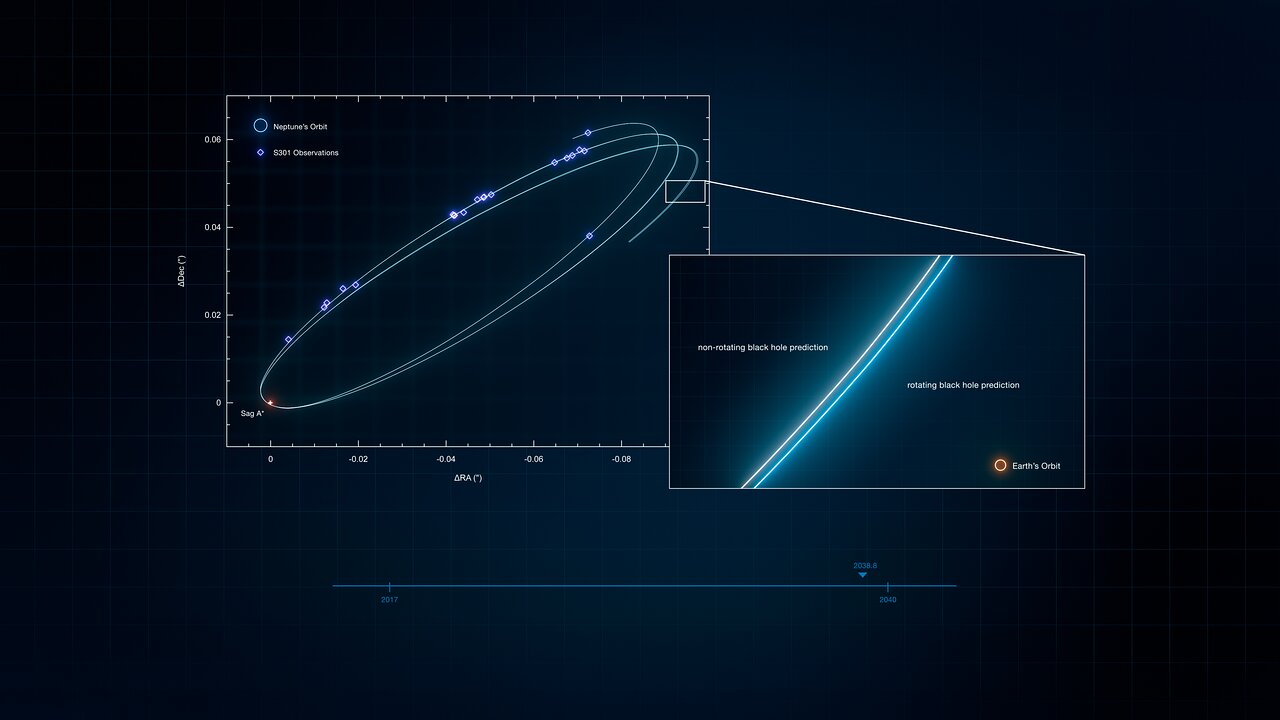
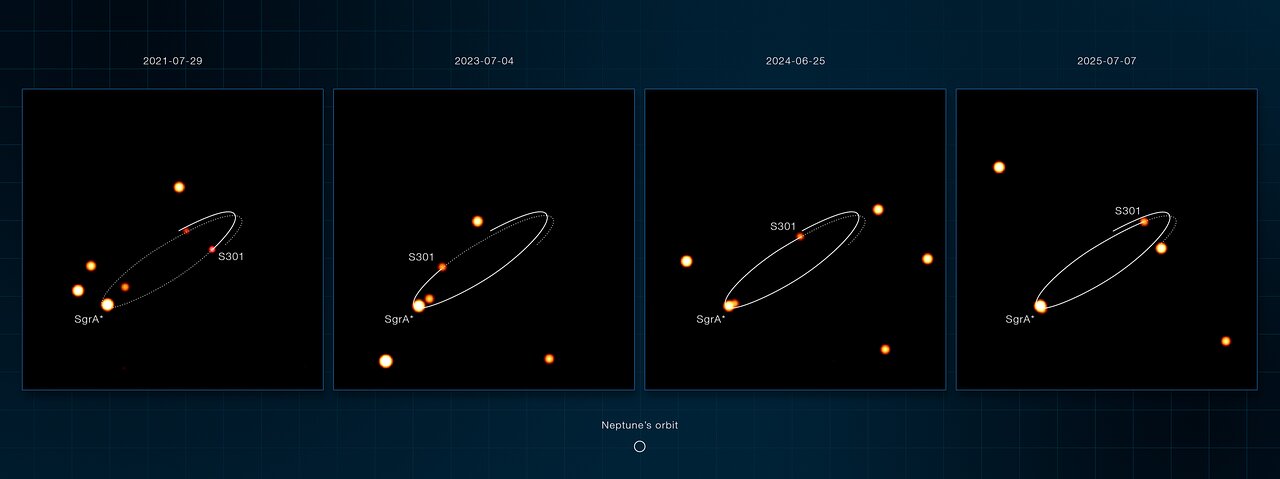
Since 2017 the team has pointed the GRAVITY instrument at the crowded central arcsecond around Sagittarius A*, collecting complex interference patterns—visibilities—from six telescope baselines. Most nights the goal was simply to keep tracking known stars. In spring 2023, image reconstructions turned up a new speck roughly 15 milliarcseconds northwest of the black hole. Over the following months it drifted outward; dedicated pointings in 2024 and 2025 locked in more positions. Tracing the orbit backward recovered weak detections in 2021 and 2017 as well. Nineteen precise locations later, the path snapped into focus.
S301 completes one lap every 8.7 years—the shortest confirmed stellar period around Sagittarius A*. Its semi-major axis is only 83 milliarcseconds, and its eccentricity sits near 0.983. At closest approach the star skims just 136–142 Schwarzschild radii from the black hole (one Schwarzschild radius is the size of the event horizon for a non-spinning black hole of this mass). Peak speed hits about 25,000 kilometers per second—more than 8 percent the speed of light.
Think of it as a pebble flung almost into the drain of a cosmic whirlpool, then flung back out again. Because the swing-by is so deep, the familiar relativistic corrections already measured with the famous star S2 become dramatically stronger. The orbit itself precesses by nearly two degrees every revolution simply from the curvature of space-time around a non-spinning black hole—the Schwarzschild effect. On top of that sits a subtler twist that depends on whether the black hole itself is rotating.
Why spin leaves a fingerprint
In Einstein’s theory a black hole is almost featureless: mass, spin, and (usually negligible) charge. Spin drags the surrounding space-time along with it—an effect called Lense–Thirring precession, or frame-dragging. The extra wiggle falls off steeply with distance, which is why most stars are insensitive to it on human timescales. For S301 the in-plane contribution reaches roughly 0.11 degrees times the dimensionless spin parameter per orbit. That is comparable to the Schwarzschild precession already detected for S2, yet it arrives on a much shorter orbital clock.
Current near-infrared interferometry and the coming generation of extremely large telescope spectrographs are poised to catch the difference. Mock data that extend today’s measurements through 2035, assuming realistic precision of about 100 microarcseconds and future radial-velocity accuracy near 1 km/s, suggest the spin magnitude could be constrained to better than 0.2—and its orientation to roughly ±30 degrees—if the black hole is spinning vigorously and the geometry is favorable. Other S-stars will keep tightening the mass and distance of Sagittarius A*, reducing degeneracies, while their longer orbits help separate genuine frame-dragging from gentle Newtonian nudges by unseen stellar-mass black holes nearby.
The researchers are careful: a full spin measurement will eventually need higher-order relativistic modeling, and an extended mass distribution could mimic some signals. Still, the phase signature of Lense–Thirring precession peaks near pericenter, whereas stellar perturbations tend to show up more near apocenter. Nature has handed observers a natural filter.
An ordinary star with an extraordinary past
S301 is almost certainly a main-sequence star of early F type, mass between about 1.1 and 1.5 solar masses, radius roughly 1.4–1.6 solar radii. That makes it too compact to have been shredded at pericenter; a giant would have begun losing its envelope. No continuum or spectral features have yet been pulled from existing integral-field data, so radial velocity remains unknown and two mirror-image orbital orientations are still allowed. Future spectroscopy with the Extremely Large Telescope’s MICADO instrument should easily pick up the expected Brackett-gamma absorption line and settle the three-dimensional geometry.
How did such a star end up on so extreme an orbit? Star formation this close to a supermassive black hole is nearly impossible. The high eccentricity is a natural calling card of the Hills mechanism: a compact binary wanders too near Sagittarius A*, the black hole rips the pair apart, one star is captured on a tight, highly eccentric path, and its companion is flung outward as a hyper-velocity star. The present semi-major axis implies the original binary was only about 0.1 astronomical units across—common among F-type stars and likely already tidally circularized. If S301 still remembers that spin, its equatorial rotation could reach 20–70 km/s, a prediction future high-resolution spectra can test.
Dynamical clocks support the picture. Angular-momentum relaxation and collision timescales are shorter than the star’s main-sequence lifetime, so either S301 arrived recently and still carries the memory of its capture, or its eccentricity is simply a rare draw from a thermalized distribution. Either way, the orbit itself has not had time to shrink much by gravitational waves or two-body scattering.
Looking ahead with quiet excitement
S301 is already tightening checks on possible deviations from general relativity and on any extended mass near the black hole. Continued monitoring will sharpen those limits further. In the longer run the same star offers a path toward measuring the black hole’s quadrupole moment and testing the celebrated “no-hair” relation—the idea that spin and mass alone should fix the external space-time.
For now the wonder is simpler. A single faint star, barely brighter than the background glow, has slipped into the deepest gravitational well we can study up close. Its next few swings past Sagittarius A* will carry a tiny extra twist written by the black hole’s own rotation. Watching that twist accumulate is one of the cleanest dynamical experiments astronomy has ever been handed—and it is only just beginning.
“The motion of S301 is directly sensitive to the spin of Sgr A*.” — GRAVITY+ Collaboration