Superfluid Paradox
A Bridge Built of Light
Picture two quiet pools of liquid connected by a narrow canal. Give one pool a little extra volume and watch the level equalize. In everyday water that flow is messy and sticky. In a superfluid—a quantum fluid that can move without friction—the story is stranger, and far more interesting.
A research team including Simon Wili, Meng-Zi Huang, and Tommaso Bonaccorsi has built a version of that canal out of laser light and ultracold atoms. Their arena is a cigar-shaped cloud of fermionic lithium-6—an isotope whose atoms behave like electrons, refusing to share the same quantum state. Roughly 270,000 atoms, cooled until their temperature sits at about 14 percent of the Fermi temperature (the natural energy scale of the gas), are tuned to unitarity, a strongly interacting sweet spot where pairs form readily and the whole cloud can act as a superfluid.
A carefully shaped laser beam then splits the cloud into two reservoirs joined by a quasi-two-dimensional channel—a flat, ribbon-like passageway whose width the experimenters can dial from less than a micrometer to nearly twenty micrometers. A digital micromirror device, the same family of chip that paints images in a projector, sculpts that width with tiny mirrors. An extra attractive beam boosts the local density so the atoms stay degenerate right through the constriction.
Watching the Imbalance Drain
The team tips the scales just a little: an atom-pair imbalance of about one-tenth, so one reservoir starts slightly fuller than the other. Then they simply watch. The imbalance does not drain in a straight line. It discharges nonlinearly and rings with damped oscillations, the precise pattern depending on how wide the channel is.
Those curves are the experimental heartbeat of the work. In ordinary fluids, viscosity and turbulence would set the pace. Here the flow is governed by quantum coherence—the shared wave-like order that lets a superfluid glide. When that order is forced through a narrow, low-dimensional path, theory predicts that resistance can still appear through sudden, localized events called phase slips, or through the birth and motion of tiny quantum whirlpools known as vortices.
Theories Meet a Controllable Canal
Two classic pictures are brought to the table. The Langer–Ambegaokar–McCumber–Halperin framework treats resistance as a sequence of phase slips—brief, thermally assisted jumps in the superfluid’s phase, like a skipping rope that momentarily loses its rhythm. A second family of models focuses on finite-size vortices that can thread the thin channel and impede the smooth transfer of pairs. The researchers also lean on a model-free energy analysis, letting the data speak before any particular equation is forced upon them.
By sweeping the channel width from less than a micrometer to nearly twenty micrometers and recording how the imbalance relaxes each time, the experiment maps the crossover between regimes where different mechanisms should dominate. The setup is deliberately clean: the same atomic species, the same strong interactions at unitarity, the same temperature window, with only the geometry changing. That isolation is what makes the comparison with theory sharp.
Low-dimensional superfluids have long carried a quiet puzzle—sometimes called a resistance paradox—about when and how dissipation should reappear once the flow is squeezed into a plane or a wire. The lithium channel does not erase every open question; the team’s own diligence shows up in the careful error bars on atom number and reduced temperature, and in the decision to test multiple models rather than crown a single winner. Those caveats are the ordinary scaffolding of precision work.
Why a Micrometer-Wide Bridge Matters
Superfluids and their charged cousins, superconductors, already underpin exquisite sensors and lossless current pathways. Understanding how resistance sneaks back in when the geometry shrinks is not an abstract exercise. It is the difference between a device that stays frictionless and one that quietly heats. Cold-atom simulators like this one let physicists turn the knobs—width and imbalance—that are fixed or messy in a solid-state wire, while holding the gas at unitarity.
The atoms themselves remain almost unimaginably gentle. A few hundred thousand lithium particles, held in a vacuum by light and magnetic fields, reenact the same phase-slip and vortex physics that theorists have debated for decades in thin superconducting films. Each damped oscillation is a tiny message from a world where viscosity is optional and geometry is destiny.
The canal is open, the reservoirs are balanced or deliberately not, and the quantum fluid is still teaching. Every new width setting is another chance to see frictionless flow negotiate a squeeze—and to learn, with growing clarity, how a perfect fluid can still find a way to resist.
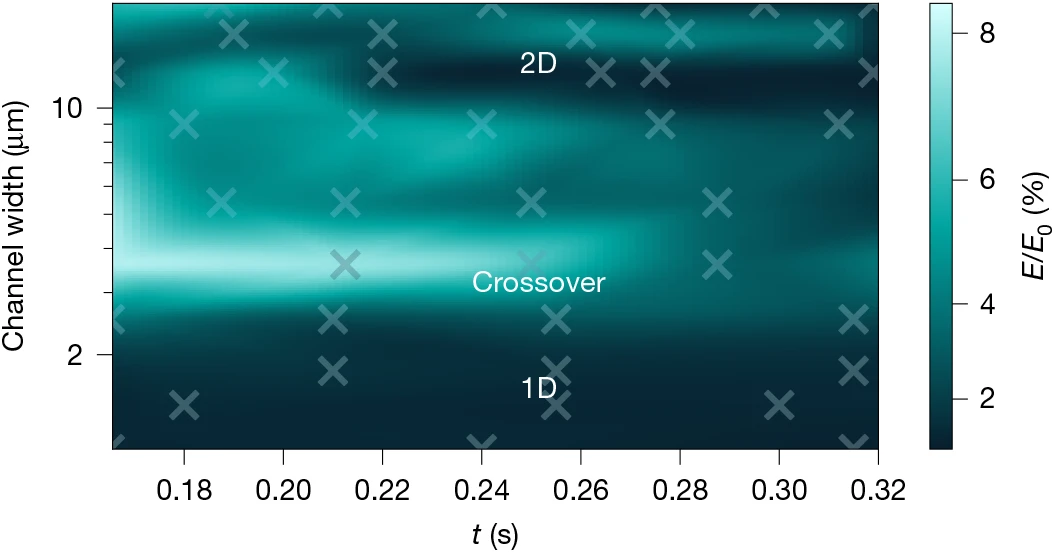 “The remaining energy in the oscillator paradoxically varies non-monotonically as a function of the channel width 'w'.”They have a cloud of ultracold atoms (a superfluid) that sloshes back and forth between two reservoirs connected by a narrow channel — like water oscillating in a U-shaped tube. “Remaining energy” means how much of that sloshing energy is still left after some time has passed (instead of being lost to friction/dissipation).Normally you’d expect a wider channel to always lose less energy (lower resistance). Instead, the amount of energy left over goes up and then back down as they change the channel width. That’s “non-monotonic” — it doesn’t steadily rise or fall; it has a peak. And it’s “paradoxical” because it goes against the usual “wider = less resistance” intuition.
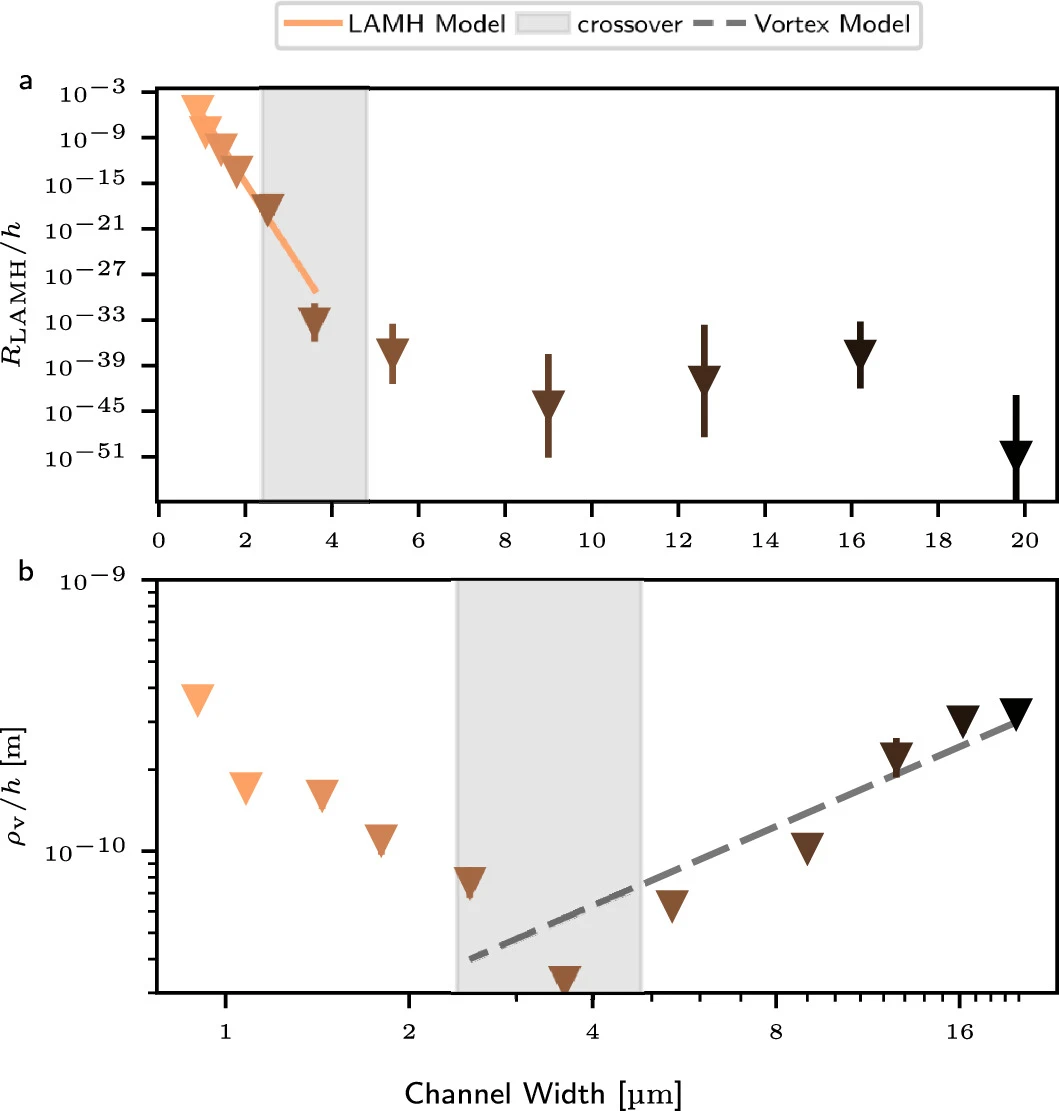 Breakdown of scaling laws at dimensional borders.