Tiny Shells Learn Cell Tricks
Imagine a factory so small it could float in a dewdrop, yet organized with the quiet cunning of a living cell. That is roughly what a team in China has built: hollow nanoreactors that borrow two of biology’s favorite efficiency hacks and put them to work making hydrogen peroxide under ordinary light.
Hydrogen peroxide (H₂O₂) is the clean, versatile workhorse behind everything from water treatment to green chemical synthesis. Making it with sunlight instead of energy-heavy industrial routes has long been a dream of artificial photosynthesis. The catch? The two half-reactions—reducing oxygen and oxidizing water—rarely run at matching speeds, and protons and electrons often wander off in unhelpful directions.
Two borrowed blueprints
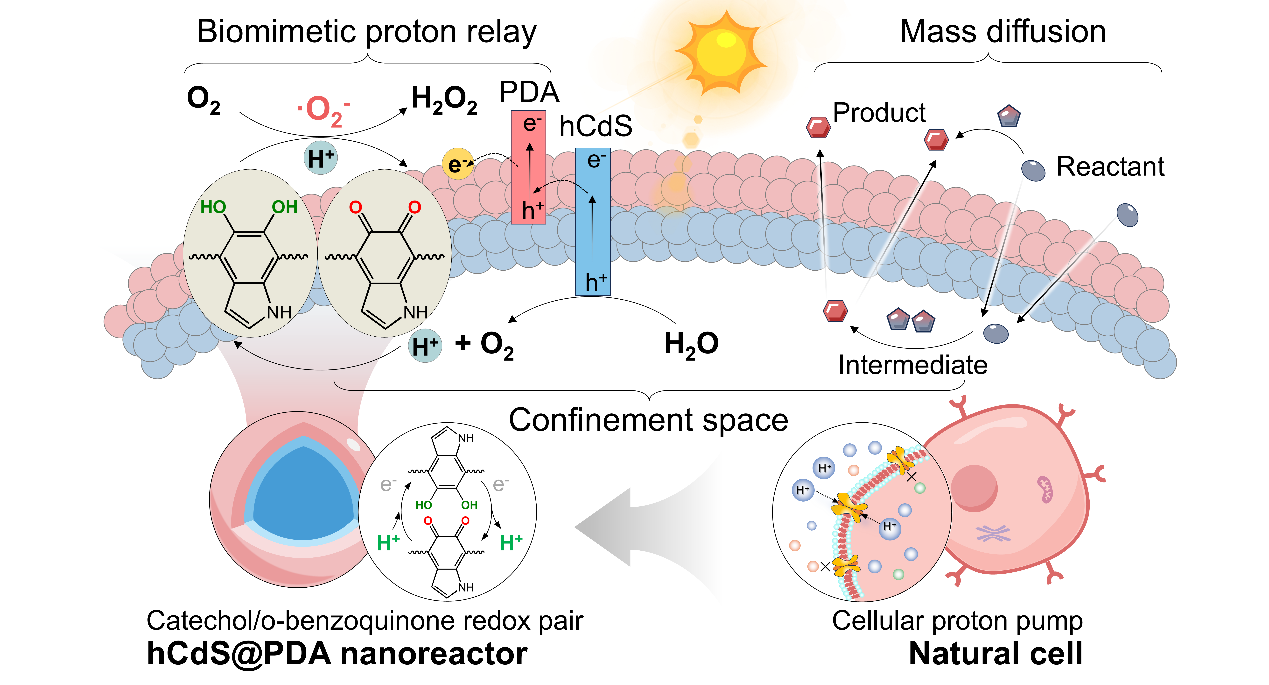
Researchers led by Can Li at the Dalian Institute of Chemical Physics of the Chinese Academy of Sciences, working with Jian Liu’s group at Inner Mongolia University, decided to take notes from the cell. Their answer is a hollow cadmium sulfide core wrapped in a thin polydopamine shell—written hCdS@PDA for short.
Inside that shell sit dynamic pairs of chemical groups called catechol and o-benzoquinone. Think of them as a molecular bucket brigade. Instead of a protein pump shoving protons around, these pairs simply catch a proton, hand it off, catch another, and so on. The relay speeds up proton-coupled electron transfer—the elegant dance in which a proton and an electron move together so neither gets stranded. Biologists see the same choreography in enzymes; here it is rebuilt in a synthetic polymer.
The second trick is pure architecture. A porous outer shell encloses a nanoscale cavity. That compartmentalized design concentrates reactants, eases their diffusion, and even traps photons the way a tiny greenhouse traps heat. Finite-element simulations and in-situ spectroscopy confirmed the enrichment and light-harvesting effects working in concert with the proton relay.
Balancing the books of light chemistry
Together the two features help even out the kinetic mismatch between oxygen reduction and water oxidation. The team showed the system operates through a Z-scheme heterojunction—a staggered arrangement of energy levels that keeps photogenerated electrons and holes moving in useful directions rather than recombining uselessly.
Under visible light in plain water the nanoreactors produced hydrogen peroxide at 3.24 millimoles per gram of catalyst per hour. The solar-to-chemical conversion efficiency reached 1.2 percent. Those numbers are early-stage laboratory results, yet they already demonstrate that cell-inspired organization can measurably lift performance.
From powder to pocketable gel
Powder catalysts are hard to recover. So the researchers nestled the nanoreactors inside a soft, food-grade sodium alginate hydrogel—the same family of seaweed-derived gels used in cooking and wound dressings. The resulting monolithic pieces stay active under natural sunlight and can be lifted out, rinsed, and reused. An environmentally gentle matrix meets a recyclable solid form: practical elegance on a small scale.
“Our study provides a new strategy for engineering biomimetic nanoreactors that increasingly replicate the sophisticated functions of living cells, opening new opportunities in artificial photosynthesis, energy catalysis, and synthetic chemistry,” said Professor Li.
What the next light will show
Plenty remains to explore. Scaling the hydrogel pieces, testing longer outdoor runs, and tuning the shell chemistry for still higher selectivity are natural next steps. The work does not claim a finished industrial process; it offers a clear proof that borrowing both the chemistry and the spatial logic of cells can move artificial photosynthesis forward.
There is something quietly cheering about watching a synthetic shell learn the patient habits of a living membrane. Light falls, protons hop, peroxide appears—and a little more of the cell’s quiet competence finds a home in materials we can hold in our hands.
“Our study provides a new strategy for engineering biomimetic nanoreactors that increasingly replicate the sophisticated functions of living cells.” — Prof. Can Li