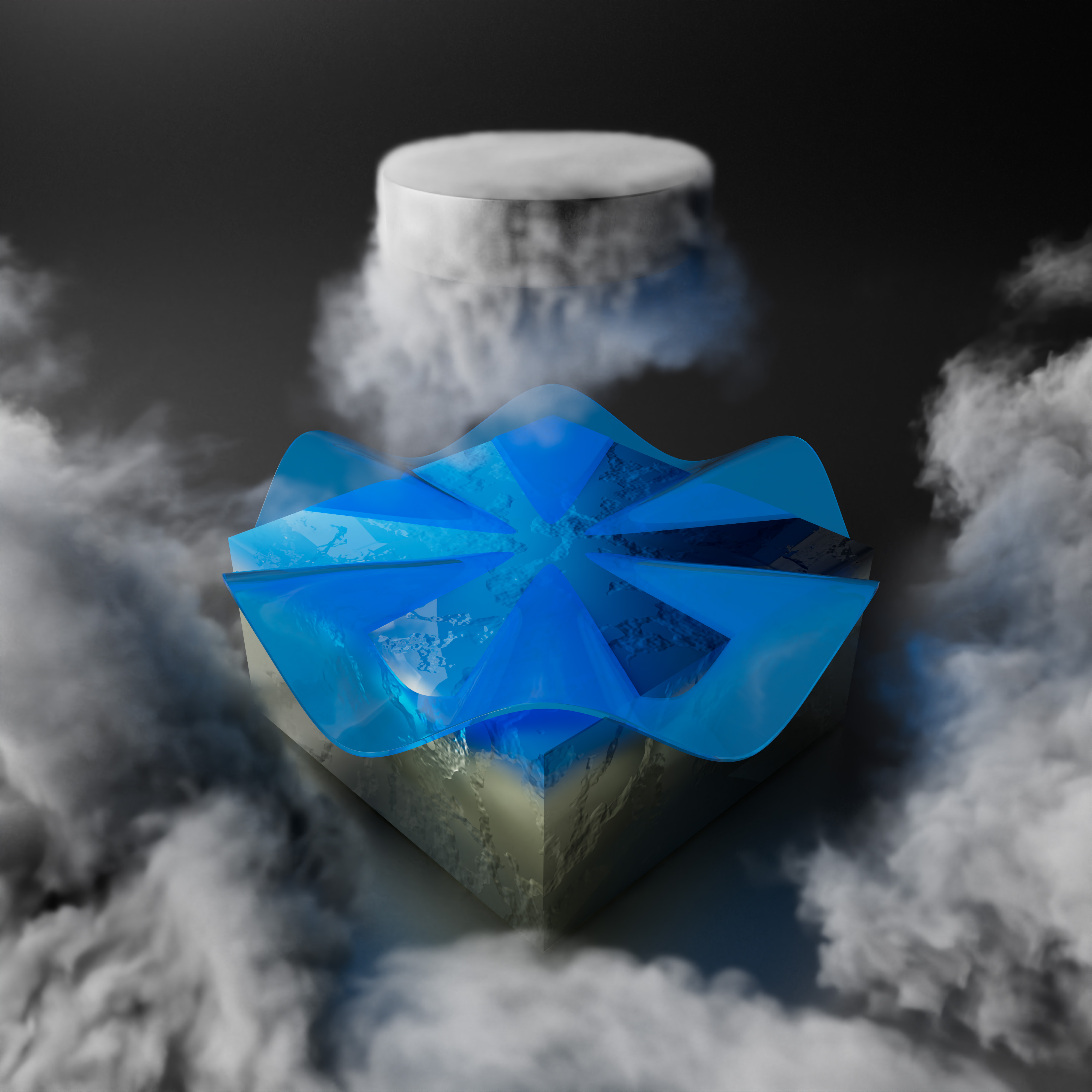
Topological Superconductor
A Crystal That Superconducts Only on Its Skin
Most superconductors are all-or-nothing affairs: cool them enough and the whole bulk lets electrons zip around without resistance. Platinum bismuth—PtBi₂—does something quieter and far more particular. Only its top and bottom surfaces go superconducting. The interior stays an ordinary metal. That alone would make it a curiosity. New measurements now show the pairing on those surfaces is stranger still.
Researchers at the Leibniz Institute for Solid State and Materials Research (IFW Dresden) and the Würzburg–Dresden Cluster of Excellence ct.qmat have mapped how surface electrons lock into pairs. Their high-resolution angle-resolved photoemission spectroscopy—ARPES, a technique that essentially photographs the energies and momenta of electrons escaping a crystal—reveals six preferred directions where pairing simply refuses to happen. Everywhere else on the surface, the electrons do pair and glide without friction. The pattern matches the three-fold rotational symmetry of the atomic lattice itself, producing an overall six-fold “nodal” structure. No other superconductor has shown this arrangement.
“We have never seen this before,” says Dr. Sergey Borisenko of IFW Dresden. “Not only is PtBi₂ a topological superconductor, but the electron pairing that drives this superconductivity is different from all other superconductors we know of.”
Why Topology Matters Here
The surface electrons are not free to wander into the bulk. They are confined by the material’s topology—a robust property that survives as long as the crystal’s overall symmetry stays intact. Slice the crystal in half and fresh surfaces instantly inherit the same locked-in electrons. That robustness is what makes topological materials so appealing: the interesting behavior is hard to destroy by ordinary disorder.
At low temperature those surface electrons form Cooper pairs—the two-electron teams that carry supercurrent. Because the pairing amplitude vanishes along six radial lines in momentum space, theorists call the state a nodal i-wave superconductor. Ordinary “s-wave” superconductors pair electrons in every direction; the famous high-temperature cuprates show a four-fold d-wave pattern. Six-fold nodal pairing is new territory.
Density-functional theory calculations and models based on the Bogoliubov–de Gennes equations (the standard mathematical language of superconducting quasiparticles) confirm that this unusual gap structure naturally pins Majorana modes along the edges of the superconducting surfaces. Majorana particles are exotic quasiparticles that are their own antiparticles; a pair of them can encode a single electron’s worth of information while remaining spatially separated. That separation is the foundation of topological quantum computing, which aims for qubits far less fragile than today’s versions.
Building Edges on Demand
“Our computations demonstrate that the topological superconductivity in PtBi₂ automatically creates Majorana particles that are trapped along the edges of the material,” notes Prof. Jeroen van den Brink, Director of the IFW Institute for Theoretical Solid State Physics. “In practice, we could artificially make step edges in the crystal, to create as many Majoranas as we want.”
The team used a helium-lamp ARPES setup for broad Fermi-surface maps and a laser source for the fine energy- and momentum-resolved gap measurements that revealed the six silent directions. Leading-edge gaps were tracked across multiple temperatures, samples, and cleaves, giving the experimental picture its strength.
Honest Unknowns, Clear Next Steps
The researchers are frank that the microscopic origin of the i-wave pairing is still a mystery. “We don’t yet understand how this pairing comes about,” Borisenko says. That open question is now a research invitation rather than a dead end. Thinning the crystal can turn the metallic interior into an insulator, quieting unwanted bulk electrons so the surface Majoranas can be addressed more cleanly. A magnetic field can shift energy levels and may nudge the Majorana modes from edges toward corners—another handle for control.
Only a handful of materials have ever been proposed as intrinsic topological superconductors, and until now none carried convincingly consistent experimental support. PtBi₂ changes that picture. It is already a working laboratory for surface-only superconductivity, six-fold nodal pairing, and edge-bound Majorana modes—all inside one shiny grey crystal that can still levitate a magnet the way any good superconductor should.
The next chapters will be about steering those modes with thickness and fields, and about listening more carefully to how the pairs form in the first place. For a material that looked, at first glance, like just another metallic crystal, PtBi₂ has turned out to be an unusually generous teacher.
“We have never seen this before. Not only is PtBi₂ a topological superconductor, but the electron pairing that drives this superconductivity is different from all other superconductors we know of.” — Sergey Borisenko