Proteins Written in English
Tell a computer what you need—and it drafts a protein
Imagine asking for a molecule the way you’d text a friend: “Make me something that lights up green,” or “Build an enzyme that can nibble polyethylene terephthalate.” For decades, that kind of wish belonged to specialists who either started from nature’s existing proteins and mutated them, or translated every goal into painstaking geometric and sequence constraints.
A team led from Westlake University has built a different front door. Their model, Pinal, is a 16-billion-parameter foundation system trained to read a natural-language description of desired function and propose candidate proteins—sequence and structure included—that aim to match that intent.
In lab tests spanning four very different jobs, the intended behaviors showed up. Two of the designs were enzymes that actually catalyzed their reactions. One metabolic helper even outperformed its bacterial counterpart in a carbon-dioxide fixation pathway.
From sentences to folds
Pinal learned on 1.7 billion synthetically annotated protein–text pairs, stitching functional language to the molecular world. Architecturally it works in two stages. First, a module called T2struct turns the written prompt into a structural sketch written in 3Di tokens—compact symbols that capture a protein’s three-dimensional shape language. Then SaProt-T, conditioned on both that sketch and the original text, proposes an amino-acid sequence. Candidates are ranked by how probable they look jointly, how foldable they seem to structure predictors, and how well they align with the functional description.
Computationally, the designs tended to look foldable, diverse, and on-message with their prompts—useful signals when deciding what is worth synthesizing. The deeper test was wet-lab work.
Four wishes, four working molecules
The researchers asked Pinal for four distinct functions and followed the designs into the lab.
One request produced a fluorescent protein. Experimental work confirmed the intended function: the designed molecule fluoresced as hoped.
A second request targeted a polyethylene terephthalate hydrolase—an enzyme class of interest for breaking down PET plastics. After computational filters, one standout candidate showed the intended catalytic activity.
A third brief called for alcohol dehydrogenases (ADHs)—workhorse enzymes that shuffle electrons while converting alcohols. Several diverse candidates proved catalytically active in lab assays.
The fourth design may be the most quietly striking. H-proteins shuttle a lipoamide “arm” inside the glycine cleavage system, a multi-enzyme machine cells use in one-carbon metabolism. Without rounds of experimental directed evolution, a Pinal-designed H-protein raised product titre 1.7-fold compared with the native Escherichia coli H-protein inside a reconstituted multi-enzyme CO₂ fixation pathway. In other words: a language-prompted design slotted into a carbon-fixing cascade and helped it make more product on the first experimental pass the team reports.
What “programmable” really means here
Protein engineering has long oscillated between directed evolution—letting variation and selection do the searching—and structure-based design that demands careful human translation of function into geometry. Pinal does not erase those crafts. It reframes the starting point. Functional intent can be stated at a high level in ordinary language, and the model supplies a pool of testable candidates with less reliance on manually specified structural or sequence constraints.
The researchers are careful about scope. Success still required expression, purification, and assay; computational scores guided prioritization rather than guaranteeing activity. Training and release choices also reflect biosecurity diligence: large structural training material drew from the AlphaFold database collection that excludes viral proteomes, and full-scale training corpora were held back from open release while weights, inference code, and a public web server were shared under an Apache 2.0 license.
Those caveats read less like dead ends than like the ordinary scaffolding of responsible molecular engineering. The open pieces—model weights on Hugging Face, code on GitHub, and a browser interface—invite other labs to prompt, rank, and test their own functional sentences.
A gentler interface to molecular possibility
What lingers is the shift in posture. Instead of starting every project by hunting a natural homolog or drafting a constraint file, a researcher can begin with a plain description of a job worth doing—light, catalysis, metabolic transfer—and receive diverse folds that already lean toward that story.
Nature still gets the last word in the tube. But the conversation can now open in English, and sometimes the reply folds, fluoresces, snips a polymer bond, or lifts a carbon-fixing pathway’s yield on the first try. That is not magic. It is programmable exploration—with a warmer, more human on-ramp—and a promising step toward proteins designed by intent as much as by inheritance.
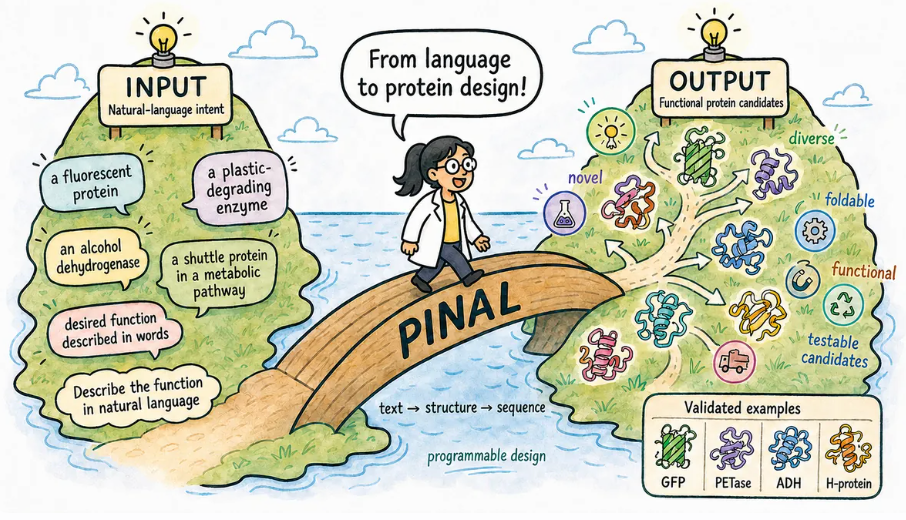 Experimental validation confirms the functions of Pinal-designed proteins across four tasks.
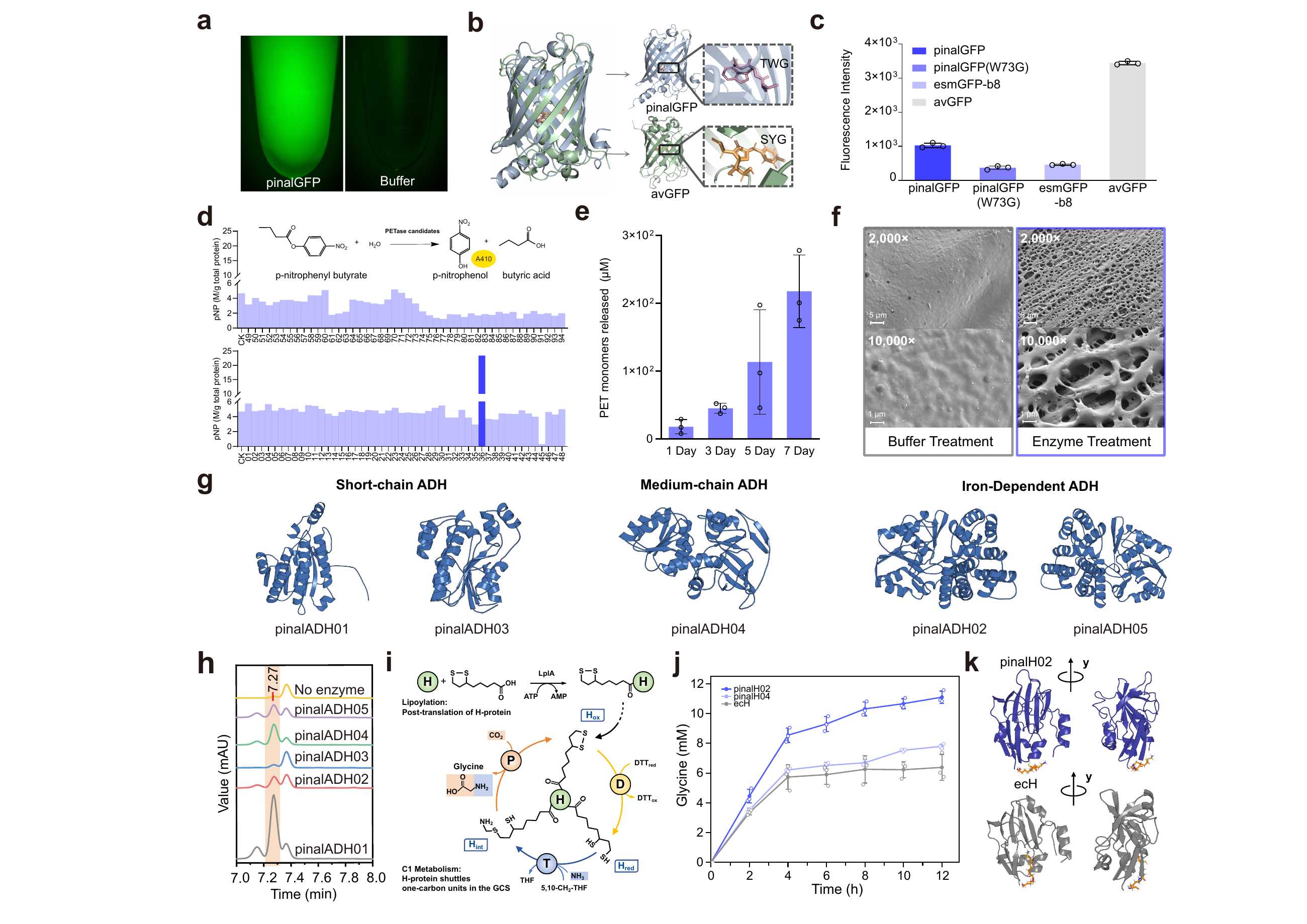 Experimental validation confirms the functions of Pinal-designed proteins across four tasks.
 The research team discusses protein design