Designing Quantum Materials
Materials Science Breakthroughs Point to More Robust Quantum Sensors and Computing
New research from the University of Illinois Urbana-Champaign suggests that thoughtful materials design is emerging as a critical enabler for practical quantum technologies. Assistant Professor Chris Anderson and colleagues have mapped key properties needed for optically active spin qubits—microscopic quantum systems that store information in the spin of electrons while interacting with light—offering a clearer path toward applications ranging from ultra-secure communications to nanoscale biological sensors.
Quantum Information Carried by Light-Interacting Spins
Inside certain crystals and molecules, tiny imperfections known as defects can trap individual electrons. These trapped electrons possess a quantum property called spin, which behaves like a tiny magnet with two distinct states that can represent the 0s and 1s of a quantum bit, or qubit.
What sets certain qubits apart is their ability to absorb and emit photons—particles of light—in ways that directly encode their quantum state. This optical interface is significant: it allows qubits to be initialized and read out at room temperature, without the extreme cooling typically required, and enables quantum information to travel through existing optical-fiber networks that already power the internet.
No Single “Perfect” Qubit—Application Determines the Design
Results indicated that the ideal material depends entirely on the intended use. For quantum sensing—imaging individual molecules, detecting magnetic fields at the nanoscale, or enabling GPS-free navigation—room-temperature operation and strong optical contrast are essential. Diamond’s nitrogen-vacancy (NV) center has become the gold standard here and is already commercialized in scanning quantum microscopes.
For quantum communication, however, the requirements shift. Long-distance entanglement demands photons that are spectrally pure, highly coherent, and emitted at telecom wavelengths compatible with fiber-optic infrastructure. Anderson’s cover article in the latest issue of MRS Bulletin reviews the full spectrum of candidate materials, including diamond, silicon, silicon carbide, two-dimensional materials, and designer molecular systems.
A New “Periodic Table” for Quantum Coherence
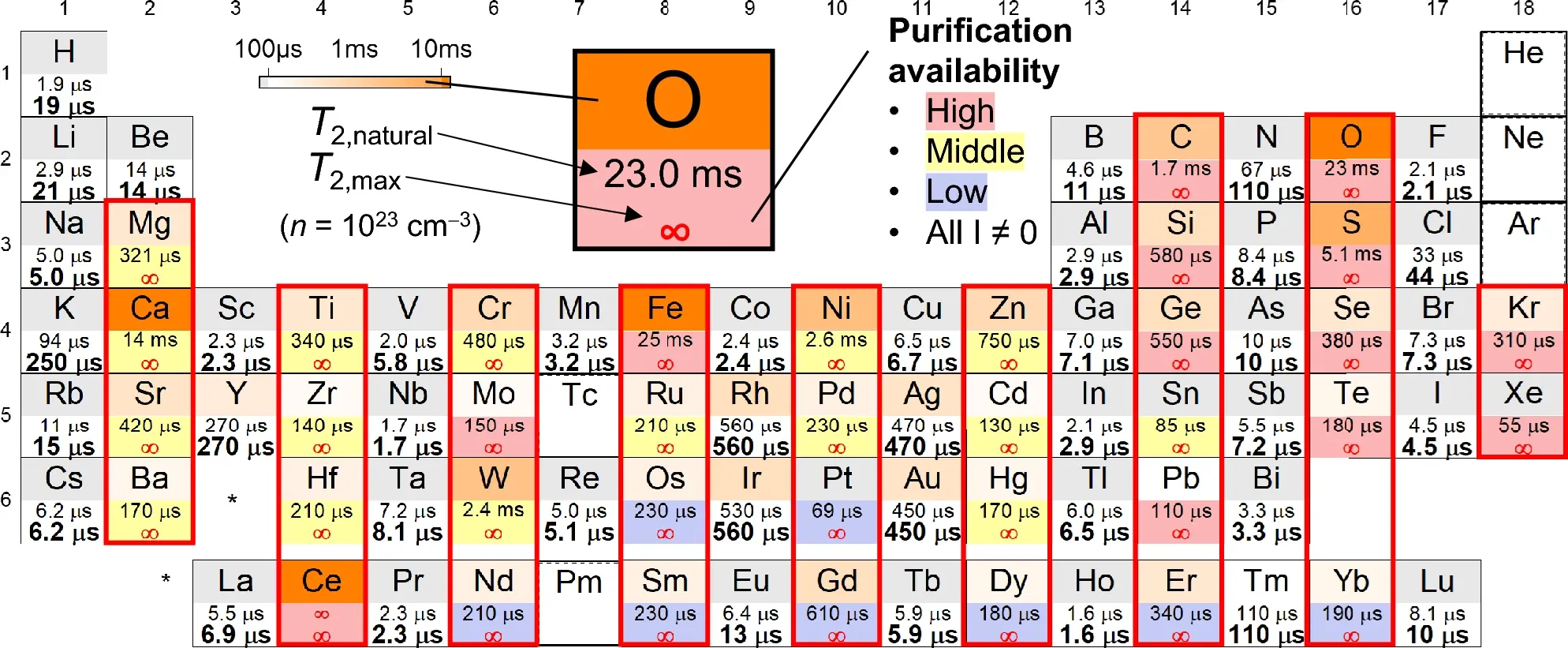
In a companion impact article also featured on the cover, Anderson and co-authors introduce a unified periodic table focused on decoherence—the loss of fragile quantum information caused by noise from the surrounding material. Many host materials contain nuclei with magnetic moments that act like tiny, fluctuating magnets, disrupting the electron’s spin.
By isotopically purifying materials—selecting isotopes free of nuclear magnetic moments—researchers can dramatically reduce this noise. Yet not every element can be purified effectively. The new framework evaluates each element’s contribution to decoherence through computational screening, providing the first universal “cookbook” for designing spin-qubit platforms.
“What excites me and horrifies me the most is that the design space for these quantum systems is enormous—we have essentially the whole periodic table to choose from, and then all the combination of elements as well,” said Assistant Professor Chris Anderson. “However, with the right combination of computational screening, experimental ingenuity, and proper guidelines we can discover platforms with capabilities haven’t even imagined yet.”
Why Materials Science Is the Critical Bottleneck
The papers emphasize that surfaces introduce noise, nanofabrication can degrade coherence times, photonic integration requires thin films, and isotopic composition ultimately determines usefulness. Solving these interconnected challenges demands simultaneous advances in synthesis, computational design, and device engineering—precisely the cross-cutting expertise found in materials science and engineering programs.
While the work does not claim immediate commercial breakthroughs, it frames a systematic approach to materials discovery that could accelerate progress across quantum sensing, computing, and the quantum internet. Anderson, who also served as guest editor for the MRS Bulletin special issue, and his collaborators have provided researchers with clearer guidelines for selecting and engineering robust qubit hosts.
The bottom line remains measured: continued collaboration between materials scientists, physicists, and engineers will be essential to translate these design principles into real-world quantum technologies capable of delivering on their long-promised benefits.