Discovery of Ice XXI
Unveiling Hidden Pathways in Water's High-Pressure Transformations
New research from Korea Research Institute of Standards and Science (KRISS) suggests that water, under extreme pressure at room temperature, can follow multiple freezing and melting pathways through a newly identified metastable ice phase called ice XXI. This finding, detailed in a study published in Nature Materials, highlights the complexity of water's behavior and could refine our understanding of phase transitions in materials essential for planetary science and beyond.
The Enigmatic Nature of Water Under Pressure
Water is far more versatile than its everyday appearance suggests. Composed of just hydrogen and oxygen, it forms over 20 known polymorphic phases—distinct crystal structures—from familiar ice Ih (the hexagonal ice in snowflakes) to exotic high-density forms like ice XX. These phases arise from rearrangements in hydrogen-bond networks (HBNs), influenced by pressure and temperature. At low temperatures, slow molecular movements allow for metastable states—temporary, higher-energy configurations—that lead to intricate transition pathways.
However, at room temperature, where molecules are more active, such diversity was thought to be limited. The new study challenges this by showing that supercompressed water (SW)—water pressurized beyond its normal limits—can still exhibit metastable phases and unexpected routes to stable ice VI, a high-density ice stable around 1 gigapascal (GPa), or about 10,000 times atmospheric pressure.
Innovative Techniques Reveal Rapid Transitions
To explore these pathways, researchers employed a dynamic diamond anvil cell (dDAC), a device that compresses samples between diamond tips at rates up to 120 GPa per second, combined with X-ray free-electron laser (XFEL) techniques for time-resolved observations. This setup allowed the team to monitor pressure-time (P–t) curves and capture crystallization events in microseconds.
The experiments involved repeatedly compressing and decompressing water samples for hundreds of cycles at room temperature. Optical imaging and synchrotron X-ray diffraction identified five distinct P–t curve types, each corresponding to different freezing-melting sequences. For instance, in one pathway, SW directly forms ice VI, while in others, it passes through metastable ice VII (ms-ice VII) or the newly discovered ice XXI.
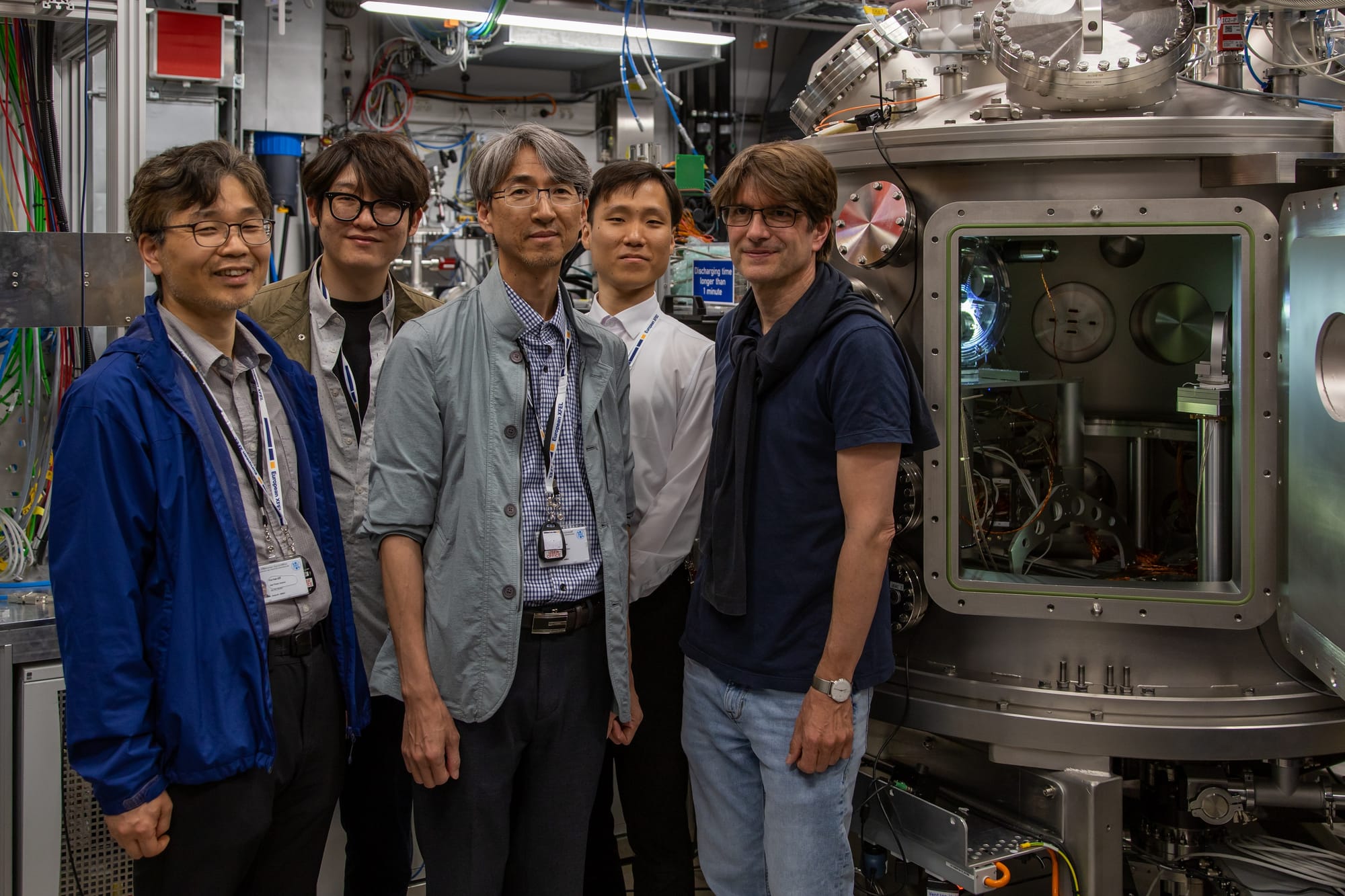
The XFEL, provided by the European XFEL facility, offered megahertz-speed detection to resolve ultrafast events. "This achievement is the result of close collaboration with international research teams," said Senior Researcher Geun Woo Lee of the Korea Research Institute of Standards and Science (KRISS), the corresponding author.
Key Findings: A New Ice Phase and Multiple Routes
Results indicated that supercompressed water evolves structurally from high-density water to very-high-density water as pressure increases, influencing phase selection. Molecular dynamics simulations using models like simple point-charge flexible water confirmed this evolution, showing changes in pair distribution functions—graphs depicting atomic distances—and angle distribution functions, which reflect distortions in hydrogen-bond networks.
The standout discovery is ice XXI, a body-centred tetragonal structure with a large unit cell containing 152 water molecules, yielding a density of about 1.413 grams per cubic centimeter at 1.6 gigapascals. This metastable phase forms directly from supercompressed water above 1.6 gigapascals and can transition to metastable ice VII or stable ice VI.
The five pathways are:
- SW → ice VI → water
- SW → ms-ice VII → water
- SW → ms-ice VII → ice VI → water
- SW → ms-ice XXI → ice VI → water
- SW → ms-ice XXI → ms-ice VII → ice VI → water
These align with Ostwald's step rule, where metastable intermediates form before stable phases due to lower nucleation barriers—energy hurdles for crystal formation.
Implications for Science and Beyond
The findings provide encouraging insights into water's phase diagram, potentially aiding models for icy moons like Europa or Enceladus, where high-pressure ices may harbor conditions for life. They also underscore how structural similarities between liquids and solids can dictate transition kinetics, a principle applicable to designing materials with tailored properties.
"We expect it will contribute to the development of accurate atomistic potential models for water and the exploration of new materials with controlled transition pathways," - Geun Woo Lee
This work reminds us of water's profound complexity, even at familiar temperatures.