Mechatronic Metamaterials
Materials that Keep Their Own Beat
Most machines wait for a signal. A metronome, a controller, a human hand. Living systems often do the opposite: they find a steady rhythm from the inside out—heartbeats, walking gaits, the quiet pulse of a cell.
Now a team of physicists has coaxed that kind of self-timing into a new kind of material. By linking simple robotic units into elastic lattices, they watched the whole structure settle into stable, repeating patterns that roll through both space and time—patterns researchers call time crystals—without anyone tapping out a beat from outside.
The work, published in Nature, comes from collaborators in Amsterdam, Leiden, and the United Kingdom. It sits at a lively crossroads of crystal physics, active matter, and mechatronic metamaterials, and it offers an important step toward biology-inspired multifunctional robots.
Crystals in Time, Not Just Space
Ordinary crystals—table salt, diamond, ice—are famous for order in space. Their atoms sit in tidy, repeating grids. Time crystals are a newer idea: structures whose order also repeats as the clock ticks. Instead of only a fixed shape, they carry a reliable cycle.
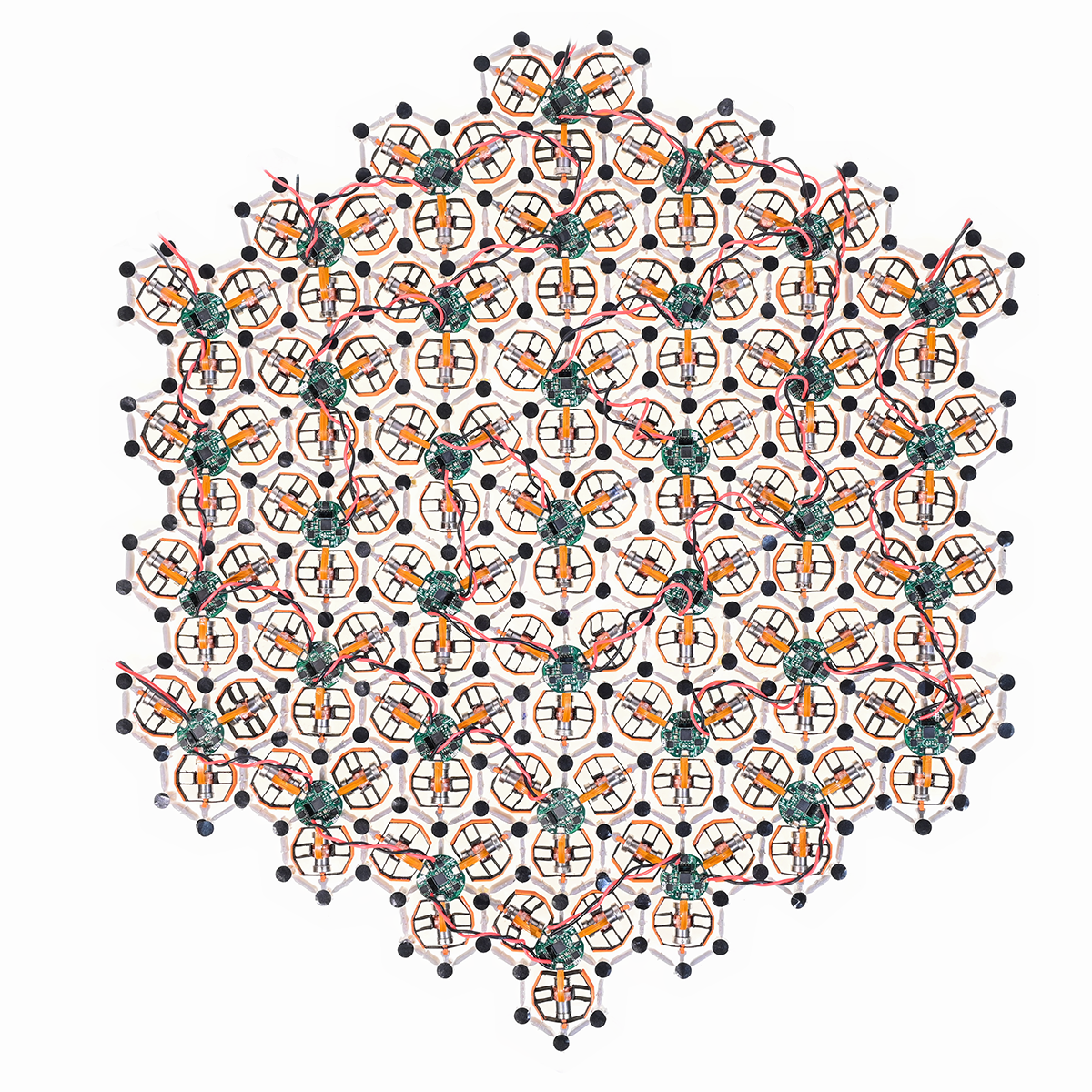
The Amsterdam–Leiden–UK group paired that idea with active matter—collections of parts that carry their own energy and push on one another, the way a flock of birds becomes one flowing unit. Here the “particles” are not molecules. They are small elastic cells, each fitted with a voice-coil actuator (a tiny electromagnetic pusher), a Hall-effect sensor that reads motion, and a microcontroller that decides how hard to push next.
Those controllers enforce a non-reciprocal force rule between neighbors: when one cell deforms, its neighbor answers with a push that is not a perfect mirror image of the force it received. That slight one-way bias is enough to keep energy flowing through the lattice and to drive collective motion that ordinary passive springs cannot sustain.
A Ring and a Honeycomb
The researchers built the idea in two geometries.
One is a one-dimensional loop: a 24-unit elastic ring. The other is a two-dimensional sheet—a 37-cell honeycomb resting on a lubricated glass plate so the whole network can slide and flex with less sticking. In both cases they gently drove the system past a Hopf bifurcation—the mathematical tipping point where a quiet rest state gives way to a self-sustained oscillation, much as a quiet feedback loop can suddenly begin to hum.
Once past that threshold, the lattices did not merely jitter. Self-oscillations appeared as measurable strain fields, and something more intriguing followed. Wavelength, period, and amplitude grew together. Small, local wiggles merged and lengthened—a process the team describes as wave coarsening—until the material locked into large, orderly, repeating cycles: time crystallization emerging from the dynamics themselves.
Continuum models of odd elasticity (elasticity that includes those non-mirror, “odd” force rules) and discrete computer simulations matched the lab recordings. The models also clarified a quiet hero of the setup: friction with the substrate. In a perfectly frictionless world, momentum would be conserved and the coarsening waves might keep growing without bound. Friction breaks that conservation and arrests the coarsening, parking the system in a stable, readable pattern instead of letting it run away.
Order That Survives a Jostle
Emeritus Professor of Theoretical Physics Wim van Saarloos puts the broader excitement plainly: “This paper shows that active elastic metamaterials are a gold mine of new physics.”
In the experiments, the team saw movements change and grow in size like waves, a route that can lead to the spontaneous formation of time crystals. They also noticed a practical gift. Unlike many ordinary two-dimensional systems, where tiny random kicks quickly smear out order, this material kept a clear pattern even when small disturbances appeared. That robustness matters if anyone hopes to turn laboratory lattices into working devices.
The building blocks are mechatronic metamaterials—engineered structures whose behavior comes as much from how the parts are wired and programmed as from the raw stuff they are made of. Because each cell senses and actuates, the “material” is already halfway to a robot. Link enough of them, and the collective dance—powered by an internal rather than an external beat—points toward biology-inspired multifunctional robots that do not need a central conductor shouting tempo over a wire.
Toward Softer, Smarter Machines
The press summary frames the result as an important step toward biology-inspired multifunctional robots. That claim stays honest about stage. These are controlled laboratory lattices—rings and honeycombs of dozens of units—not finished field robots. The physics is early, careful, and full of next questions: how far the patterns scale, how different force rules reshape the coarsening, how friction and geometry trade off when the substrate changes.
Yet the hopeful core is already on the bench. A material that finds its own rhythm, grows orderly waves from local rules, and holds that order against small noise is a concrete step on that path—visible already, strain field by strain field.
Watch a honeycomb of little actuators settle into a shared pulse, and it is hard not to feel the future leaning closer—not a sudden leap, but a steady internal beat, finally built into the stuff itself.
“In our experiment, we observed a new way in which their movements change and grow in size, like waves. This process can lead to the spontaneous formation of time crystals.” — Wim van Saarloos