Advancing Planet Discovery
A faint glow next door
Somewhere out there, billions of planets circle other suns. Most of them are drowned out by starlight so fierce that a planet’s own glow looks like a firefly beside a searchlight. Coronagraphs—masks and optics that try to blot the star—help, yet leftover speckles from tiny telescope wobbles and optical quirks still swamp the faint signal.
A collaboration spanning Northwestern University and Caltech has built a different kind of eraser. They call it Physics-based Learning for Imaging Planets, or FLIP: a software twin of the James Webb Space Telescope’s Near Infrared Camera (NIRCam) that learns the exact shape of a star’s glare, then subtracts it. On published NIRCam data the approach recovers known planets with sensitivity two to fifteen times better than the usual reference-star technique known as KLIP. In one case it pulled a previously hidden planet into clear view.
Building a telescope that lives in code
FLIP begins as a fully differentiable model—every optical surface, the star’s position and brightness, and even pixel-by-pixel detector quirks are knobs a computer can turn. The team seeded the model with established optical simulations (STPSF) and rewrote the whole chain in PyTorch so automatic differentiation could race through the physics.
First comes calibration on a reference observation. Roughly a million parameters—wavefront errors measured in fractions of a wavelength, slight star offsets, detector response maps—are adjusted until the digital twin matches what the real telescope recorded. Next the model shifts to the science image, tightening a smaller set of parameters while deliberately tracking fake planets that researchers inject. Those decoys act as a guardrail: the optimizer is punished if it starts erasing real planetary signals along with the starlight.
When the residual starlight is finally peeled away, the difference image is startlingly clean. Lead author Rodrigo Ferrer-Chavez, a graduate student at Northwestern working with astronomer Jason Wang, describes the iterative process as watching the star’s glare disappear in bizarre ways—growing dimmer and deformed—until a pretty clean image remains and, if fortune smiles, a compact glowing blob: the planet.
The planet that was already in the archive
The team tested FLIP on three well-studied systems observed by JWST/NIRCam: HIP 65426, 51 Eridani, and TYC 5899. The standout was 51 Eridani b. Standard starlight subtraction of the same frame had left the planet undetected in the original analysis; its expected location sat empty inside a dashed circle. After FLIP subtraction the same data show a clear detection at precisely that spot, matching both the predicted position and the expected shape of a planetary signal.
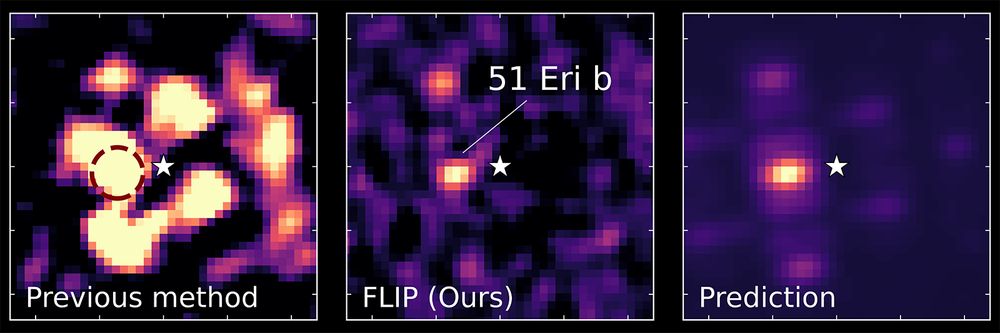
Caltech’s Katie Bouman, whose computational-imaging group co-developed the approach, notes that the tiniest imperfections can still bury a planet under residual glare. What excited the team is the demonstration that careful computation can push past those hardware limits. By marrying a physical instrument model with machine-learning-style optimization, starlight can be removed far more precisely—revealing faint worlds and, in this case, one that had been hiding in plain sight inside the JWST archive.
“What's exciting is that we're showing how computation can help overcome limitations of the telescope itself. By combining a physical model of the instrument with optimization techniques from machine learning, we have been able to remove starlight much more precisely, making it easier to detect faint exoplanets and even reveal one that was previously hidden in the JWST data.”
“Directly imaging exoplanets is incredibly challenging because even the tiniest imperfections in a telescope can make it difficult to separate the faint light of a planet from the overwhelming glare of its star.”
— Katie Bouman, professor of computing and mathematical sciences, electrical engineering and astronomy, Caltech
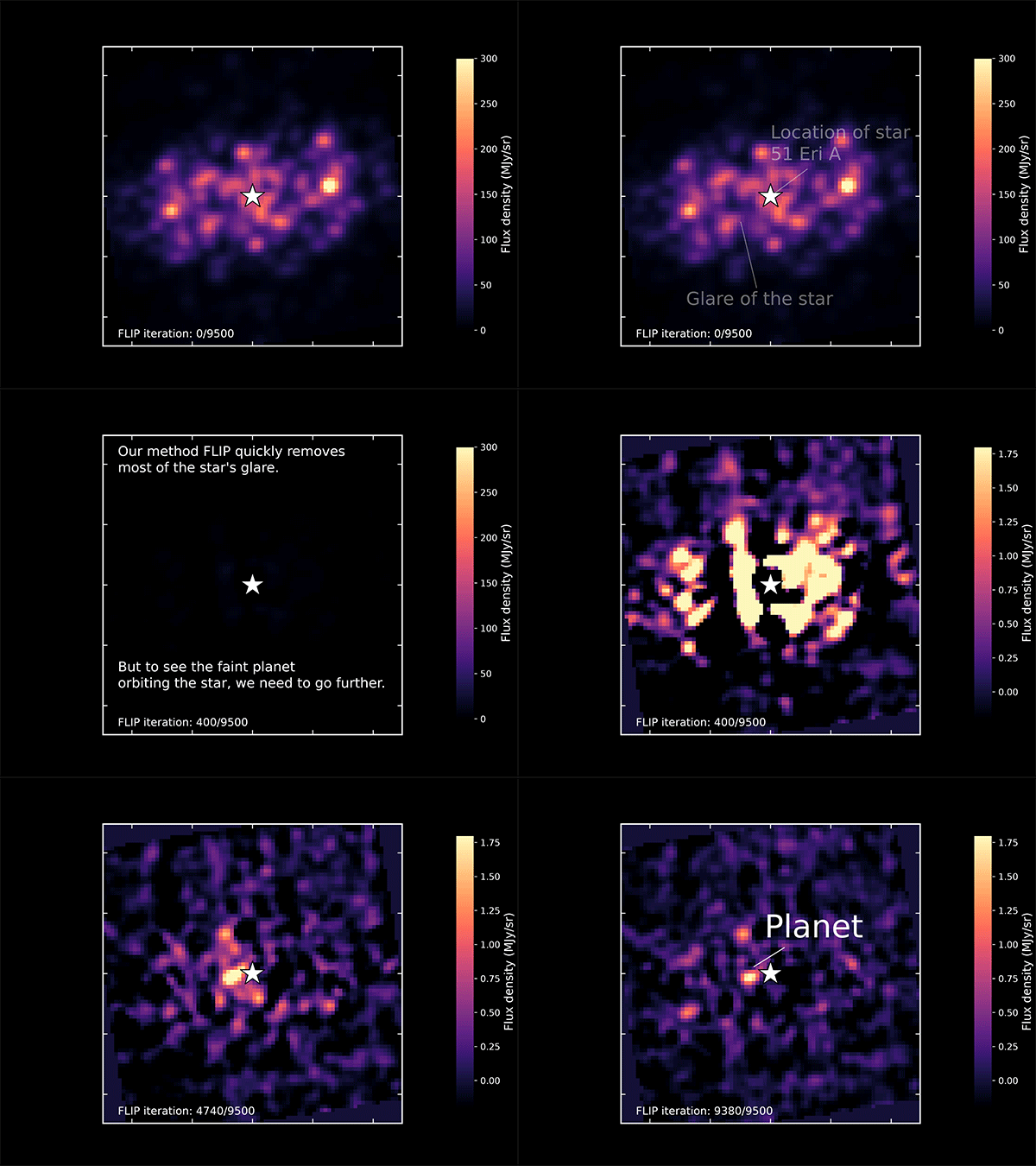
Ferrer-Chavez emphasizes the practical payoff: researchers can now revisit existing images looking for planets that were missed or only marginally hinted at before. The planets were already in the photons; the software simply learned how to stop the star from shouting over them.
Beyond the stability ceiling
JWST is stable to the nanometer level—an engineering marvel—yet even that residual jitter has been treated as a hard ceiling on how faint a companion one can image. Ferrer-Chavez puts the milestone plainly: the work shows, for the first time, that those little imperfections need not set the limit on the kinds of planets we can image. Because FLIP is built around the physics of the instrument rather than a single telescope’s quirks, the same paradigm can travel. The group already plans refinements for other platforms, including the Nancy Grace Roman Space Telescope’s coronagraph and ground-based systems, and sees the method informing designs for NASA’s future Habitable Worlds Observatory.
“I feel we just unlocked a new frontier. We've now gone beyond the telescope stability limit for the first time with this new technique, and this new paradigm, I think, can be applied to every instrument that's trying to image exoplanets.”
— Jason Wang, astronomer, Northwestern University
That next-generation mission aims to photograph Earth-like planets in the habitable zones of Sun-like stars. Cleaning the image after the fact will never replace exquisite optics, yet it can relax how ruthlessly engineers must chase every last instability. In that sense FLIP is less a finished product than a new division of labor between glass and code.
Imaging an Earth-like world means pulling a signal roughly 10 billion times fainter than the star sitting right beside it—a challenge Ferrer-Chavez calls brutal for both software and hardware.
The researchers are frank that much remains. Sensitivity gains of two- to fifteen-fold are measured on known planets in existing JWST frames; turning the same lever toward truly Earth-like worlds will demand still more careful modeling, longer baselines, and instruments built for the task.
“There's still a long way to go, but this work shows how much more is possible when we combine advances in telescope technology with computational imaging. Sometimes, the key to seeing something new isn't just building a better instrument but finding a better way to make sense of the light it collects.” — Katie Bouman
For now, a handful of archival frames have grown sharper. A planet once lost in glare has a face again. And every future coronagraph—space-borne or mountain-top—has a new partner waiting in the software stack, ready to keep turning the starlight down until the neighbors come into view.