
NGC 2264 Christmas Tree Cluster
As the holiday season winds down here on Earth, the universe keeps the festive spirit alive with one of its most whimsical wonders: NGC 2264, affectionately known as the Christmas Tree Cluster. This stellar spectacle reminds us that magic twinkles in the cosmos year-round. At happydaze.io, we're all about finding joy in the world, so let's dive into this celestial holiday icon that's lighting up the night sky like a decorated evergreen.
What is the Christmas Tree Cluster?
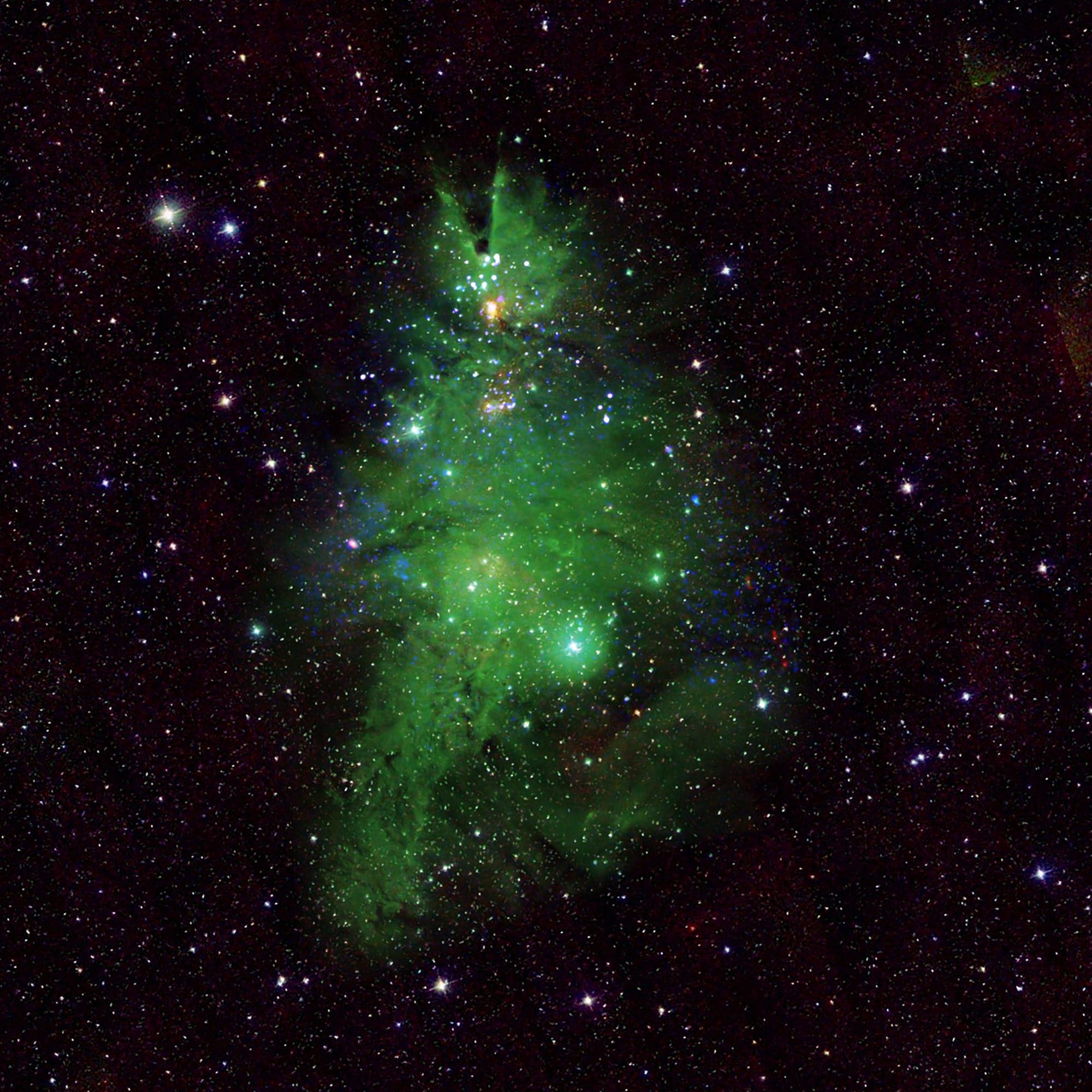
NGC 2264 is a stunning open star cluster embedded in a nebula, located in the constellation Monoceros (the Unicorn). It's about 2,500 to 2,700 light-years away from Earth, making it relatively close in astronomical terms. This proximity, combined with its large size, has made it a favorite for astronomers to study. The cluster gets its festive nickname from its triangular shape, which resembles a Christmas tree when viewed in certain orientations—complete with "ornaments" of bright young stars and a "trunk" formed by denser gas clouds.
At its tip sits the famous Cone Nebula, a dark, cone-shaped pillar of dust and gas that's being sculpted by the intense radiation from nearby hot stars. Together, the cluster and nebula create a breathtaking scene of star formation in action. The stars here are newborns, aged between one and five million years old—practically infants compared to our Sun's 4.6 billion years.
A Brief History of Discovery
NGC 2264 was first cataloged by William Herschel in 1784, but its holiday-themed moniker came much later as imaging technology improved. Modern telescopes like NASA's Chandra X-ray Observatory and the Hubble Space Telescope have revealed its twinkling details, showing young stars "blinking" with variable brightness—almost like fairy lights on a tree. In recent years, especially around the holidays, space agencies release enhanced images to celebrate, like NASA's 2023 composite that made the cluster look even more festive. Just this week, fresh views from 2025 observations have been shared, emphasizing its 80-light-year-wide span.
Scientific Wonders and Fun Facts
- Star Formation Hotspot: NGC 2264 is a nursery for stars, where dense molecular clouds collapse under gravity to birth new ones. The region's emission nebula glows blue from ionized hydrogen, while infrared views pierce the dust to reveal hidden protostars.
- Variable Stars Galore: Many stars in the cluster fluctuate in brightness, offering clues about stellar evolution. It's a key site for understanding how stars like our Sun formed.
- Holiday Tie-In: The "tree" shape is best seen in wide-field images, with the Cone Nebula as the pointy top. Some enhanced photos even add a green tint to the gas for that extra Christmas vibe!
- Size and Scale: Spanning about 80 light-years, if this cluster were in our solar system, it would stretch from the Sun to beyond Alpha Centauri. Yet, from Earth, it appears as a faint fuzzy patch visible through binoculars under dark skies.
How to Spot It Yourself
If you're inspired to stargaze, NGC 2264 is visible in the winter sky for Northern Hemisphere observers. Look for it near the bright star Betelgeuse in Orion—Monoceros is just to the east. With a small telescope or binoculars, you can make out the cluster's core stars and the hazy nebula. Pro tip: Dark, moonless nights in late December or early January are ideal, tying perfectly into the holiday season.
A vibrant capture of NGC 2264, showcasing the star cluster's resemblance to a lit-up Christmas tree.
Wrapping Up the Cosmic Cheer
The Christmas Tree Cluster isn't just a pretty picture—it's a reminder of the universe's ongoing creativity and the joy of discovery. Whether you're an astronomy buff or just love a good holiday story, NGC 2264 brings a smile to the stargazer's face.
This composite image shows the Christmas Tree Cluster. The blue and white lights (which blink in the animated version of this image) are young stars that give off X-rays detected by NASA’s Chandra X-ray Observatory. Optical data from the National Science Foundation’s WIYN 0.9-meter telescope on Kitt Peak shows gas in the nebula in green, corresponding to the “pine needles” of the tree, and infrared data from the Two Micron All Sky Survey shows foreground and background stars in white.
Stay starry-eyed,
The Happy Daze Team